Thursday, March 30, 2006

A Year To Live, A Year To Die

Rebecca Peterson courageously remembers and shares what it is like to live when someone you love is diagnosed with a fatal illness. I really admire her because she lets people know the real story.

I have known several families that have gone through this and the truth is that it's not as the movie of the week would like us to believe it is. The reality is that not all of us can transcend our humanness to make this an almost spiritual event. I would say most of the time situations like this do not bring out the best in us.

When I was much younger, I remember watching a couple in their thirties with three young children going through this. I remember thinking, the spouse that was "taking care" of the dying spouse seemed a bit removed from the situation, and wondered why he wasn't devoted like the a spouse taking care of their afflicted loved one is portrayed in the movies.

This answers many of those questions for me.

Read more...

Wednesday, March 29, 2006

Our Brain Never Stops Working

We already know sleeping helps to reinforce what we've learned. Brain scans show that cerebral activity associated with learning new information is replayed during sleep. But, a new study demonstrates for the first time that the brain starts structuring information before we go to sleep.

Read more...

Thursday, March 23, 2006

Researchers find 'switch' for brain's pleasure pathway


Dopamine is the critical component in the reward system in the brain. When we experience something pleasurable, the dopamine neurons in your brain start firing. Up until now the mechanism that starts this reward system in the brain was unknown.

Pitt professor of neuroscience, psychiatry, and psychology Anthony Grace and Pitt neuroscience research associate Daniel Lodge may have discovered that one area in the brain stem, known as the laterodorsal tegmental nucleus, is critical to normal dopamine function.

"We've found, for the first time, the brain area that acts as the gate,
telling neurons either to go into this communication mode or to stop
communicating
," says Grace. "All the other parts of the brain that talk
to the dopamine neurons can only do it when this area puts them into the
communication mode."

Read more...

Tuesday, March 21, 2006

A Trash Can For Your Techno Junk


Dispose of up to 70 pounds of digital waste or obsolete technology - computers, cell phones, laptops, printer cartridges, CDs, jewel cases, pagers, PDAs, rechargeable batteries, handheld devices, cables, cords, keyboards, etc. - for $30.

Greendisk will send you a special cardboard box, called the Technotrash Can. When the box is full, you go to Greendisk's Web site and schedule a pick-up from the U.S. Postal Service.

Through marketing tactics, the company is hoping to eventually make it so that the process will be free. They are hoping to get the manufacturers of the Technotrashcan to advertise on the outside of the box.

Read more...

Saturday, March 18, 2006

One Jellyfish Is Enough For Me.

Read more...

Saturday, March 11, 2006

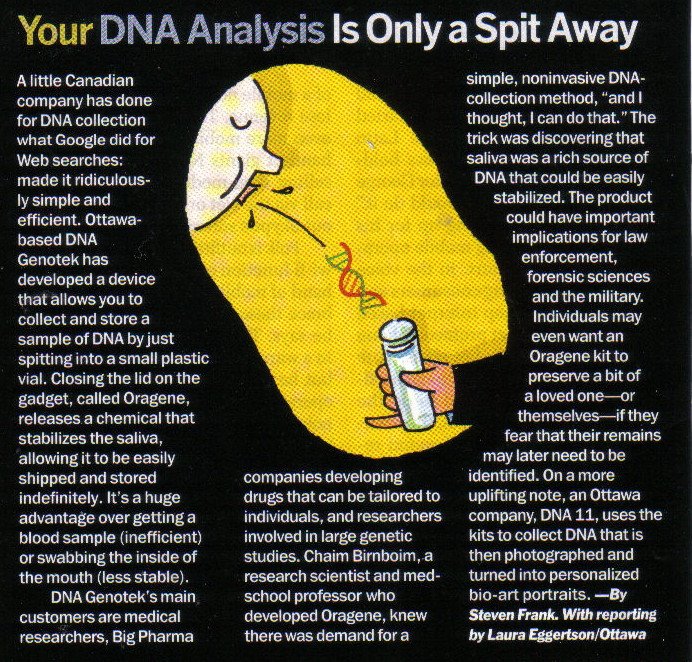
Bio-Art Portraits As A Memorial Of A Loved One.


Individuals may even want an Oragene kit to preserve a bit of a loved one--or themselves--if they fear that their remains may later need to be identified. On a more uplifting note, an Ottawa company, DNA 11, uses the kits to collect DNA that is then photographed and turned into personalized bio-art portraits.

Read more...

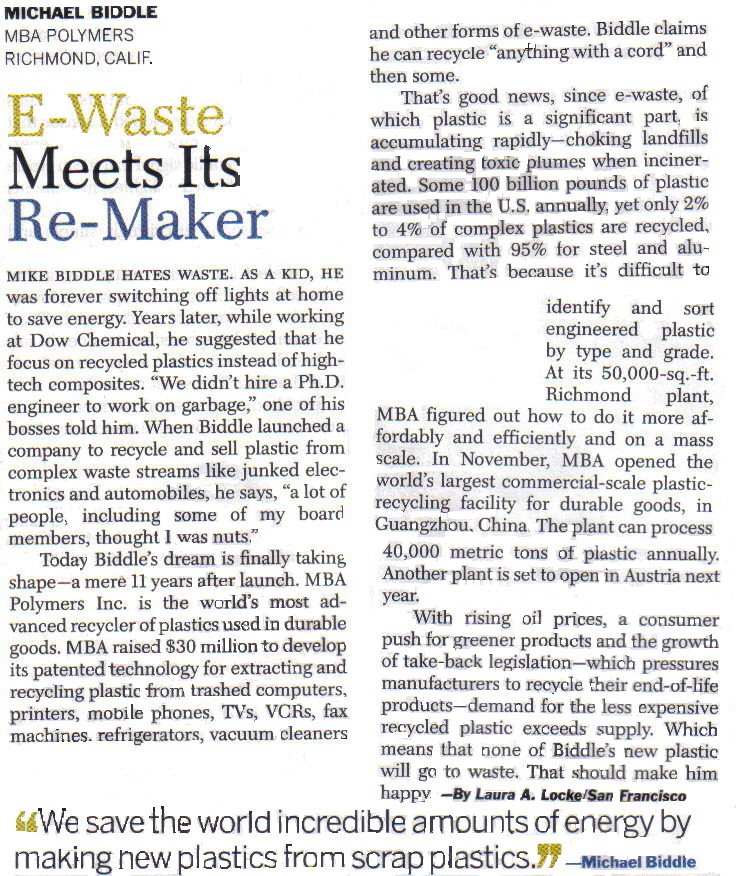
We Need More People Like This


From Time Magazine, this short article highlights Michael Biddle who started the company MBA Polymers Inc. As the world's most advanced recycler of plastics this company has developed an automated process to recover plastics and other materials from durable goods such as electronics, computers and automobiles containing commingled materials.
MBA Polymers was one of the 36 Technology Pioneers of 2006 by The World Economic Forum.

Read more...

Tuesday, March 07, 2006

Wal-Mart Using Bloggers To Improve Public Relations

The New York Times reported that Wal-Mart is working directly with bloggers to improve its public image. Wal-Mart is very interested in developing a relationship with independent bloggers to promote their public image. The problem is that many of these bloggers are not indicating that the information they are posting is coming directly from Wal-Mart headquarters, word for word.

Read more...

Monday, March 06, 2006

Where Is Wal-Mart?

Read more...

Saturday, March 04, 2006

Wal-Mart Should Pay Fair Share

Maryland's "Fair Share" bill which forces employers with more than 10,000 employees to spend, at the very least, 8 percent of their payroll to pay for employee’s healthcare or pay a fine into that state's health care fund, is catching on with other states. Wal-Mart was the only employer affected in Maryland's health care mandate law.

Minnesota, for example, is now trying to push through a bill that would force employers with more than 10,000 employees to spend a minimum of 10% of their payroll to pay for employee’s healthcare. In the state of Minnesota, 19,000 people are employed by Wal-Mart.

The supporters of this bill argue that Wal-Mart doesn’t pay its employees enough, thus forcing their employees on to government funded healthcare programs. A labor-funded group in Minnesota pushing the legislation estimates that Minnesota spends $14 million dollars on Wal-Mart employees in state medical assistance.

Wal-Mart, of course, is challenging this and so far has been fairly successful. Maryland, where the bill originated is the only state it has passed so far.

Read more...
Iraq Deaths Estimator
Petitions by Change.org|Start a Petition »

  © Blogger templates The Professional Template by Ourblogtemplates.com 2008

Back to TOP