UK or US: Who is More Civilized?
The following info-graph/poll can be found at the Justice Gap, a magazine about law and justice. And the difference between the two
See which side of the pond of justice you stand.

The following info-graph/poll can be found at the Justice Gap, a magazine about law and justice. And the difference between the two
See which side of the pond of justice you stand.
 |
| Crosley Green |
"People are alarmed to find out that courts have no problem at all saying you filed one day late… we're gonna use that as a basis to keep you in prison for the rest of your life not withstanding the fact that you can prove a clear miscarriage of justice," -- Seth Miller, runs the Innocence Project of Florida.
 | |
| Crosley Green, top row center, target with a bull's eye...the black spot you focus on. |
“That's a target with a bull's-eye for Crosley Green. ...His picture is smaller and darker than the other pictures," Harrison said of the photo lineup. "Anybody involved in police investigation and prosecution knows this. ...the position that your eyes are normally drawn to are right in the middle."And why was Kim Hallock eliminated as a suspect when it's normal procedure to investigate the last people to see victim alive...everyone closest to the scene? No one knows.
"It's a black spot," Green said of the photo. "That's what you focus on, that black spot." [...]
“When I went to homicide school ... they told us that this spot is the most likely that someone will pick a picture from," Mark Rixey said of the photo lineup.
"And where exactly is Crosley Green in that--"
"That's Crosley Green right in that spot," Green said, pointing to the second of three images in the top row.
"Anything that strikes you about this lineup?" Moriarty asked Christopher White.
"You can't see the guy in the top middle very well at all," he replied. "Crosley Green's photo is the darkest."
"If you don't specifically know who you're looking for, then that's the spot you will pick nine times out of 10," said Rixey.
“That's homicide 101, anybody who is present at the scene of a shooting ... gets their hands tested for gunshot residue," Rixey explained. "That should have been the very first thing that was done. ...That was never done."Moreover, the Brevard County State's Attorney's Office had a history of pressuring, coercing witnesses into lying. In the 1980s, Brevard County put away three men whose convictions have since been overturned.
“They coerced witnesses ... to lie and it's really as though you see -- a deliberate pattern of the state creating evidence to achieve a result that they wanted to achieve and that's what they got," said Jeane Thomas.In 2009, Green received a reduced sentence (life in prison) due to an error in sentencing. In total, Crosley Green has spent almost 26 years incarcerated for a crime he did not commit. Three witnesses recanted their testimony.
“Every witness recanted their story," Moura explained. "And every one of them had reason to be afraid of the police. ...They were squeezed. ...And they were squeezed hard."As it stands now, undeterred by exculpatory evidence withheld by the prosecution, the recantations of four of the prosecution's star witnesses, not to mention, more inconsistencies than a government's official story, the Florida Attorney General's Office is fighting to uphold Crosley Green's conviction. It says Green failed to meet a filing deadline for his appeal.
Hunger in the US is now the highest since the era of the Great Depression as real unemployment is much higher than the 5.6% rate reported in the mainstream media (closer to 40-50% if you include the marginally employed); as earnings are stagnant or declining for 90% of the work force; as inflation of food prices spiral out of control, not to mention a significantly compromised social safety net and the subtle, yet continuous effort to criminalize poverty.
Unlike now, during the Depression tightly knit communities and family farms stretched across the nation to provide a safety net that served to catch some or many of those who suffered the worst consequences of the failed economy. Unlike now, people knew the entire nation was struggling. They knew that times were hard and were less likely to fault the individual.
Today, society is fragmented and the establishment media is taking advantage of that by deceiving people into believing our economy is improving and anyone who is not making ends meet...well, it's their fault! They're not trying hard enough! In fact, the criminalization of poverty is a growing trend in America.
“But many things have changed in the last 50 years, some of them so recently as to have gone largely unnoticed by pundits and policy makers. The poor, and especially poor people of color, have long been over-represented in the prison population. This used to be attributed to the fact that the poor are more likely to be tempted by criminal activities such as theft and drug dealing. Just in the last ten years, however, it has become apparent that being poor is in itself a crime in many cities and counties, and that it is a crime punished by further impoverishment. As Karen Dolan explains in this hard-hitting report, a simple traffic violation – such as a broken tail-light – can bring down a cascade of fees and fines, which mount quickly if not paid on time and can lead to incarceration.So, big cities across the nation are struggling to keep up with the growing number of homeless, hungry Americans. Washington, D.C., our capital wins this contest as it increased its homeless population by more than 60% in 2015.
The mid-00s were a turning point in the criminal justice system’s treatment of misdemeanors. Local governments increased the fees, fines and court costs they levied for minor transgressions, and at the same time, increased the number of possible misdemeanors to include truancy (for which parents can be punished), driving with an expired license (as is the case in Washington, DC), putting one’s feet up on a subway seat (in New York City), and a variety of other minor infractions. The latter two are grounds for immediate arrest, leading to the imposition of fines and court costs. If the defendant cannot pay, he or she may be jailed and, in the ugliest twist of all – later charged for the cost of room and board, then re-jailed for failing to pay that. If the defendant is put on probation, he or she must pay for the probation officer and anything else required for monitoring, like an ankle bracelet.
Ferguson, Missouri helped bring attention to the extent of “offender-funded” criminal justice services. The city was relying on fees, fines, and court costs for 20 percent of its budget, effectively turning it into an occupied territory, with a 95 percent white police force supporting itself by forcibly preying on a nearly 70 percent black population.
Who benefits from this “criminalization of poverty”? In the short-term, municipalities and counties may appear to benefit, as well as the private companies that increasingly provide probation services and operate detention facilities and prisons. In addition, the increasing barriers, such as drug testing and criminal record searches, to social benefits like public housing, SNAP, and TANF may also temporarily help relieve cash-strapped local governments. But the overall effect is to perpetuate poverty and even expand the poverty population, to no possible good effect. Poor and indigent people cannot afford to pay for the means to coerce and incarcerate them, and nothing is gained by repeatedly jailing them. The criminalization of poverty – and increasing impoverishment of people judged to be criminals — amounts to a system of organized sadism.
This is the real “cycle of poverty:” Poverty leads easily to criminal charges from unpaid debts, unrenewed licenses and the like. Criminal charges in turn lead to ever-mounting debt and, despite laws prohibiting debtors’ prisons, to incarceration. There is no mystery about where government needs to intervene — first, by stopping the persecution of people who are already struggling to get by, and second, by mitigating that struggle
“The past year has marked the year of homelessness in the US as Los Angeles, Washington, D.C., and Seattle — America's most populated areas — hosted a huge jump in the number of people on the streets, according to the Hunger and Homelessness study. Washington, D.C. ranks first in the list of cities with homeless as figures say it has 28 percent more homeless and 60 percent more transient families. The demand for food for the hungry rose 27 percent over last year's.The recently released US Conference of Mayors Hunger and Homelessness Survey presents the results of a survey of 22 of the citie s whose mayors serve on The U.S. Conference of Mayors' Task Force on Hunger and Homelessness.
The survey said that across twenty-two cities including Chicago, San Francisco, Philadelphia, and Baltimore, homelessness rose by 1.6 percent overall and handouts increased by 3 percent over the past year.
Read more...
- Emergency food assistance requests rose by an average of 2.8 percent during the survey period in more than half, 61 percent, of the cities involved in the survey.
- Twenty-three percent of requests for emergency food assistance in the cities surveyed went unmet.
- Food pantries and emergency kitchens had to cut back on the amount of food given out as groceries or meals in 47 percent of cities involved in the survey. Additionally, in far more than half of cities surveyed, 57 percent, families and individuals had to cut down on the number of visits to charitable food outlets they could make each month. The same percentage of cities were unable to meet food requests by homeless and hungry residents demand because they lacked sufficient resources.
- Lack of affordable housing, an issue that continues to worsen in many places around the country, was the primary reason given for homelessness among families with children. Poverty, unemployment and low-paying jobs were the reasons that followed.
- In 50 percent of cities surveyed, mayors indicated they expected homelessness to rise “moderately” next year. Similarly, 65 percent of cities say they expect emergency food requests to “moderately” increase over the coming 12 months.
Did O.J. do it? The more I learn, the more I think he is innocent of the crime of murder.
On Thursday, Mississippi is scheduled to execute the first woman, Michelle Byrom, 57, in the state since 1944, even though her son, Edward Byrom Jr., repeatedly confessed to the killing that she is slated to die for — evidence the jury did not hear because her defense attorneys--their first capital murder trial-- never admitted the confession letters into evidence. Ms. Byrom was a lifelong victim of abuse, both as a child and in the marriage that ended in her husband’s death. Not to mention, at the time of her husband's death, Ms. Byrom was in the hospital for double pneumonia while on mind-altering drugs.
“As I sat on my bed, tears of rage flowing, remembering my childhood my anger kept building and building, and I went to my car, got the 9mm, and walked to his room, peeked in, and he was asleep. I walked about 2 steps in the door, and screamed, and shut my eyes, when I heard him move, I started firing.” -- Edward Byrom JrDespite corroborating evidence supporting the son's confessions such as the gunpowder found on his hands, Byrom Jr. pinned the murder plot on his mother after prosecutors convinced him to take a plea deal in exchange for a reduced sentence.
“When they got me here, I gave them a bullshit story after another, trying to save my own ass, but when David Smith started questioning me, and told me what happened, I was so scared, confused, and high, I just started spitting the first thought out, which turned into this big conspiracy thing, for money, which was all BS, that's why I had so many different stories,"--Edward Byrom Jr.So authorities allege that Byrom Jr., his mother and his friend, Joey Gillis, colluded to kill Byrom Sr, in order for Michelle Byrom to collect on her husband’s life insurance policy. However, both Byrom Jr. and friend, Joey Gillis--accused of pulling the trigger despite the gun powder residue on Byrom Jr.'s hand-- walk free today.
“I have attempted to conjure up in my imagination a more egregious case of ineffective assistance of counsel during the sentencing phase of a capital case. I cannot."--Judge Jess DickinsonRead more...
In the documentary below, former Conservative MP, Michael Portillo pushes his body to the brink of death in an investigation into the science of execution. At the very beginning he states, "If the state's going to kill people, you want to do it as humanely as possible, I think most people agree on that." I'm not so sure. From my very limited perspective, I think the man who invented the lethal injection protocol, Dr. Jay Chapman's response, "My basic attitude is so they suffer a little pain, who cares?" might just be the attitude shared by most.
Of course, as I've stated repeatedly, I do not believe in the death penalty under any circumstances, but if the state insists upon executing people, the least they could do is spare the doomed individual as much pain as possible. As I have also stated many times before, I think the lethal injection protocol is, as they say in the film "torture disguised as a medical procedure." And that's whether they carry it with two or three drugs. I mean, just imagine not getting enough of the drug that is supposed to cause unconsciousness, before getting the paralyzing drug (most likely used for aesthetic reasons) that renders you unable to signal your distress, followed by a heart-stopping drug, which "feels like a fire traveling through the vein to the heart.” The chance of this occurring is extremely high because it is administered by ill-trained staff. After all, doctors and nurses are supposedly bound by the "Hippocratic Oath" or take a pledge to do no harm.
It's not just a lack of expertise that contribute to the controversy over lethal injection; it's the second drug in the cocktail: pancuronium bromide, the paralyzing agent Carol Weihrer, who has testified in 15 court cases against lethal injection, knows all too well the pain this drug can cause. During a routine eye operation, in which she was given anesthesia and then pancuronium bromide, the anesthesia failed to work, leaving her fully aware of the excruciating pain as the pancuronium bromide coursed through her veins, but unable to tell anyone or move. She said if felt like "ignited jet fuel going through your body feeling like you're absolutely on fire." Carol believes that most executed inmates go through the same experience as she did. She states that the anesthetic used in the lethal injection protocol is "short-acting, five minute version" and that that lethal injection "takes between 10-12 minutes on a good day." In other words, the inmate is put out for a couple of minutes, and then conscious, thus feels the pancuronium bromide painfully charge through their veins without being able to alert anyone and dies from suffocation before their heart is stopped.
One example:
 |
| Angel Diaz |
“Prohibition will work great injury to the cause of temperance. It is a species of intemperance within itself, for it goes beyond the bounds of reason in that it attempts to control a man's appetite by legislation, and makes a crime out of things that are not crimes. A Prohibition law strikes a blow at the very principles upon which our government was founded."--Abraham Lincoln, U.S. President. 18 Dec. 1840
 |
| CCA houses over 80,000 inmates in more than 60 facilities across the US. |
Update:: Dennis McGuire surpassed the projected five minutes--experiencing the "agony and terror of air hunger as he struggles to breathe for five minutes after [executioners] intravenously inject him with the execution drugs"--before he loses consciousness and expires--his lawyers said it would take to die, It took 15 minutes for him to die, as he "gasped, snorted and snored during a prolonged execution" from "air hunger" on January 16, 2014, when the state used the controversial, never-before-tried lethal injection after supplies of the state's previous drug dried up.
“The 53-year-old's attorneys had argued against using intravenous doses of the sedative Midazolam and the painkiller Hydromorphone, claiming the combination would cause 'air hunger' - where someone experiences immense terror and agony as they strain for breath during the execution."[...]
“He was then still for five minutes before emitting a loud snort as if snoring and continued to make this noise for several minutes. His stomach rose and fell several times as he repeatedly opened and shut his mouth, making what the Columbus Dispatch described as 'deep, rattling sounds.'Why can we put a dog/cat to death in less than 10 seconds but can't seem to do it when it involves putting a human-being to death. The answer is we can but the sequence of the "lethal cocktail" that enters the body is designed to provide the condemned with a feeling of terror, otherwise why not just inject a general anesthetic followed by whatever it is that stops the heart immediately?
His family sobbed as they watched him slowly die. At one point, his daughter exclaimed 'Oh my God' as she observed her father's final moments.
A coughing sound was Dennis McGuire's last apparent movement, at 10:43 a.m. He was pronounced dead 10 minutes later. McGuire as first injected with the drugs at 10:29 a.m."
“Ohio and other death penalty states have been struggling to keep executions going because supplies of pentobarbital traditionally used in a three-drug mix have all passed their sell-by dates thanks to its Danish manufacturer prohibiting its sale to US prison services. The European Union has also threatened to restrict sales of Propofol, a leading anaesthetic used in hospitals, were US death chambers to use it instead."I feel my whole body burning.
Across the nation, thousands of new prisons are being built as the multi-billion dollar Prison Industrial Complex is one of the fastest-growing industries in America, and when you consider that most prisoners are in jail for non-violent offenses, and that their only "crime" is disobeying the government's arbitrary system of "laws", the fact that corporate America profits so obscenely must raise the question of who the criminals really are.
From Unmasking the Prison Industrial Complex Part 1: The High Profits of Prison Labor:
“The research that went into this post revealed harsh realities about the state of our country and it's deeply rooted capitalist mentality. Story after story, it was clear that real Americans were suffering in ways that simply did not have to be. It was obvious that the prison industrial complex was created and perpetuated in a way that is unprecedented. Stories such as, US Technologies, an Austin, Texas based company, who closed their doors and laid off hundreds of employees only to ship their jobs, not overseas, but to the nearest Austin, Texas Prison, where inmates work for cents a day. Many companies have begun using prison labor, such as Chevron, IBM, Motorola, Compaq, Texas Instruments, Honeywell, Microsoft, Victoria’s Secret and Boeing. You may have had firsthand experience dealing with the hardest of criminals if you have ever called TWA to book a flight. That’s right folks; TWA uses prison inmates to book flights. Even federal prisons have gotten a piece of the action, a company under the trade name Unicor uses prisoners to make everything from lawn furniture to congressional desks. Their web site proudly displays “where the government shops first.” For private corporations, prison labor is pure gold. With prison labor there are no unions, no strikes, no insurance benefits, and no rights! This is even backed up by the 13th Amendment of the United States Constitution. State Corrections agencies are even advertising their prisoners to corporations by asking them questions such as: “Are you experiencing high employee turnover? Worried about the cost of employee benefits? Getting hit by overseas competition? Then the Washington State Department of Corrections Private Sector Partnerships is for you.”
An American worker, who once upon a time made $8/hour, loses his job when the company relocates overseas where workers are paid only $2/day. Unemployed, and alienated from society indifferent to his plight, he becomes involved in the drug economy or some other outlawed means of survival. He is arrested, put in prison, and put to work. His new salary: 22 cents/hour. This fictional story, unfortunately is true of many Americans, that have not been given many options. Prison is quickly becoming the new form of slavery, as the laws against crime disproportionately affect the African American Community."
"Why lock somebody up while you're locked up? You're trying to kill their spirit even more," says Michael Kemp, describing his six-month stay in solitary confinement at age 17.Read more...
Solitary confinement was once a punishment reserved for the most-hardened, incorrigible criminals. Today, it is standard practice for tens of thousands of juveniles in prisons and jails across America. Far from being limited to the most violent offenders, solitary confinement is now used against perpetrators of minor crimes and children who are forced to await their trials in total isolation. Often, these stays are prolonged, lasting months or even years at a time.
Widely condemned as cruel and unusual punishment, long-term isolation for juveniles continues because it's effectively hidden from the public. Research efforts by the American Civil Liberties Union and the Texas Criminal Justice Coalition have struggled to uncover even the most basic facts about how the United States punishes its most vulnerable inmates.
How can a practice be both widespread and hidden? State and federal governments have two effective ways to prevent the public from knowing how deep the problem goes.
The first has to do with the way prisons operate. Sealed off from most public scrutiny, and steeped in an insular culture of unaccountability, prisons are, by their very nature, excellent places to keep secrets. Even more concealed are the solitary-confinement cells, described by inmates as "prisons within prisons." With loose record-keeping and different standards used by different states, it's almost impossible to gather reliable nation-wide statistics.
The second method is to give the old, horrific punishment a new, unobjectionable name. Make the torture sound friendly, with fewer syllables and pleasant language. This way, even when abuse is discovered, it appears well-intentioned and humane.
So American prisons rarely punish children with prolonged solitary confinement. Instead, they administer seclusion and protective custody. Prison authorities don't have to admit that "administrative segregation" is used to discipline children. Just the opposite, actually. It's all being done "for their own protection."
Seclusion? Protecting children? Who could argue with that?
For starters, there is Juan Mendez, the United Nations special rapporteur on torture. Americans are accustomed to the U.N. investigating incidents of prisoner abuse in other countries -- which Mendez has done in faraway places like Kyrgyzstan and Tajikistan. But increasingly, his inquiries are focused on American prisons.
Mendez spoke publicly about Bradley Manning's deplorable treatment in solitary confinement. Now he is calling on the United States to ban isolation for minors, which he considers, "cruel, unusual, and degrading punishment." It's a recommendation he shares with the American Academy of Child and Adolescent Psychology.
The ACLU report, Growing Up Locked Down, is one of the few detailed, comprehensive examinations available. This devastating and detailed look at solitary confinement for minors has led to this online petition that will be presented to Attorney General Eric Holder in October 2013.
Because the prison system is so opaque, reform has been slow in coming. A congressional hearing on solitary confinement, chaired by Sen. Dick Durbin (D-Ill.) last year, heard testimony from mental health experts, questioned the director of federal prisons, and brought a replica of a solitary confinement cell onto the Senate floor. In recent years, seven states -- Maine, Connecticut, West Virginia, Mississippi, Oklahoma, Arizona, and Alaska -- have enacted laws to restrict the use of punitive isolation on young people. As awareness of the magnitude of the problem grows, more reforms are likely to follow.
If we believe that juveniles are inherently less responsible for their actions than adults - and more susceptible to rehabilitation - then it follows that their punishments should be less severe.
Given the severity of the punishment, prohibiting solitary confinement for young people is a first step. The greatest challenge remains demanding greater transparency from a prison system that wields total control over its most vulnerable inmates.
Or I might add especially when the President is black. At least when 'W' did something horribly racist and criminal, as he often did, there were loud voices protesting in opposition. But when Obama does the same thing, it’s considered good leadership. President Obama received 95% of the black vote. In return, African Americans received a check that came back stamped: insufficient funds. He tells African Americans to stop whining and pull themselves up by their own bootstraps while his actions set these same people up to fail and keep them trapped by his support of legislation--specifically, in this case, by actively trying to maintain racially discriminatory prison sentences--that further empowers and emboldens the New Jim Crow Lulled to sleep by the rhetoric of color-blindness and the appearance of great racial progress, most of us are blind this new form, or should I say, formless invisible institutional racism.
In UNITED STATES OF AMERICA v. CORNELIUS DEMORRIS BLEWETT (12-5226) and JARREOUS JAMONE BLEWITT (12-5582),, "a crack cocaine case brought by two currently incarcerated defendants seeking retroactive relief from racially discriminatory mandatory minimum sentences imposed on them in 2005," President Obama quietly tried to enforce racially biased federal crack cocaine laws that have since been repealed" by the 2010 Fair Sentencing Act. The Obama administration asked a federal appeals court to make sure thousands of people--almost all of them poor and most of them black--remain locked in prison despite a total lack of justification.
Crack cocaine and powder cocaine are "pharmacologically identical," the only difference being who consumes these pharmacologically identical substances: crack cocaine, the drug of mostly poor black folk, and powder cocaine, the drug of wealthier white folk. To be sure, young African American males are the most disposable, yet at the same time, profitable--for the for-profit prison industry--demographic in this prison nation. Not only do the private prisons prosper, corporations can put these people to work for a few cents an hour, not to mention, these human-beings are excluded from poverty statistics and unemployment data thus masking the severity of issues more than they already are.
Although Black people make up only 34% of crack users, they are 85% of those convicted on crack charges. As early as 2011, 30,000 people were serving time for crack charges in federal prison, 85% of them Black.
“…persistent bias occurred with respect to the contemporary enforcement of drug laws where, in the 1990s and early 2000s, blacks constituted a minority of regular users of crack cocaine but more than 80 percent of crack defendants.” -- Harvard Professor William J. StuntzAs legal scholar Michelle Alexander argues, "we have not ended racial caste in America; we have merely redesigned it." One such strategy is through targeting black men and women (often mothers) through the "War on Drugs," decimating communities of color.
“There are more African American adults under correctional control today, in prison or jail, on probation or parole, than were enslaved in 1850, a decade before the Civil War began. As of 2004, more black men were disenfranchised than in 1870, the year the 15th amendment was ratified explicitly prohibiting laws that deny the right to vote on the basis or race....During the Jim Crow era, poll taxes and literacy tests, circumvented the 15th amendment and operated to deny African Americans the right to vote. A black child born today has less of a chance of being raised by both parents than a black child born during slavery. This is due in large part to the mass incarceration of black men....The mass incarceration of black men take them out of the dating pool at the years they would be most likely to commit to a partner, to a family. But, what's worse is that by branding them criminals and felons at early ages, often before they're even old enough to vote, they're rendered permanently unemployable in the legal job market, virtually guaranteeing that most will cycle in and out of prison, sometimes, for the rest of their lives.The incarceration rate has quintupled over the last 30 years, from a prison population of 300,000 in the early 1970s to well over 2 million! During this same period of time that the incarceration rates increased exponentially, crime rates have fluctuated, leading most sociologists and criminologists to admit that incarceration rates and crime rates have moved independently of one another.
[...]
Today, in many states, felon disenfranchisement laws accomplish what poll taxes and literacy tests ultimately could not. This does not effect some small segment of the African American community. To the contrary, in many large urban areas, more than half of working age African American men now have criminal records and thus subject to legalized discrimination for the rest of their lives. In some cities--Baltimore, Philadelphia, Chicago (80%), DC--the statistics are far worse." -- Michelle Anderson, highly acclaimed civil rights lawyer, advocate, and Associate Professor of Law at Ohio State

Read more...What is “Nigger Season?”It’s George Zimmerman walking freeIt’s all-white juriesWhen Skittles and iced tea become weaponsIt’s a “justice system”That’s soooo proficientPutting black people in jailAnd, can’t get justice for oneIt’s 44 days for a killer to be arrestedIt’s a damn “knock, knock” jokeGlib to black deathIt’s white expectations of black violenceIt’s Fox News jumping with gleeIt’s their analysis being justifiedIt’s “Stop and Frisk” being justifiedIt’s colleges and universities fiending for black athletesBut dismantling affirmative actionKilling voting rightsHere’s what kills rednecksSpecifically, Republicans and ConservativesThis is what they think:“A nigger president”YETThat presidentWanting a “bromance”Having a schoolboy crush on RepublicansActing like oneWanting to do their biddingHe kills for themWith themDrones and allBrown-skinned folks runSoon to be turned on to AmericansSpy on them, tooWe go from COINTELPRO to COINTELBROAND they STILL think he’s a nigger(Like their boy, Clarence Thomas)Conservatives and the GOPMaking his girls political fodderSanctioning one of their fellow “Crackers”Talking about Michelle’s buttIt’s that same Cracker having fantasiesOf days of yoreDreaming of being a slave ownerOr, a ship’s captainSeeking the “good ol’ days”Having his way with nigger bitchesEnhancing his proficiency with the lashBible on his right hip(Analyzing it wickedly)Gun on his left hipMastering the use of shacklesAroused at thoughtsWiping Native Americans and AfricansWhipping Native Americans and AfricansChristianizing Native Americans and Africans(By dehumanizing them)Off the face of the earthSensenbrenner feeling good about those fantasiesGOP couldn’t even feign to disavow himBut then, why should they?If the hood fits WEAR IT!DAMN HIM!DAMN THEM ALL!Some 2520sThinking, but not saying “nigger”Prejudging black peopleAssociating them with the worstExpecting them to be:“The Chuckle People”Joking and singing on TV and moviesAnd in the officeOr, acting like orificesOr, expecting them to go to the “Big House”And, I’m not writing about the U of M football fieldAlthough for some that’s pleasing“Run that ball, nigger!”(“Look at that nigger run!”)“Jump over that hurdle, nigger!”“Slam that ball, nigger!”“All the day long, nigger!”“All the live-long day, nigger!”Then, when those “niggers” are off the fieldOr, the dance floorSome 2520s think:“Serve me quick, nigger!”“I’ll pay you less nigger!”“I’m Paula Deen, nigger!”“This is Dixie, nigger!”“Rather, this is America, nigger!”“You’re just monkeys, nigger!”(“What’s a ‘honky,’ nigger?”)(“Why do you niggers say, ‘My nigger?’”)“You just steal, nigger!”“You’re hard to believe, nigger!”“Even when you academically achieve, nigger!”“You’re still OJ, nigger!”“Not always OK, nigger!”“I’m going to follow you in this store, nigger!”“Even if you can pay for something, nigger!”“You’ve got to have bad credit, nigger!”“Killing Trayvon’s OK, nigger!”(“Zimmerman’s my hero, nigger!”)“Keep wearin’ a hoodie, nigger!”“I’ll drop a cap in you, nigger!”“I won’t even go to jail, nigger!”(“Cause I can get better lawyers, nigger!”)(“That’s why I don’t go to jail on drug charges, nigger!”)“Be gone, nigger!”“Get out my way, nigger!”“Know your place, nigger!”“They’re called ghettos, nigger!”“Or, called barrios, nigger!”“Or, reservations, nigger!”“All of you look the same, anyway!”“I’m always right, nigger!”“Because I’m white, nigger!”So, brothers and sisters of all huesOf all racesConsidering the events of the dayAny dayIn AmericaOr, globallyHow should I feel?What should I believe?Based on the evidenceBased on my experienceBased on what I see:Without rhyme or reasonIT’S ALWAYS NIGGER SEASON!


“The prosecution, Mr. Valeska specifically, looked me in the eye and said, quote, 'there ain't no such thing as an F.B.I. report.' Well, there probably wasn't a report, but there were 256 pages of information collected by Decatur police officers that were sent to the F.B.I.," -- Judge ThompsonAccording to Judge Thompson, Assistant Attorney General Don Valeska later came to him confessing there was withheld information. "Mr. Valeska came forward with the information after the conviction," said Judge Thompson. “Clearly, the only remedy was to grant him a new trial and I did," he said. "It frustrated and angered me that he would be willing to lie to the court," he continued.


“I feel like my prayers have been answered...It's been 24 years of this ordeal for my family and my friends, and now with it coming to an end, it's like a dream come true." -- Nathson Fields(M. Walberg, “23 years after judicial misconduct, ex-gang leader freed," Chicago Tribune, April 9, 2009). (R. Hussain, Man formerly on death row acquitted in retrial,” Chicago Sun-Times, April 8, 2009). See also People v. Hawkins, et al., 181 Ill.2d 41 (January 29, 1998) (upholding a circuit court's reversal of Fields' and Hawkins' convictions).


“In an interview yesterday in his mother's house, where he has lived since he was released in February on bail, Johnson said that "anger destroys," but still he is bitter about the legal system that twice convicted him, once to death, and once to life in prison. He accused prosecutors of manipulating both the jury and the testimony because they cared only about getting a conviction, not about the truth.
"It was a legal lynching," he said. The prosecution, he said, "fabricated and conspired" with Meyers. Both juries were all white; the murder victim was white, too, and Johnson, who is black, said the racial fears of the jurors were played on by the prosecution.
"I totally believed in the system of justice," he said. "My faith in the system is gone."


 |
| Ron Keine, Assistant Director for Witness to Innocence |
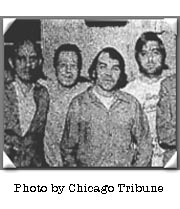 The four (left) were convicted of kidnapping, raping and killing William Velten. They could have been executed if not for an investigation by the Detroit News, which interviewed a key eyewitness in the case who said she was coached to identify the four. Seventeen months later, the men were freed when another man confessed to the murder.
“In 1974, Keine, Doc and three friends had borrowed a van for a trip home when they were stopped and harassed by police in Oklahoma. They were arrested and charged with armed robbery of a gas station, which had burned down two years prior. But before Keine and his friends were set free, they were told they had to be extradited to New Mexico and were being charged with the Albuquerque murder of college student William Velten.
Once in New Mexico, Keine's court-appointed public defender advised Keine and his cohorts to plead guilty so they would only get life in prison. Keine pleaded not guilty and was taken immediately from the arraignment to death row, where he sat for two months awaiting trial.
At the trial, the prosecutor presented the testimony of a motel maid who claimed to have seen the men carry out the murder. Police, however, had found no evidence in the van the men were riding in or on their pocket knives, according to Keine. Keine asked his public defender several times to object to the evidence, but to no avail. He was convicted and sent to death row.
Keine said at that moment his "whole value system slammed down on you. Everything you believed about the law, the honesty, the ethics of it, out the window."
Keine stayed on death row awaiting his execution for two years, until a former police officer, Kerry Lee, confessed the murder to the pastor of a church. Keine was notified of his retrial nine days before his scheduled execution and was freed in 1976, according to the Death Penalty Information Center.
© Blogger templates The Professional Template by Ourblogtemplates.com 2008
Back to TOP