Missing Money.
Image compliments of Masters in Accounting Degrees

Remember the GAO audit released on July 21, 2011, discovering $16.1 trillion went to foreign banks, and foreign corporations in addition to domestic banks and corporations? Well, apparently you can add $9 trillion that's supposedly unaccounted for, or lost. And let's not forget the $2.3 trillion missing from the Pentagon, announced by Donald Rumsfeld on 9/10/2001.
As one seadooyah1 commented:
“How is it the IRS (which is the mafia for the FED) can find a $100 mistake on our tax returns, but cannot find 9 trillion dollars of our money???And as Hugh Mann said:
“Money? What money. There hasn't been REAL money on this planet in decades. This digital horseshit called currency isn't even backed by shit. It's absolutely worthless. The banks print money from thin air, loan it to you with interest and when you can't repay the loan, they take all you own. What an ingenious idea of getting something tangible for nothing.
The Parasites That Be are spending and losing like drunken sailors because they know it's crap and it's going to collapse. They better get as much as they can before it's too late.
It's no secret that the ruling class does not want an alert and informed citizenry that can read budgets and ask critical questions. In fact, millions, if not billions of dollars are spent to keep the masses completely in the dark regarding our monetary system. Why? Those who "get it" are far more likely to fight for control.
In an overly acquisitive society such as ours, where the drive to amass obscene amounts of wealth trumps any and all regard for human life, it's time to reform our monetary system. Hence, the reason why it's so important to develop an understanding of what money really is. That is, if we, the masses, wish to not only take back our nation, but, moreover, to maintain our humanity.
Here's the thing, there is so much disinformation circulating, it's not easy to discern the truth. Nevertheless, this is some of what I've learned so far.
Economics is not a science, yet economists - in an effort to make economics, more scientific, I guess - removed "normative values" from its study. What are "normative values"? In one word, morality. Well, removing standards of ethics, honesty and morality from its study might be okay if economics followed the scientific method, and wasn't so intertwined with our survival, but it doesn't, and it is.
Unfortunately, too many economists ignore the historical origins of money, as most are trained to support the status quo...something that is clearly not working. As Alexander del Mar once said, "As a rule, economists do not take the time to study the history of money. It's much easier to imagine it and deduce the principles of this imaginary knowledge."
So, what is money?
John Locke and Ben Franklin defined money as a pledge for wealth instead of wealth itself. However, it is Aristotle's definition: "money exists not by nature, but by law," that made "money" by it's very nature, a fiat of the law. Now, despite the ranting and raving of the many against our fiat money system, fiat money, in and of itself, is not the problem; rather, it's fractional reserve banking...the private creation of "money" that is the problem here. Why? In a nutshell, it benefits only those who control its usurious issue. If the money power is privately controlled, it benefits the few...if publicly controlled, it benefits the many.
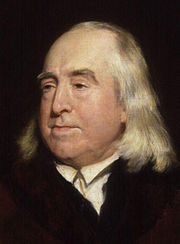
It was Jeremy Bentham, best known for his advocacy of utilitarianism, and his influence upon modern welfare economics, who we can thank for redefining usury. In a series of letters written to Adam Smith, he tried to convince Smith to give up his support for interest rate limits. Originally, the concept of usury was much more comprehensive than the mere charge of interest. According to Stephen Zarlenga, usury was the "antisocial misuse of the money mechanism for private gain". Our entire monetary system is a usurious kleptocracy.
Part of the "monetary" agenda consists of substituting the idea of credit for the concept of money, so that we, the people will come to think of money and credit as interchangeable, when that not true at all. Credit is only a promise to pay in the future; whereas money pays at the time of exchange. Not to mention, credit evaporates in a crisis; money does not.
What about Ron Paul and his mission to return to the gold standard?
Essentially, he is mis-defining money as a thing...in other words, as wealth. This will not give our society the ability to advance properly, because there will never be enough gold to keep pace with population and commerce growth. As history has shown, banks will cheat and issue private bank paper that only pretends to be convertable to gold. One can only imagine the problems that would cause in a crisis.
So back to Aristotle's defintion. The only problem with is that his definition is all too brief. Alexander del Mar later expanded on Aristotle with the following defintion of money:
"What is commonly understood as money has always consisted tangibly of the number of pieces of some material marked by public authority named and understood by the laws and customs that its palpable characteristic: mark of authority; essential characteristic: possession of value defined by law, and it's function: the legal power to pay debts and taxes and the mechanical power to fascilitate the exchange of other objects possessing value." -- Alexander DelmarIn other words, setting aside whatever is used to signify it - paper, metal, feathers, etc. - "money is an abstract social power embodied in law, as an unconditional means of payment." *
"When the government fears the people, there is freedom. When the people fear the government, there is tyranny." - Thomas JeffersonThe Power of the Purse Volume 1 Part 1
 The same way most of us worship God, all of us - atheists and agnostics included - worship money, as money is the "god" at the center of the religion we all subscribe, monetary theism. We have little choice but to go along, because as blood is to the human body, money is to the institution - from familial to political to religious to legal to educational and of course, monetary - it functions as the lifeblood of society, without which, life would be unbearable.
Like religion, money unifies, divides, starts wars, provides peace, involves ritual and most important of all, requires us to have faith. In fact, there is no more unquestioned form of faith in America, than the trust we place in the value of our established monetary system. The last couple of months have shown us just how dependent our economy is on our continued reverence. While it's true our current economy, headquartered at the Federal Reserve, does indeed require our loyalty, it does not necessarily mean that loyalty is deserved.
So, what's wrong with the way our government has chosen to create and distribute money? Nothing. What's wrong, is allowing private unaccountable banks create and distribute money for private profit at the expense of we, the people.
Sure, everything is made to make it look as if the central bank operates in the public interest but the Federal Reserve is a private corporation, chartered in total secrecy by an act of Congress, the Federal Reserve Act of 1913 on December 23, 1913.
The Federal Reserve is not federal. There is no reserve. And it’s not even a bank.
Those in the know, central bankers and the like, who benefit from our monetary system, purposefully obfuscate the mechanics of money supply (fractional reserve banking) so that we the people will not figure out that the creation of money is designed to perpetually rip us off by consistently transferring the wealth back to the banks.
The more complicated the economy and money creation process appears, the more we will avoid trying to figure it out, hence, just as we do with religion, we end up putting our absolute faith in this unseen entity, that works by a method that we don't fully understand. Faith is not the problem here, the issue is our knowledge of what we put our faith in.
God is mysterious and beyond human comprehension, however enough evidence exists that has convinced 75% of our nation to place our faith in His existence, and still we are constantly searching for clues to how He works. The irony is, that unlike God who we believe created us, we, human beings, create money. It's not all that mysterious and well within our grasp, nevertheless, humans who prosper so from having complete control of our money supply have a vested interest in convincing us that this institution is "sacred" and far beyond our understanding.
To truly understand the way our world works, the first thing we have to do is understand money.
Years ago, the Federal Reserve, produced a document entitled Modern Money Mechanics. This publication detailed and described the basic process of money creation in a fractional reserve banking system.
Our government decides it needs $10 billion, so the treasury prints up $10 billion of treasury bonds and places a call to the federal reserve (FR). The FR then prints up $10 billion in notes and buys the government bonds and the exchange is made. Only, in reality nothing is printed up, it is all done electronically.
Once this exchange is complete, the government than takes the $10 billion in FR notes, and deposits it into a bank account, and this deposit officially makes the FR notes, legal tender or money and adds $10 billion to the US money supply.
But wait, there's more...that was just the beginning. Government bonds are by design, instruments of debt because the government is actually promising to pay back that money to the FR. In other words, the money was created out of debt.
Based on fractional reserve banking, that $10 billion deposit instantly becomes part of the banks reserves, just as all deposits do, however only the prescribed reserve requirement needs to be present and accounted, normally 10% of the deposit. In this case, $1 billion is held as the required reserve, while the other $9 billion is considered an excessive reserve, and can be used as the basis for new loans.
One might assume that the $9 billion in excessive reserve is literally coming out of the existing $10 billion deposit. Not true. The $9 billion is created out of thin air, once again, ON TOP of the existing $10 billion deposit. Magically, our money supply expands.
From Modern Money Mechanics:
"Of course the banks do not really pay out loans for the money, they receive as deposits. If they did this, no additional money would be created. What they do when they make loans is to accept promissory notes (loan contracts) in exchange for credits (money) to the borrowers transaction accounts."This process then repeats over and over again. Let's say someone walks into this bank and borrows $9 billion and then takes that money and deposits it into their own bank account. The bank would hold 10% of the $9 billion deposit, the other 90% or $8.1 billion is now available as newly created money for more loans. And then that $8.1 billion can be loaned out and redeposited creating an additional $7.2 billion to $6.5 billion… etc…
"The modern banking system manufacturers money out of nothing. The process is perhaps the most astounding piece of sleight of hand ever created. Banking was conceived in iniquity and was born in sin. The Bankers own the earth. Take it away from them, but leave them the power to create deposits, and with the flick of the pen they will create enough deposits to buy it back again. However, take it away from them, and all the great fortunes like mine will disappear and they ought to disappear, for this would be a happier and better world to live in. But, if you wish to remain the slaves of Bankers and pay the cost of your own slavery, let them continue to create deposits". -- Sir Josiah Stamp, Director of the Bank of England,1928-41
"It is well enough that people of the nation do not understand our banking and monetary system, for if they did, I believe there would be a revolution before tomorrow morning." -- Henry Ford
"If the American people ever allow private banks to control the issue of their money, first by inflation and then by deflation, the banks and corporations that will grow up around them, will deprive the people of their property until their children will wake up homeless on the continent their fathers conquered."---Thomas JeffersonRead more...
 On a cold December morning in 1968, in the State of Minnesota, one month short of 40-years ago, a jury of 12 handed down the “Credit River Decision”. This decision, rendered in the case of First National Bank of Montgomery vs. Jerome Daly, with Justice Martin V. Mahoney, presiding, declared that creating money out of thin air is unconstitutional and against the laws of the United States of America. In other words, Jerome Daly, with the help of Justice Mahoney and 12 jurors took on the Federal Reserve... the moneychangers...our entire monetary system, and won. Six months later, in June of 1969, Justice Mahoney was dead, his body pumped full of poison, in what appeared to be a boating accident, and Jerome Daly, an attorney, disbarred.
Jerome Daly, the defendant in the case, dared to challenge the foreclosure of his home. Daly argued that the mortgage contract required both parties, he and the bank (the plaintiff), to put up a legitimate form of property for the exchange. In legal terms, this is called consideration.
Daly went on to explain that the credit (money) did not come from the bank because it was created out of thin air as soon as the loan agreement was signed. Then, the bank's president, Mr. Morgan took the stand. According to the judge's personal notes, Mr. Morgan admitted, "in combination with the Federal Reserve Bank, the bank did create the money and credits upon its books by bookkeeping entry. The money and credit first came into existence when they created it." Mr Morgan then added, "no US Law or Statute in existence gave him the right to do this."
For this contract (mortgage) to be considered legal, a lawful consideration must exist and be tendered to support the loan. The Jury found that there was no lawful consideration and decided against the bank because the bank had not lent Jerome Daly actual money, and because the bank advanced nothing of value in this exchange, it was not entitled to the property that had been handed over as collateral for the loan.
"Only God can create something of value out of nothing." - Jerome Daly
Plaintiff’s act of creating credit is not authorized by the Constitution and Laws of the United States, is unconstitutional and void, and is not a lawful consideration in the eyes of the Law to support any thing or upon which any lawful right can be built. -- Justice MahoneyThis decision, revealing the process behind our debt-based currency, could have put the banking cartel - without mentioning any names, the epitome of the "money trust" - and all of those who profit so handsomely from our current system, in the "poor" house. The powers that be would never allow that to happen...look what happened to poor Justice Mahoney and Mr. Daly. Something had to be done to make sure this decision never saw the light of day.
NEW YORK (CNNMoney.com) -- In case you haven't noticed, Second Life is booming, and its economy has boomed too - putting the virtual reality world in the crosshairs of tax authorities, experts say.
Entrepreneurs have flocked to Second Life - a computer-based 3-D virtual world where users create their own, well, second lives - in pursuit of making real money. So-called residents can buy and sell goods for Linden dollars, an in-world currency that can be converted into real U.S. dollars.
Second Life is a virtual world that anyone with a broadband Internet connection can enter. Users download software and create an avatar - a cartoon-like character that they control with their mouse and keyboard that represents them in the digital world.
When users login to Second Life, they begin the in-world experience. Using the software's tools, they can create objects and communicate with other virtual residents via instant messaging and voice services.
At least one user claims the virtual world has minted her a millionaire - and economic activity is humming along. Users of the virtual world injected about $1.6 million into Second Life in the last 24 hours alone, according to Linden Lab, the creator of Second Life.
Under current tax law, it's clear that earnings in real U.S. dollars generated within virtual realities are reportable to the IRS. If a Second Life real estate mogul cashes out of her in-world property portfolio, she's liable to pay income tax on any profit that's been exchanged into real greenbacks - just as an eBay (Charts) seller is responsible for reporting income generated from an online sale.
Tax law is murky, however, when it comes to dealings that occur solely within Second Life or other computer-simulated environments. For instance, is a transaction that occurs only in Linden dollars and doesn't involve any real-world, dollar exchange taxable?
Questions like that have the tax community buzzing about the issue, said Paul Caron, a professor at the University of Cincinnati who edits the TaxProf Blog.
The issue has also attracted the interest of the Joint Economic Committee of Congress, which said last fall that it was studying issues related to the economies of virtual realities like Second Life and World of Warcraft, an online role-playing game.
Results of the study - due to be released before the end of the month - suggest that "as long as virtual activity stays within the virtual economy, it shouldn't be taxable," said Christopher Frenze, executive director of the JEC, which conducts policy research on economic issues facing Congress
But there is a valid argument that even profits that come from, and stay in, the virtual world are taxable, according to Bryan Camp, a professor at Texas Tech University School of Law. "As soon as you start looking at what's going on in these worlds, they look a lot like real economic transactions," he said.
Even if profit isn't realized in real dollars, there's still an exchange of items of economic value. In the real world, if someone trades goods or services without the exchange of real money - also known as bartering - that's a taxable event, Camp noted.
Given all the attention paid to the topic, the IRS eventually will have to respond to the situation, said Caron. "I think it's on the IRS's radar screen in a way it was not six months ago," he said.
When asked about the agency's position on collecting taxes from virtual economies like Second Life, an IRS spokesman offered the following comment via e-mail: "Any time someone wins a tangible prize or award, the value is reportable as taxable income. An accumulation of 'points' would not result in tax consequences, but redeeming or selling them for money, goods, or services would."
Edward Castronova, a professor at Indiana University who heads the Synthetic Worlds Initiative, a research center focused on online communities like Second Life and World of Warcraft, doesn't see taxes on virtual-only transactions coming anytime soon.
But "in the next three or four years, we'll likely see it. In the next 10 years, there's no question about it," he said. "If you look at these transactions, they're huge."
For its part, Second Life operator Linden Lab isn't concerned about looming tax regulations on virtual economies, at least not yet.
"Given the reassuring statements from the JEC, it's pretty clear this is a moot point," a spokesman for San Francisco-based Linden said. "Linden is focused on what it does best - scaling technology and building Second Life's platform."
Stay tuned.
© Blogger templates The Professional Template by Ourblogtemplates.com 2008
Back to TOP