Showing posts with label oil. Show all posts

Thursday, January 23, 2014

Why Did OPEC-Covering Wall Street Journal Reporter, David Bird, Go Missing?

Missing Wall Street Journal Reporter, David Bird
Almost two weeks ago, on Saturday January 11, 55-year old David Bird, a reporter who covers energy markets for the Wall Street Journal, left his house in the Millington section of Long Hill, NJ, telling his wife that he was going out for a quick walk.  He took his wallet and jacket, leaving his cell phone and the medication he takes twice daily (for liver transplant he had in 2005) behind.  He never returned-- disappearing without a trace, despite a continuing search by hundreds of volunteers and law enforcement officials, including the FBI.

Just to give you an idea of how expansive the investigation is, the following agencies are involved in the search, according to the Morris County Prosecutor's Office:
Long Hill Township Police Department, Morris County Sheriff’s Office, Morris County Department of Law and Public Safety-Office of Emergency Management, New Jersey State Police, Morris County Park Police, Harding Township Police Department, Bernards Township Police Department, Warren Township Police Department, New Jersey State Park Police, Bergen County Sheriff’s Office, Federal Bureau of Investigation, Millington Fire Department, Stirling Fire Department, Warren Fire Department, Liberty Corner Fire Department, New Vernon Fire Department, Chatham Township Fire Department, New Providence Fire Department, Berkeley Heights Fire Department, Somerset County Department of Public Safety, Parsippany Search Rescue and Recovery, Whippany Swift Water, Boonton Dive Team, Pequannock Dive Team, Jefferson Dive Team, Picatinny Dive Team, U.S. Department of Fish and Wildlife, United States Veterans Administration Police and Fire – Lyons, NJ, Long Hill First Aid Squad, Long Hill Township Office of Emergency Management, the Salvation Army, Long Hill Community Emergency Response Team Volunteers, and the Warren Township Community Emergency Response Team.

Moreover, according to all who knew him, he gave no indication of having a reason to disappear, not to mention Mr. Bird was an avid hiker, biker, camper, Boy Scout troop leader, and he ran in the New York City Marathon. In other words, the man was in good shape.

While there is no evidence as of yet suggesting a connection between his work and his disappearance, NBC reported that “the family believes that his coverage of OPEC may be related to his disappearance.” He was reporting on an oil glut -- “rising fuel inventories," specifically, "a supply imbalance caused by overproduction of shale oil in the U.S. in the face of slacking demand."  So it's possible that David Bird's factual reporting on the oversupply/low demand of oil might ruffle a few feathers in high places, not to mention it somewhat contradicts the propaganda that the U.S. is on the path to economic recovery.  It's also possible that Mr. Bird recently came across some information not yet published.  After all, the rich and powerful are always cooking up schemes to further enrich and empower themselves at our expense.
The U.S. Senate’s Permanent Subcommittee on Investigations, chaired by Senator Carl Levin, is currently investigating the role played by large Wall Street firms in owning tankers, terminals, and pipelines that store or transport oil while simultaneously speculating on the price of oil in the futures market. The investigation is broad in scope and includes Wall Street’s ownership of other commodities. It is understood that the investigation will also look at allegations by beer and soda manufacturers that Wall Street has gained control of the London Metal Exchange and metal warehouses where they have created bottlenecks in the supply of aluminum, raising prices to both the manufacturers and consumers for canned beer and soda.

Read more...

Tuesday, July 16, 2013

Is Louisiana Sinkhole Transforming Area Into a Liquefied Wasteland.?

See video below for a tour of above picture

Here is the latest on the Louisiana sinkhole (above):

On July 14, 2013, an Assumption Parish official, John Boudreaux, says the deepest part--picture an upside down witch's hat--of the dangerous gas-emitting  22-acre sinkhole near Bayou Corne is not what Texas Brine previously reported: 110-220 feet, but, at the very least, 500 feet deep. It could even, and most probably is, much deeper. 
An Assumption Parish official says the deepest part of the 22-acre sinkhole near Bayou Corne is at least 500 feet deep, and not between 110 to 220 feet deep that has been estimated by Texas Brine.

John Boudreaux, director of the Assumption Parish Office of Homeland Security, said previous depth reports released by Texas Brine Co. may have been inaccurate because the company’s sonar did not penetrate debris fields inside the sinkhole.

The swampland hole emerged last August after a Texas Brine salt dome cavern failed deep underground. That failure forced the evacuation of 350 residents for almost a year.

Texas Brine spokesman Sonny Cranch said Sunday he is confident the company’s depth findings are correct. A Texas Brine contractor has said the sinkhole is from 110 feet to 220 feet deep, according to previous monthly depth-finding surveys.

The most recent sonar test on June 7 found the depth of the sinkhole to be 140 feet deep.

Boudreaux likened the bottom of the sinkhole to a swimming pool with the deepest part located in the middle.

Boudreaux said he did not use a sophisticated method like sonar to measure the sinkhole. Instead, he said, he took a 10-pound crowbar with the ends cut off and attached it to a 500-foot surveyor’s tape measure, drove out to the center of the sinkhole in an amphibious vehicle and let the crowbar go, unspooling the tape measure until it could not go any further.

“It’s the simplest of the simple,” Boudreaux said of the device.

He performs these checks periodically to confirm the numbers Texas Brine is finding using sonar testing.

Boudreaux said he took six other measurements and found the floor in other areas to be between 125 and 180 feet before he found what he described as an “upside-down witches hat,” a deep cone with a pointed end.

He said there is debris, including trees, in the sinkhole and the sonar Texas Brine is using is bouncing off the debris, leading officials to find a false bottom.
Moreover, a 1600 square foot chunk of land  fell  into the Louisiana sinkhole abyss (see video below), and due to all of the methane pressures Bayou Corne is expressing, minor explosions abound, not to mention, fish are dying right and left.


Tour of the Louisiana Bayou Corne Sinkhole site:


Links:

Off-Shore Pipeline Info: Who Owns What.
It lists everything out in the gulf and who owns it.

Below Sinkhole: 500 billion cubic feet of gas, 200 million gallons of oil estimated in Napoleonville Salt Dome

Sinkhole: Napoleonville Salt Dome Project hydrocarbon survey was over 50 square miles — Reported size of 1 mile by 3 miles only includes top of dome

Read more...

Wednesday, May 22, 2013

What About the $20 Trillion-EU-McGraw-Hill-Oil-Price-Fixing Scandal?

The mainstream media doesn't waste a minute confusing "informing" the masses about the Beng­hazi scandal. The DOJ/AP Reporters scandal. And let's not forget Jodi Arias trial. Fortunately for them, horrific natural and/or man-made disasters seem to occur almost weekly as well, distracting the public from what may be the most important scandal of all.

However, the masses have heard next to nothing, if anything at all, about the $20 trillion -McGraw-Hill-Oil-Price-Fixing scandal: the European Union's investigation/raid of the London bureau of pricing agency Platts and the offices of Statoil, Royal Dutch Shell and BP.  Like the Libor scandal, this is also about the price-setting mechanism.

Publishing giant McGraw-Hill is more like an octopus whose tentacles reach far and wide, or maybe a hydra because the company responded to demands by investors to break itself up by dividing itself into two businesses: McGraw-Hill Markets, which includes the S and P rating and index businesses and McGraw-Hill Education, composed of the publishing and education businesses owned by McGraw-Hill.

“That means the real power to con­trol the world lies with four com­pa­nies: McGraw-Hill, which owns Stan­dard & Poor’s, North­west­ern Mutual, which owns Rus­sell Invest­ments, the index arm of which runs the bench­mark Rus­sell 1,000 and Rus­sell 3,000, CME Group which owns 90% of Dow Jones Indexes, and Barclay’s, which took over Lehman Broth­ers and its Lehman Aggre­gate Bond Index, the dom­i­nant world bond fund index. Together, these four firms dom­i­nate the world of index­ing. And in turn, that means they hold real sway over the world’s money.”
So,  what does this have to do with the petroleum price fixing scandal?  Well, oil-pricing agency Platts, under EU investigation, is a unit of McGraw Hill Financial Inc, and is the most influential of the "independent price-reporting agencies." Platts makes assessments that are used to close deals for physical oil and oil derivatives that are worth billions in an overall $2.5 trillion market.

This complicated issue started when Hungary’s Pannonia Ethanol became one of the first companies to complain about access to the Platts market-on-close (MOC) system. The EU Commission has concerns that the companies may have colluded in reporting distorted prices to a price reporting agency to manipulate the published prices for a number of oil and biofuel products.”MOC trading is a series of bids, offers and trades that goes on during the last half hour of the trading day. Platts determines oil prices after that period. Furthermore, the Justice Department was asked to get involved in the EU investigation.

This price-fixing scandal dates back to 2002, right after 9/11, not to mention, Enron, and could have had a "huge impact" on the price of petrol at the pumps "potentially harming final consumers". However, this is not so much about petroleum, as it's about the commodities trading of the criminal, corrupt global financial sector.


Links:

The Rise of Financial Terrorism Part I

The Rise Of Financial Terrorism, Part II

The Four Companies That Control the 147 Companies That Own Everything

McGraw-Hill’s S&P Imperils $4.6 Billion Gain: Corporate Finance


Read more...

Saturday, April 27, 2013

Marathon Buys Up 2/3 Homes for Open Space Around $2.2 Billion Detroit Refinery Expansion Before Explosion.

Marathon has bought 2/3 of homes for open space around $2.2 billion Detroit refinery expansion and not two weeks later...BOOM! Another explosion.

Authorities are evacuating people from the area, after an explosion at the Marathon Detroit Refinery. The Refinery has not commented on the situation other than to say they are trying to get the situation under control. A HazMat team has been sent from the Detroit Fire Department.

Update:

8:37 P.M. Police in Melvindale are giving residents the ‘all clear’ to return to their homes after a mandatory evacuation order was issued due to an explosion at a near-by oil refinery.

A spokesman for Marathon Petroleum says no injuries have been reported after a fire broke out at a refinery in Detroit.

Shane Pochard tells The Associated Press the fire occurred Saturday evening in one of the small tanks at the Marathon Petroleum refinery. He says the fire has been put out. Pochard says there are no reports of any injuries to employees or contractors.
A coincidence? 
"Marathon Petroleum Corp. has bought two-thirds of the homes in an area of southwest Detroit where the oil company is carrying out a $2.2 billion expansion, a newspaper reported today.

The company announced in November 2011 that it wanted to create a buffer area between its growing refinery operation and residential areas. The area already had many vacant buildings and empty lots.

Marathon has bought 205 homes so far, according to The Detroit News, though it was unclear how much money the company had spent to purchase all of them.

The company began with a list of 296 homeowners, and 265 of them agreed to discuss terms for a possible sale. The company made offers to 258 of them.

Marathon has said that it's offering a minimum of $40,000 for owner-occupied homes.

According to Marathon spokesman Jamal Kheiry, the average appraisal has been about $16,000 and the company's average offer has been about $65,000.

“We consider it quite a success,” said Kheiry. “The whole project was an opportunity to give folks who wanted to move an opportunity to do so in an economically viable way.”

Above its minimum offer of $40,000, the company said it will pay the average of two appraisals, plus a premium bonus of 50 percent.

The company also is giving $5,000 allowances for miscellaneous expenses, $500 for owners to use for real estate advice and up to $1,500 in new mortgage assistance.

The view from Cristy Moore's front porch has changed markedly in the past year, including the demolition Wednesday of the house next to hers.

“Just in this part of the neighborhood, I'd say we've seen 20 to 25 homes knocked down,” Moore said. “It's like ghost town.”

Linda Chernowas and her husband said they had no intention of moving but changed their minds because of his health problems. The couple is moving to the nearby suburb of Taylor.

“This neighborhood now looks like a disaster area as far as I'm concerned,” Chernowas said. “Now when I leave to go to work on our new house and come back here, I don't know which buildings are still going to be standing and which will be gone.”

Read more...

Sunday, February 12, 2012

Is the Mainstream Media Fabricating Events in Syria?

Well, someone is censoring Syrian websites trying to get the truth out. That's for sure.

The Syrian Youth states "Our country has been targeted by the media. Our views have been distorted and manipulated to fit "what sells best". We are the Syrian youth. This is our country. This is our story."  There is only one problem.  The links that take you to the information are censored.

Lizzie Phelan deconstructs the fabrications put forth by the global media about Syria.


Related Links:


Iran, Iraq, Syria will sign the largest gas pipeline project in Middle East


The Israel Lobby’s Role in Pushing for Regime Change in Syria

An Offer You Can’t Refuse—Israel’s Latest Veiled Thermo-nuclear Threat against a War-Weary West

Read more...

Tuesday, May 10, 2011

BP Genocide?

Gulf of Mexico dead zone
The impact of the BP Oil spill, made much worse by the toxic dispersal agent Corexit 9500 -  originally developed by Exxon and now manufactured by the Nalco Holding Company, which is 11 times more toxic than oil - is continuing to destroy lives, at a greater rate than before, yet, we hear almost nothing about it from the mainstream media.

According to four university studies, 79% of the oil is still there; however, as much of a problem as that poses, it's the toxic chemical dispersant  that is destroying the physical health of countless Gulf residents, not to mention, non Gulf residents.

People are sick...very, very sick.  Some have even died.  Eyewitness and personal accounts of scabs, lesions, skin rashes, and internal bleeding from every orifice including coughing up blood, nose bleeds, and rectal bleeding are reported all throughout the Gulf region. Because Corexit literally destroys red blood cells. The surfactants, which are the primary ingredient in Corexit destroy cell membranes.

"Oil rain"

Evaporation proceeds more quickly at higher temperatures. So, unlike the frigid water temperatures that the Exxon Valdez tanker dumped 11 million gallons of crude, the much warmer Gulf of Mexico waters will allow the “phase transition” of liquid to a gaseous state where it is then absorbed into clouds, and then released as “toxic rain”, potentially upon all of Eastern North America.

NASA conducted studies of the atmosphere and found a millimeter of oil over the Gulf, something they had never seen before. Robert Naman, president of Act Laboratory Inc in Mobile, AL, is one of the many people testing swimming pools and finding Corexit 957. Swimmers are developing rashes, vomiting, diarrea, low-grade fevers, and other flu-like symptoms as Corexit goes right through skin.

Barbara Schebler of Homosassa, Florida, just one hour north of Tampa, received word that test results on the water from her family’s swimming pool showed 50.3 ppm of 2-butoxyethanol, a marker for the dispersant Corexit 9527A used to break up and sink BP’s oil in the Gulf of Mexico.

From a scientist at the center of the spill:
The dispersant works as follows: The oil mixes with the dispersant and forms into tiny microdroplets of oil. These microdroplets have the same specific gravity as the water, so they just kind of hang suspended in the water. On the surface, this helps to break up the oil.

But in the deep sea, this prevents the oil from rising to the surface as quickly. The oil just hangs suspended in the depths, and is moved by the deep-sea currents.

In the history of oil spills before this one, dispersants had only been used on the surface. So this is the first time ever that dispersants have been used subsurface.
You also have to consider that in the deep sea there are hundreds of pounds of pressure per square inch; and it’s very cold, maybe one or two degrees Celsius; and there’s no sunlight to break down the dispersants—there is no sunlight below about 1,000 meters. All of those factors mean even more that the oil down there, when mixed with dispersant, will not rise to the surface for a long time.

Unfortunately we can’t measure the true impact of the spill if most of the oil is below the surface.

Are you saying that if the dispersants had not been applied at the well-head, then most or all of the oil would rise to the surface and these underwater plumes would basically not exist?

For the most part, yes. Or at least, the underwater plumes would be far shorter-lived since they would be rising to the surface.

If we had avoided the deep sea use of dispersants, and had simply let all of the oil rise to the surface or just below the surface, the situation would be much less catastrophic: We know how to deal with oil at the surface. We have precedent for that: We can skim it, we can burn it.

On the other hand, we cannot treat oil in the depths of the sea. There is no precedent. We don’t know how to do it. And as of now there is no plan to even try.

The trade-off was made between two fragile habitats: the marsh/freshwater habitat, and the deep-sea habitat of the Gulf of Mexico.

The marsh/freshwater habitat on the coast is very visible to the public, and of course a disaster there is also a PR disaster for the company that caused it.

The deep-sea habitat is largely unknown and certainly unseen. So in a sense, it is out of sight, out of mind. BP attempted to save the marsh/freshwater habitat at the expense of the deep-sea habitat.

But even with use of dispersants at the well-head, still a lot of oil is rising to the surface and is now making its way into the marsh/freshwater habitat—hence all the oil-covered fish, birds, and other creatures that are making the news.

So, instead of one habitat being saved at the expense of the other, effectively both habitats have been ruined.


Links:

Changing the end game

Gulf Chemist: BP Contractors Are Now Applying Toxic Dispersant - at Night and In an Uncontrolled Manner - Which BP Says It No Longer Uses

Statement from Gulf Oil Disaster Recovery Attorney Stuart Smith


Gulf oil spill harming children's health

Gulf Coast Barefoot Doctors

Read more...

Monday, April 11, 2011

Treasonous Oil Spikes

It's hard to rile up the Snooki-obsessed American public. Three wars, the continued plundering of the US economy by the ruling class, growing unemployment, and the emerging "security-industrial complex," aren't enough to wake up the Snooki-watchers. But, do you know what will? The skyrocketing cost at the pumps. And, whether they know it or not, with good reason.

As the "humanitarian" war in Libya pushes oil - the lifeblood of the US economy - above $112 barrel, with no immediate prospect of relief, gasoline prices, will most likely hit $5 a gallon, shortly. Here is the thing. It's even worse than most Americans realize. You see, thanks to globalization, rather than those oil/gasoline profits returning to the stream of purchasing power, investment, and/or capital-building, therefore, possibly adding redemptive value to the much loathed price increase -  insofar as those profits might serve to create jobs, and increase consumption -   a good portion of those profits have left/will leave the country, thus, fleecing the US taxpayers once more.

Therefore, not only does this price surge - especially when you add in the rising costs of food, and other petroleum products - make it even tougher for average Americans to make ends meet in this "more fragile than reported" economy, the rising cost of petroleum will suck approximately $300 billion out of the US economy, according to economist Bob Chapman.

Locals gathered in front of the hotel that will host the meeting between a delegation of African leaders and Libyan rebels on today to broker a ceasefire between Qadhafi and the opposition, but rebel leadership rejected the plan because it did not stipulate the Libyan leader would step down.

The crowd in this photo looks like it could be CGI.  But, of course, it isn't. 

Read more...

Tuesday, March 29, 2011

Libyan Rebels Super-Heros?

They must be.  This "ragtag bunch of rebels," enveloped in obscurity, have already established a new national oil company and a new central bank of Libya! They are truly magical.  So, why on earth do they need our help?

Well, could it be that the previous Central Bank of Libya (CBL), was 100% state owned? One of only a very few state-owned central banks in the entire world that owns and issues its own money. This means the international bankers  actually had to go through the state-owned bank, and its national currency. How humiliating to be stripped of your power like that!!

Then, of course, there is Libya's vast reservoirs of water, and their top-quality crude...in fact, so top quality, that it takes three barrels of Saudi Arabian crude to equal one barrel of Libyan crude.

So, these super-hero rebels are not super-heros at all. They more than likely work for the super parasitic predator class, and the latest invasion is simply one more take down in order to substitute a neo-liberal capitalist ruling class that will transfer everything over to multi-nationals.

Link:

Libyan Rebels Forced to Retreat as Nations Seek Qaddafi’s Fall

Read more...

Sunday, February 13, 2011

Is Blue Gold the New Black Gold?

Flow the film:


"Come and listen to a story about a man named Jed; A poor mountaineer, barely kept his family fed. Then one day he was shootin at some food; And up through the ground came a bubblin crude. Oil that is, black gold, Texas tea..."  Believe it or not, a case could be made the story of the Beverly Hillbillies should be each and every one of our stories, as a conservative estimate of our oil wealth states that every man, woman, and child alive in all 50 United States of America is worth a minimum of $5 million!

However, oil, even though it is a natural resource, is not considered something essential for life; therefore, in a capitalist economy, it's first come, first serve. And those few first-comers have profited so immensely that they gained the ability to deceive and control the rest of us enough to expand that wealth into a powerful cartel.

Which leads us to H2O. Water, that is, blue gold, nexus sea... Okay, I tried. Anyway, aside from the often discussed "contamination" of our water supply, there is another issue surrounding our water, even more important,  and that is the individuals, corporations and governments preparing to take over the supply and delivery of our water through privatization and theft. And unlike oil, water is essential to human life, right after the air we breathe.

Water is a $400 billion dollar global industry already. Keep in mind that only 2% of the world’s water is fresh, and that 20% of the world’s population does not have access...that’s 1.2 billion people.

The Great Lakes contain 6 quadrillion gallons that is spread over 94,000 square miles...that's enough to cover the US in 10 feet of water. Almost 20% of the world’s fresh water supply is held in the Great Lakes.

In 1998, a company received a permit that allowed it to pump water from Lake Superior, and ship 50 freighters of the pumped water to Asia. Politicians found out and promised to craft legislation that would prevent that from ever happening again. What they didn’t say was that they were going to insert convenient loopholes, one of which would allow water shipped to foreign lands if it was contained in bottles.

Michigan does not even charge royalties for its water. Former Gov. John Engler gave the global corporation, Nestle, aka, Perrier millions of dollars in tax-breaks, only charging them $100 per year to drill, pump and pipe hundreds of gallons of water every minute.

Consider the strategic purchase of the the Bush family. In 2006, W, under his daughter Jenna's name bought 100,000 acres in Paraguay which is sitting on top of the Guarani aquifer, the world’s largest aquifer .

Then there is T. Boone Pickens, who bought up huge amounts of land in TX panhandle, that's over one of the largest aquifers in the US, the Ogallala aquifer. Under TX law, any water you can access under your property is yours, for the selling. Only there was one problem. Pickens does not own the Ogallala aquifer or the land between his property and Dallas, El Paso, and San Antonio, his targeted areas to play water god. But that's not enough to stop Pickens. He changed TX water laws by spending millions on lobbyists and politicians to transform his property, Mesa Vista, all 68,000 acres, into a water district. Now, his property is like a town with special priviliges, such as eminent domain. He can buy up people’s land in order to lay his pipeline whether the owner wants to sell or not.

So, yes, there is an emerging water cartel including industry giants such as Suez and Vivendi of France, the German-British conglomerate RWE-Thames, and more recently, the Carlyle Group, a huge global investment firm with $97.7 billion in assets, who in the process of buying Mountain Water Co.

Links:

A bid by the Shell Exploration and Production Co. for a 15 billion- gallon water right

Charity Water

Food and Water Watch


The Natural Resources Defense Council

Americans alone spend $16 million on bottled water.
Consumers of bottled water pay, on average, $12/gallon. That's 4,000 times as much as conventional tap water. And we complain about the price of gasoline?

Read more...

Sunday, June 27, 2010

What About the Super Sized 1000-year Methane Old Bubble?

Apparently "the most vigorous methane eruption in modern human history," is something to be concerned about...very concerned,  because methane, in addition to its explosive properties, on a 20-year time scale - as a greenhouse gas - is 56 times more potent, metric ton for metric ton, than carbon dioxide.
Methane or CH4 gas is being released in vast quantities in the Gulf waters. Seismic data shows huge pools of methane gas at the location immediately below and around the damaged "Macondo" oil well. Methane is a colourless, odourless and highly flammable substance which forms a major component in natural gas. This is the same gas that blew the top off Deepwater Horizon and killed 11 people. The "flow team" of the US Geological Survey estimates that 2,900 cubic feet of natural gas, which primarily contains methane, is being released into the Gulf waters with every barrel of oil.

12 scientists from the Texas A&M University, who have been running tests in the area within a 5 mile radius of the drill site, have found levels of methane in the ocean that are through the roof. In some pockets of the ocean the concentrations of methane gas levels are up to 100,000 times the norm and even more incredibly up to 1 million times higher.
The oil emanating from the seafloor contains about 40 percent methane, compared with about 5 percent found in typical oil deposits, said John Kessler, a Texas A&M University oceanographer who is studying the impact of methane from the spill.

BP and Transocean were warned, a little over a year ago, that putting their exploratory rig directly over the area of seabed containing this massive super-sized bubble of methane  might be unstable and inherently dangerous. 


Read more...

Friday, June 25, 2010

Drill Baby Drill! Echoes Despite A Profoundly Ravaged Ecosystem

Thirty-seven of the 64 judges - in Gulf Coast districts, where the bulk of Gulf oil spill-related lawsuits are pending - have financial connections to big oil.  This, of course, complicates matters immensely, because federal judicial rules require judges to disqualify themselves from hearing cases involving a company in which they have a direct financial interest., which brings us to Federal Judge Martin Feldman, appointed by President Ronald Reagan in 1983.

On Tuesday, Judge Feldman blocked the temporary moratorium on new offshore exploration and deepwater drilling that the Obama administration imposed last month.  However, this judge, according to the most recent financial disclosure form, had holdings of up to $15,000 in Transocean in 2008 and recently owned stock in Halliburton, Prospect Energy, Hercules Offshore, Parker Drilling Co., and ATP Oil Gas. A financial conflict of interest? Possibly. As of today, most of his recent financial disclosures are not yet available.

Regardless, rather than express humility in the face of forces not fully understood, in the midst of the biggest environmental disaster in US history, this judge, the corporate elite and government officials have chosen to proceed with the same hubris and arrogance that left the earth with a gaping, gushing hole that no one knows how to repair and countless individuals with nowhere to turn.

Read more...

Tuesday, June 15, 2010

What does BP stand for?

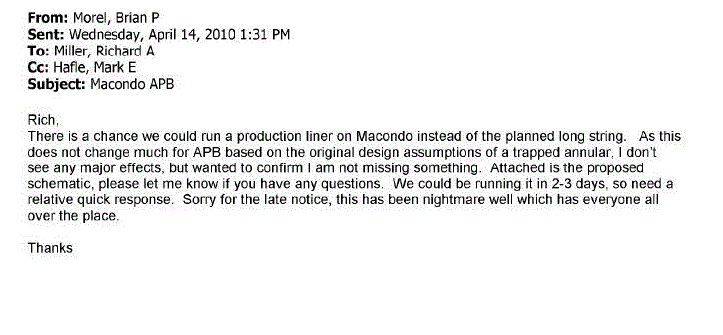
The House Energy and Commerce Committee has published documents relating to its hearings into the Deepwater Horizon accident and subsequent oil leak, and what should come as a surprise to no one,  BP made a series of money-saving shortcuts and blunders that dramatically increased the danger of a destructive oil spill in a well that an engineer ominously described as a "nightmare" just six days before the blowout.

Congress wrote a letter to Tony Hayward outlining its concerns that BP took shortcuts and undertook risky practices, in an attempt to keep costs down. This letter was written in preparation for Hayward's testimony on Thursday of this week.

Worse yet, oil and gas industry insider, Matt Simmons has been warning that the scale of the spill is much bigger and that there's a larger leak several miles away.  He also thinks that sealing the gush of oil might very well entail  "what the Soviet Union did decades ago -- setting off a bomb deep underground so that the fiery blast will melt the surrounding rock and shut off the spill."

Despite BP's egregious history and continuance of corporate criminality -  in addition to its behavior before and after the the Deepwater Horizon oil spill - BP, which stands for Beyond Prosecution
"...the Justice Department (DOJ) abruptly shut down West's investigation into BP in August 2007 and gave the company a "slap on the wrist" for what he says were serious environmental crimes that should have sent some BP executives to jail."
and will no doubt avoid the harsh consequences it deserves, as BP stands for  Bankruptcy Protection.
They have about a month before they declare Chapter 11. They're going to run out of cash from lawsuits, cleanup and other expenses. One really smart thing that Obama did was about three weeks ago he forced BP CEO Tony Hayward to put in writing that BP would pay for every dollar of the cleanup. But there isn't enough money in the world to clean up the Gulf of Mexico. Once BP realizes the extent of this my guess is that they'll panic and go into Chapter 11. -- Matt Simmons
Meanwhile, T. Boone Pickens, Rand Paul, and  Mike Bloomberg think we're being too hard on BP.

On his weekly radio show, the mayor of New York said, "The guy who runs BP didn't exactly go down there and blow up the well."

No, he didn't "go down there"...he didn't have to "go down there." Remote control is just as effective.

In other news, over the weekend, oil spilled once more.  21,000 gallons from a Chevron pipeline leaked into the Red Butte River which runs through the center of Salt Lake City.
Chevron is expected to unveil a cleanup plan this morning, after a day in which the company focused on containing an oil leak that fouled Red Butte Creek and Liberty Park pond, in hopes of keeping the toxic spill from reaching the Great Salt Lake.

Read more...

Sunday, June 13, 2010

Oil Disaster: If It Were My Home

See all 8 photos: Caught in Oil

A bird (left) is mired in oil on the beach at East Grand Terre Island along the Louisiana coast on Thursday, June 3, 2010. (AP Photo/Charlie Riedel)

As the BP Oil gush makes its way to land, the effects are becoming much more evident. It's bad enough when innocent birds and animals are injured due to either accidental events or acts of nature, however, it's beyond heartbreaking to watch as the Gulf's seabirds and creatures suffer due to an event brought on by human greed, negligence, and if you ask me, downright evil.

At the website Ifitwasmyhome you can visualize the BP oil spill disaster and move it anywhere you want in the world and then move it back again.

Read more...

Tuesday, June 08, 2010

Remember Who Authored this Tragic Script..

As NPR's  Chris Satullo   so eloquently authored and voices in A driller's lament, President Obama is not the "author of this tragedy".

Most of us can agree, I'd imagine, that the Obama administration has made a political hash out of the Gulf oil spill.

The president hasn't nailed either half of the required theatrics: the righteous rage toward BP and the rest, of the Clintonesque quivering lip that shows he feels the Gulf Coast's pain.

But we do understand a few things, don't we? The latest Gallup Poll suggests that many of us do. Such as:

The inability to stem the leak is a technical issue, not one of political will. It is a failure of engineering know-how, not leadership.

It's not that people aren't trying to stop the oil from gushing. They've tried everything they could think of, and nothing worked.

And that's the scary thing.

Which drives you back to deeper points. What in the world were we doing letting corporations drill this deep if we couldn't curb the damage should something go wrong? And why let corporations follow their own judgment when it comes to keeping things from going terribly wrong?

Those mistakes date back to long before the current president.

Some people now deem it very bad form to point out that any current calamity is very significantly the fault of George W. Bush. Of course, many of the people who say that have spent the last 40 years blaming everything that goes wrong in America on a couple of Supreme Court decisions and a few hairy protesters back in the 60s.

Fact is, we do have political parties in this country, and they are different.

Only one party has made a national project out of limiting rules on business and defanging the agencies that enforce those rules. Only one party chants Drill, Baby, Drill!

As you may have heard, the agency that was supposed to help prevent calamities like the spill is a mess, a watchdog put to sleep by bribes as cheap as tickets to a football game.

Ask yourself: Which president was himself a driller, who made it his agenda to to put industry executives in charge of the agencies that regulate industry?

Hint, it wasn't Barack Obama. It was that guy before him.

Just thought I'd mention that before we all swallow hole the emerging media theme that the spill is Obama's Katrina.

Read more...

Thursday, June 03, 2010

A Drop in the Bucket Could've Prevented Oil Spill?

The BP oil well "accident" that has evolved into one of the largest oil spills ever in US water continues to spew crude into the Gulf of Mexico. 11 lives have already been lost, and countless other lives, shattered. 

Here's the thing. This "accident" could've been avoided if BP Oil  had shelled out $500,000 (pocket change)  for a remote-control shut-off valve, called an acoustic switch - an underwater valve that shuts down the well even if the oil rig itself is damaged or evacuated - that is normally used as a last-resort protection against underwater spills.  However, unlike most of the  oil producing countries of the world,  "U.S. regulators don't mandate use of the remote-control device on offshore rigs, and the Deepwater Horizon, hired by oil giant BP PLC, didn't have one."

Several years ago, the U.S. considered requiring a remote-controlled shut-off mechanism, but drilling companies questioned its cost and effectiveness, and the Minerals Management Service (MMS), part of the Interior Department responsible for regulating both offshore wind development and oil and gas drilling, decided the remote device wasn't needed because rigs had other back-up plans to cut off a well.

Really?

Well, I guess, amidst “a culture of substance abuse and promiscuity” MMS officials had better things to do than regulate oil drilling. After all, when you're "responsible" for collecting approximately $10 billion in royalties annually and you're one of the government’s largest sources of  income, it's easy to understand how hubris and greed could've created the "free-for-all" atmosphere that developed and prevailed for much of the Bush administration’s watch and how that might obscure one's thinking. Thus,  making it probable that the first priority became maintaining that coke-sniffing, porn surfing, golf playing, orgasmic kind of climate. And how do you ensure its continuance? Profit, profit, and more profit.

Now, after this horrific event, BP says it is spending $6 million a day to battle the oil spill. Clearly, the sense of power and greed that inspired these officials to shun the vagaries of self-control and instead fully embrace monumental hedonistic debauchery, complete with the senseless and random act of taking "tickets to a Toby Keith concert", did, in fact, render these "officials" dumb as...well, dumb as a BP oil executive.

Granted, much is still unknown about what caused the problems in Deepwater Horizon's well, however, because of the greedy oil executives and the immoral, compliant, greedy MMS officials, who seem to predominate today, in this culture of deregulation that was so heavily advocated for during the Bush Administration - or really, since the inception of Reaganomics - we'll never know if the decision to make the infinitesimally small purchase, relatively speaking, of a football-sized acoustic remote-control may have been able to stop the oil well disaster.

Read more...

Monday, May 31, 2010

Ain't it Obvious? We Can't Trust BP to Do the Job.

BP's only interest is the bottom line. From no plans in case of a disaster, to its audacious short-cuts throughout the entire process, judge shopping, and the outright lies BP has told since the beginning, this company is useless and good for nothing, except maybe for its lobbying talents. 

Greed is the essential component in the formula for disaster. Why? Because ultimately, greed leads to negligence, incompetence and most of all bold faced lies, which, thanks to Rachel Maddow, is eloquently demonstrated in a segment of "The Rachel Maddow Show"(video below).

So, it follows that when the only incentive given to each player is individual profit,  (huge windfall profits) the incentives of the company will never align with the needs of public safety...or the public good.

It's very clear. Mad dashes for profit and perverse incentive structures = disaster.

BP is one of the biggest spenders on lobbying in the oil and gas industry to represent its interests in Washington.

During the first quarter of 2010, it spent $3.5 million on lobbying, second only to ConocoPhillips, according to figures compiled by the nonpartisan Center for Responsive Politics.

Yet despite the far from resolved Gulf Oil disaster and as plenty of evidence suggests, BP's responsibility, they want to avoid curbs on new drilling, according to  its lobbyists.

BP officials, who put profits above all else, including safety, wanted to proceed quickly as possible in order to save money on the current well's cost, and  so they could begin on another well, which was behind schedule.

Lies and more lies.


BP, Government Risk Larger Spill to Stem Leak

BP CEO disputes claims of underwater oil plumes.


BP Lowballing Oil Flow

BP is vastly understating the amount of oil flowing into the Gulf in order to decrease fines, which are based on the number of barrels leaked per day. Host Scott Simon talks with Markey about his criticism of the oil company and its efforts to contain the oil spreading in the Gulf of Mexico.


Read more...

Sunday, May 30, 2010

Ensuring Change Takes Place This Time Around.


31-years ago, on June 13, 1979, while the Trans-Alaskan oil pipeline (right) -  technically 800 miles of pipleline with a diameter of 48 inches that crosses three mountain ranges and over 800 rivers and streams, that connects oil fields in northern Alaska to a sea port where the oil can be shipped to the lower 48 states for refining - was in a state of "repair" (continuous)  from the previous oil leak(s) that allowed 1500 barrels of crude oil to escape, the Gulf of Mexico was trying to handle a much larger oil spil(June 3, 1979) that dumped 30,000 barrels of crude per day into the Gulf.

Sound familiar?  Well, that's not all. The techniques used to contain the 1979 spill are all too familiar to us today, and on August 7, 1979, reports of oil containment workers were still dominating the news. Then, on n August 8, 1979, reports of that all too familiar loop current, that we hear so much about today. On September 25, 1979, it was reported that "Operation Sombrero" that tried to put a 300 ton steel cone over the mouth of the runaway well, that once in place will collect over 90% of the crude oil, gushing from the well for over 3.5 months. BP's "Top Hat", anyone?  Yes, they even tried their own brand of "Top Kill", and pretty much every other technique we see trying and... failing today.

And the best part? All of these failed techniques used over thirty years ago, failed in 200 feet of water! What in the hell has possessed the minds of these over-the-top, highly paid, oil-drilling "experts" that makes them think these failed techniques will work at a depth of 5,000 feet?  Could it be "royalty breaks of $1 billion over five years" that is drying up the brains of these high-paid executives? Royalty Tweaks Target Deep Reserves?

Well, as we've seen in the banking industry, "royalty increases" greed can drain the capacity for all forms of high level cognitive activity in even the most brilliant of minds.  And therein lies the problem. It's all well and good to develop oil and gas resources, even when they are the most costly to develop and access, if they will more than likely pay off to line the pockets of those in charge.

Anyway, the 1979 "historical" oil spill continued for nine months, until relief wells were created to relieve pressure on the blown-out well, so that eventually it could be capped.


In the end, the only way to ensure change takes place is if we are willing to raise our standards of what we deem acceptable. If we contiue to allow personal gain to trump all else, things will never change...ever.

Thanks to Rachel Maddow's fabulous report on how much oil disasters and oil disaster response has not changed one iota in over 30 years.

Read more...

Thursday, November 13, 2008

Stop the Spread of Global Petroaddiction With Pedals for Progress.


As economies like India and China start to demand more oil, the current global oil supply and the infrastructure will not be able to handle the ever increasing demand. Unfortunately, our petroaddictive behavior will definitely speak louder than words. Who are we to tell them they can't live like us?

Fortunately, there is Pedals for Progress who not only donates used bicycles to third world countries, they also help "developing world economies by promoting self-sustaining bicycle repair businesses." Convincing other countries to pedal will not be an easy chore, but someone must do it in order to save our planet.

Aside from saving the earth, pedaling has so many advantages over motoring such as the exercise it provides, the cost factor, the space factor, and the easy care and maintenance. Unlike horses or camels, bicycles do not require any fuel at all except the combustible substance of human calories.

Of course, calories is something most Americans have in spades. This is not the case for billions of people across the globe, especially now as the ripple effect of our fiscal crisis can be felt across this terraqueous ball we all occupy. Not to mention the effects of global warming, in part caused by our compulsive physiological and psychological need for more where oil ranks as the number one requisite.

Climate Change Summary Says Asia And Africa Will See Danger, Death, And Extinction Of Species Unless Countries Adapt:

Global warming's effects now still may be more pesky than catastrophic. But a new scientific report says that when the Earth gets a few degrees hotter, inconvenience will give way to danger, death and extinction of species.

The world faces increased hunger and water shortages in the poorest countries, massive floods and avalanches in Asia, and species extinction unless nations adapt to climate change and halt its progress, according to a report approved Friday by an international conference on global warming.

The poorest parts of the world, especially Africa and Asia, will be hit hardest, says the summary from the Intergovernmental Panel on Climate Change, issued Friday after a long, contentious editing session.
In a New York Times article, Scientists Detail Climate Changes, Poles to Tropics, James Kanter and Andrew C. Revkin report on how climate change is already changing the planet and detail how it will get worse.
"In its most detailed portrait of the effects of climate change driven by human activities, the panel predicted widening droughts in southern Europe and the Middle East, sub-Saharan Africa, the American Southwest and Mexico, and flooding that could imperil low-lying islands and the crowded river deltas of southern Asia. It stressed that many of the regions facing the greatest risks were among the world’s poorest."
Nevertheless, the people who do not have enough calories to burn are of little concern. If they can't afford to feed themselves, they certainly can't afford to motor themselves. Rather, we need to concern ourselves with the people who are past the point of starvation and who are starting to climb out of the depths of deprivation ...these are the people we must meddle in the affairs, to persuade them to pedal and spin their wares....and therein lies the reason I remain anonymous.

Read more...

Thursday, October 16, 2008

Signing Statements, The Military-Petroleum Complex and Oil Wars

If you have any doubt as to why we went to war with Iraq, read on.

Contrary to the rule of law and our constitutional system of separation of powers, as stated by the American Bar Association in 2006, President Bush went ahead and issued another signing statement on Tuesday that would allow him to ignore parts of the new military authorization act he signed into law.

Why? To ensure U.S. control of Iraq' oil, of course.

In the authorization bill, Mr. Bush challenged four sections. One forbid the money from being used “to exercise United States control of the oil resources of Iraq”; another required negotiations for an agreement by which Iraq would share some of the costs of the American military operations there.
Bush objected to one section of the bill barring attempts “to exercise United States control of the oil resources of Iraq.” Bush also declared the right to ignore sections of a bill meant to protect oversight at federal agencies; he rejected a provision that would allow inspectors general the right to their own counsel instead of politically appointed attorneys, and he rejected a section that would require the White House to tell lawmakers what each inspector general said about the administration’s budget proposals for their offices.

The signing statements Bush issued are necessary to keep - as Nick Turse calls it, in his book, The Complex: How the Military Invades Our Everyday Lives - The Military-Petroleum Complex, functioning.

The Pentagon awarded Shell a $338 million contract, on September 17th, in addition to the over $1 billion it was already awarded the previous year. The following day on September 22nd, Iraq and Shell officially signed a $4 billion deal to process and market natural gas. The very next day, Shell "established an office in Baghdad.

Bush scored some major points a few days ago when the Iraqi government put 40 billion barrels of oil up for sale...that's 40% of Iraq’s reserves. This is the biggest sale of oil assets ever. All the big players - Exxon Mobil, Shell, Total, BP, and Chevron - who show up regularly on Pentagon's payroll, taking home more than $4.1 billion - are involved.

It should come as no surprise that President Bush is doing all he can to ensure the future profits of oil companies, especially at a time when when the number of oil discoveries are less, the size of those discoveries, smaller, and the demand for oil is greater than ever, across the globe,

Americans use twenty million barrels of oil per day, or seven billion barrels of oil per year, that's 25% of what the world uses. That may not sound like a lot until you consider Americans make up 4-5% of the world population, and that the US reached peak oil in 1970. Our dependence on other countries will continually increase as we import approx. 70-75%, between crude oil and finished products currently.

Is there an oil shortage? I doubt it because by the time we run out of oil, we should have the technology available to harvest energy from the sun. However, shoddy oil infrastructure and waste is a problem.

After the oil price of oil collapsed in 1982, massive amount of down-sizing occurred in the industry leaving us with the "shortage" problem we have today...shortage of equipment and professionals, that is. One deep water rig costs $1 billion and takes 4-5 years to build. There are approximately 500 off shore oil rigs worldwide, today and they are on average about 28-years old...it used to be that oil rigs were retired after 25-years. In addition, there is a shortage of geologists, rig hands, reservoir engineers, drilling crews and seismic crews.

Combine an outdated oil infrastructure with the explosive economic growth of other parts of the world -- China and India -- and you can imagine the problems this might cause. Since these "underdeveloped" countries of yesteryear have morphed into the "developing" countries of today, due to , as Matthew Simmons, author of Twilight in the desert: The Saudi Oil Shock and the World Economy. says, "in a nutshell, the supply is too old and the demand is too new".

If we could contain the economic blueprint -- two or more cars per household, trucking industry, excessive use of electricity etc. -- to the U.S., Canada, Western Europe and more recently Korea and Japan, oil supply wouldn't be so problematic. However with China, India and other parts of the world adopting our wasteful ways, oil supply, demand and waste become an enormous issue.

The Iraq war may only be the beginning of whats to come. For example, the tribes of the Niger Delta are sick and tired of the oil companies taking but never giving back. Movement for the Emancipation of the Niger Delta (MEND) is blowing up pipelines and siphoning off the oil in an effort to rid their country of these greedy companies. Their ultimate goal is to totally destroy the capacity of the Nigerian government to export oil.

What could all this lead too? Oil wars, according to Simmons. But, hasn't that already started? Yes, however, so far we've been spared the brutality. If things continue on the same path...well, let's just say karma's a bitch.

Read more...

Wednesday, October 15, 2008

Blog Action Day 2008: What's Going On That We're Not Hearing About?

If Monica Lewinsky, Britney Spears and the winners and losers on American Idol can unsettle the reasoning minds, thus diverting our attention away from important current events, imagine the level of distraction as we face the horror and confusion that this fiscal crisis has produced.

As the powers that be rush to "repair" the havoc, that the egregious greed of the powers that be has wrought, by "borrowing" trillions of our dollars to reward themselves; in hopes that they can save our economy, I wonder what else are they up too? Let me rephrase that question without the annoying cynical overtones. What is happening or developing right now, that may affect our lives in the near future, as we focus all of our attention to the plight of our pocketbooks?

Global poverty is one issue that has and will suffer from the lack of attention that they might have otherwise received if not for the current fiscal crisis, especially if rich nations renege on their pledges of aid.

The world's wealthiest nations pledged billions of dollars at a U.N. food summit in June, following a spike in commodities prices that tipped 75 million more people into hunger last year.

But the U.N. Food and Agriculture Organisation (FAO) said very little of promised aid had been received so far, even though the outlook had darkened for the world's poorest.
Although, considering foreign aid represents 1% of the U.S. federal budget, and that the U.S. ranks last in the percent of gross national product spent on foreign aid - the Department of defense spending 20% of that 1% - it's not as if global poverty is a top priority anyway. However, those people, unfortunate enough to exist in a state of having no money, food, clean water, shelter etc, and most importantly no way of earning the necessities to ensure their survival, will undoubtedly take anything they can get.

Well, what does global poverty have to do with this financial crisis or us? Aside from moral imperative, there is the geopolitical one. As our world shrinks, we can no longer afford to ignore the combination of geographic. and political factors around the world. More and more, those factors will influence us, whether we want them too or not. Existing circumstances of hopelessness, marginalization, impoverishment and conditions where violation of human rights is the norm, are fertile breeding ground for terrorism, disease, backward thinking, and conflict, all of which can spread faster than William "The Refrigerator" Perry can scarf down 40 hotdogs.

What else are we missing?

On a more positive note, “Chinese leaders are expected to allow peasants to buy or sell land-use rights for the first time, a step that could draw hundreds of millions of farmers more firmly into the market economy, now centered around the cities.”

Iran is imposing the nation’s first ever sales tax.

History is being made in Zimbawbwe.

The U.S. and Iraq draft an agreement that will allow U.S. troops to stay until 2011 and gives Iraq the right to try U.S. soldiers for felonies committed off duty.

The Iraqi Government is putting 40 billion barrels of reserves up for grabs in biggest sale ever.

It was always oil. Here's the proof.

Read more...

  © Blogger templates The Professional Template by Ourblogtemplates.com 2008

Back to TOP