Showing posts with label marijuana. Show all posts

Saturday, September 25, 2010

Meanwhile Banksters Ride Shotgun for Mexico's Violent Drug Trade.

The severity revolution in criminal justice, that began when former President Nixon launched the war on drugs, that escalated during the Reagan yearsproducing some of the "most prohibitive drug control laws ever" has very little to do with "law and order" and everything to do with profit.  If you don't believe me, read the following:

We the people have spent well over $1 trillion  (much more if you consider the government spending for all of the people directly and indirectly effected), yet the availability of drugs is similar to what it was when Nixon started this "war on drugs", and Reagan took it to a new level. 

The conservatives, in their "tough on crime" law and order agenda, scapegoated Marijuana, making it their "symbol of the weakness and permissiveness of a liberal society."  They cultivated a culture of fear over growing crime and the evils of marijuana amongst other drugs which gave rise to  hundreds of new state, federal, and local laws, which, aside from creating a prison industrial complex, vastly expanded the government's power to seize and forfeit property. Because, during the 1980s, civil assets forfeiture was extended to drug trafficking and possession, and a host of other crimes, through the Comprehensive Crime Control Act of 1984, and the Drug Abuse Act of 1986, and many other such laws. In other words, the "war on drugs" enabled the Supreme Court to gradually erode  our civil liberties.  In fact,  Newt Gingrich even introduced "legislation demanding either a life sentence or the death penalty for anyone caught bringing more than two ounces of marijuana into the United States."*

Meanwhile, as our prisons are bursting at the seams with non-violent offenders, back at the ranch, America's biggest banks are riding shotgun for Mexican drug smugglers by giving "international cocaine cartels a virtual carte blanche to finance their operations".

No bank has been more closely connected with Mexican money laundering than Wachovia. 6,700 subpoenas later, Wachovia finally:

...admitted it didn’t do enough to spot illicit funds in handling $378.4 billion for Mexican-currency-exchange houses from 2004 to 2007. That’s the largest violation of the Bank Secrecy Act, an anti-money-laundering law, in U.S. history -- a sum equal to one-third of Mexico’s current gross domestic product.
However, despite the fact that Wachovia was caught red-handed in the largest anti-money laundering law in U.S. history, Wachovia (acquired by Wells Fargo in 2008) entered into a settlement with federal prosecutors. In other words, they got away with mass murder...literally.  This should come as no surprise as no U.S. bank has ever been indicted for violating the Bank Secrecy Act — or any other federal law for that matter.

So, as our "justice" system boldly roars at, imprisons, and sometimes slaughters non-violent citizens,  it conveniently turns a blind eye to those wealthy powerful elites who facilitate the heinous drug cartel killings and beheadings and burnings that, so far, claimed at least 28,000 lives, making Juárez valley, a Texas border town, one of the deadliest places on the planet.  Yet marijuana/drugs remain illegal. 

Marijuana, alone, is a $113 billion dollar business in the U.S. That's $113 billion unaccounted for...or is it?  Why would so much revenue, that is protected by brutal crime, specifically the  torturing, murdering and dismembering of countless numbers of innocent people, be allowed to remain in the hands of such violent criminals if conservatives are so concerned about law and order and fiscal responsibility and saving our economy from disaster? 

Could it be that governments and their drug prohibition policies are not intended to eliminate illegal drug use/commerce? Could it be that government officials, politicians, banksters and the corporate elite profit off the drug wars just as much, if not more than the evil cartels?

The more enforcement there is, the higher the street prices, whereas the less enforcement, the lower the prices. The "war on drugs" has nothing to do with eliminating drug use and everything to do with profit, "because most of the profits do NOT come from the sale of drugs but from the laundering of the billions of dollars by banks and other financial institutions to turn the dirty money into legal capital".**

Links:

Banks Financing Mexico Gangs Admitted in Wells Fargo Deal

* Smoke and Mirrors: The War on Drugs and the Politics of Failure by Dan Baum

** Telling the Whole Truth about the Drug War.

Read more...

Thursday, October 01, 2009

Measure of a Society: How Will America be Judged?

Jimmy Carter once said, "The measure of a society is found in how they treat their weakest and most helpless citizens. As Americans, we are blessed with circumstances that protect our human rights and our religious freedom, but for many people around the world, deprivation and persecution have become a way of life."

People around the world? How about people right here in our own country? We have a system in place that rewards and advocates for big business at the expense of the American people. For-profit business interests is our society's number one concern, even when human lives are at stake, or the quality of those lives.

Just ask the woman with breast cancer, who was denied insurance the day before her scheduled double mastectomy.

Just ask Wendell Potter, the whistle-blower against the insurance industry and former chief spokesman for Cigna Healthcare, who when testifying before congress said,

"I saw how they confuse their customers and dump the sick—all so they can satisfy their Wall Street investors. [...]"The thing they fear most is a single-payer plan. They fear even the public insurance option being proposed; they'll pull out all the stops they can to defeat that to try to scare people into thinking that embracing a public health insurance option would lead down the slippery slope toward socialism ... Putting a government bureaucrat between you and your doctor. They've used those talking points for years, and they've always worked."
And what about our incarceration rate - 2.3 million behind bars, as of 2008 - that makes the US, "prisonhouse of nations", a phrase coined by Mumia Abu-Jamal(not advocating for case, but I believe his phrase to be accurate), as well as our top ranking execution rate, following only China, Iran, and Saudi Arabia in the number of executions in 2008. Is jailing non-threatening, non violent citizens by the boatload, simply another way to line the pockets of industry?

Just ask the millions of people arrested and jailed for possessing marijuana, a plant, far less toxic than alcohol and most prescription drugs, not to mention, its many medicinal properties. Would the legalization of this easily home-grown plant cause the pharmaceutical industry to lose the unconscionable profits they rake in year after year?

Just ask Sally Harpold, grandmother of triplets. She bought one box of Zyrtec-D cold medicine for her husband at one pharmacy. Less than seven days later, she bought a box of Mucinex-D cold medicine for her adult daughter at and other pharmacy, thereby purchasing 3.6 grams total of pseudoephedrine in a week’s time. Four months later, she ended up in handcuffs, arrested for her two purchases.

What about the death penalty?

Just ask the poor and the powerless, as nine times out of ten they are the ones executed.

Or, more specifically, ask Texas, which has accounted for 69% of all executions in the southern states since 1976 and 39% of all executions in the nation during the same period. The spike in executions in Texas occurred during the reign of George W. Bush who signed the death warrants of 151 men and 1 woman during his term.

Rick Perry broke the record of his predecessor when he presided over his 200th execution in June of 2009. Not only that, Perry just fired three from the board ready to probe the execution of Cameron Todd Willingham, the one he denied a reprieve even after a detailed report by an arson expert said the evidence that Mr. Willingham had set the fire was flimsy and inconclusive. On September 18, 2009 Perry was quoted as saying that there was "clear and compelling, overwhelming evidence that he was in fact the murderer of his children"

Another measure of society is the way the culture disposes of their dead. If that's true, what will future historians say about us?

Just ask Detroit, too broke to bury their dead.. The number of unclaimed corpses at the Wayne County morgue in Detroit is at a record high, having tripled since 2000. 2000? You mean since George W. Bush took office? What a coincidence. Anyway, people just don't have the money to bury their dead and as unemployment in the area is approaching 28%, and many people, can't afford last rites; the other problem is that the county's $21,000 annual budget to bury unclaimed bodies ran out.

Jimmy Carter was not the only one who said the worth of society can be measured by the manner in which it treats its weakest member.
It was once said that the moral test of government is how that government treats those who are in the dawn of life, the children; those who are in the twilight of life, the elderly; and those who are in the shadows of life-the sick, the needy and the handicapped." ~Hubert Humphrey

"The degree of civilization in a society can be judged by entering the prisons"
~Fyodor Dostoyevsky

"A nation's greatness is measured by how it treats its weakest members." - Mahatma Ghandi

"Any society, any nation, is judged on the basis of how it treats its weakest members -- the last, the least, the littlest." ~Cardinal Roger Mahony,

The greatness of America is in how it treats its weakest members: the elderly, the infirm, the handicapped, the underprivileged, the unborn.
~Bill Federer

"A society will be judged on the basis of how it treats its weakest members and among the most vulnerable are surely the unborn and the dying,"
~Pope John Paul II


If one believes that the worth and dignity of a civilization is judged by the way its weakest members are treated, we cannot help but look back in shame at our past. However, although we can do nothing to change the past, we can make up for it by setting a new course for our future. Currently, as a nation, we value money more than life. People serve money...an entity that does not exist in and of itself, as it is nothing without people and the infrastructure to support it.

Before we change anything we must reclaim our humanity. Once we do that, the rest will fall into place.

Read more...

Sunday, September 27, 2009

Time to End Government War on Drugs?

Toxicity of Recreational Drugs - Alcohol is more lethal than many other commonly abused substances

Does anyone still believe that marijuana prohibition is working — or that all of the people currently behind bars deserve to be there? Have the hundreds of billions of dollars devoted to educating, persuading, pleading and frightening us away from drugs done the job?

After more than 70 years of criminal prohibition, 41% of the American population report having used marijuana in their lifetime.

Keep in mind that the "federal government's annual drug use survey uses fuzzy math to get their results"

"Conducted by the Federal Government since 1971, the survey collects data by administering questionnaires to a representative sample of the population through face-to-face interviews at their places of residence."
How many chronic and heavy drug users have a consistent residence? That is, if they have any residence at all. It's highly unlikely that SAMHSA's pollsters will reach these people. Not to mention, that most of the people who do use drugs, that they do catch at home, will not truthfully admit to a federal employee that they engage in an activity that could land them in prison for years.
For too long, advocates of prohibition have framed their arguments on the false assumption that the continued enforcement of said laws “protects our children.” As the numbers above illustrate, this premise is nonsense. In fact, just the opposite is true.

The government’s war on cannabis and cannabis consumers endangers the health and safety of our children. It enables young people to have unregulated access to marijuana — easier access than they presently have to alcohol. It enables young people to interact and befriend pushers of other illegal, more dangerous drugs. It compels young people to dismiss the educational messages they receive pertaining to the potential health risks posed by the use of “hard drugs” and prescription pharmaceuticals, because kids say, “If they lied to me about pot, why wouldn’t they be lying to me about everything else, too?”

Most importantly, the criminal laws are far more likely to result in having our children arrested, placed behind bars, and stigmatized with a lifelong criminal record than they are likely to in any way discourage them to try pot.
Table of types of illicit drug use in a lifetime for 2007/2008

Full results from the 2008 National Survey on Drug Use and Health: Detailed Tables

Brief history of the war on drugs:

Timeline: 30 years of America's drug war

History of Marijuana Legislation

Harrison Narcotics Act - - 63rd US Congress 1914. Restricted the sale of heroin and was quickly used to restrict the sale of cocaine.

Marijuana Tax Act - - 75th US Congress April 14, 1937, signed August 2, 1937
Attempted to tax marijuana into oblivion Marijuana had not been shown to be dangerous, but the perception that it might be a "gateway drug" for heroin users--and its alleged popularity among Mexican-American immigrants--made it an easy target.

The Comprehensive Drug Abuse Prevention and Control Act - 91st US Congress October 27, 1970. The federal government took a more active role in drug enforcement and drug abuse prevention. Nixon, who called drug abuse "public enemy number one" in a 1971 speech.

Reagan-era drug policy legislation:

Nancy Reagan's "Just Say No" anti-drug campaign becomes a centerpiece of the Reagan administration's anti-drug campaign. The movement focuses on white, middle class children and is funded by corporate and private donations.

By portraying drugs as a threat to white middle-class children, the administration was able to pursue more aggressive federal antidrug legislation.

Greater emphasis was put on military and criminal punishments rather than treatment solutions. Mandatory minimum sentencing were implemented and a competition between politicians to see who could be "toughest" on crime and drugs escalated to the point where the incarceration rate started to spiral out of control until today when the rate is far beyond any previous time in history
More prisoners today are serving life terms than ever before — 140,610 out of 2.3 million inmates being held in jails and prisons across the country — under tough mandatory minimum-sentencing laws and the declining use of parole for eligible convicts
The passage of the 1986 crime bill, notable for the imposition of mandatory minimum sentences also created the federal Sentencing Commission and the current system of federal sentencing guidelines, which did away with parole in the federal system, ensuring that prisoners would serve at least 85% of their sentences. And it included asset forfeiture.

Passage of the Anti-Drug Abuse Act of 1988, which established a federal death penalty for "drug kingpins." Reagan signed that bill in his wife's honor.
"Reagan just swept the country along with him. It was that the country was in a state of hysteria, Democrats and Republicans alike. He tapped into this hysteria and drove it to incredible heights. Everybody jumped on the bandwagon. We forget the extent to which everyone was into this. There was a phrase both parties used, 'no one to the right of me on the drug issue

...in the drug policy arena, he was just horrible. If you want a taste of the hysteria and the fear, read my book. You had kids turning in their mothers for smoking pot and people like Joyce Nalepka saying that was the right thing to do. You had Reagan pushing to get rid of Posse Comitatus so he could use the armed forces in the drug war. He was for freedom, but like so many people, not when it came to drugs. The Reagan era spawned all sorts of nasty innovations, and while not all of them came from the White House, they were all part of that same intrusive spirit. We are still suffering from that to this day," Arnold Trebach, author of "The Great American Drug War" and a pioneer in American drug reform and founder of the Drug Policy Foundation in 1988.

Read more...

Monday, April 20, 2009

Law: Choosing Between the Lesser of Two Evils.


How do we decide when something should be outlawed? How do we decide that something is wrong? Those two questions are not one in the same. Take the issues of premarital sex, alcohol consumption, smoking, excessive Twinkie feasting, etc, all of which render consequences far greater than that of ingesting marijuana, which the decision was made to outlaw, long ago. Why is that? The toxicity of smoking, alcohol, and Twinkies should be obvious, and as far as premarital sex goes, although in and of itself, it is not toxic, the results can be quite stressful to society, financially and socially. However, we do not outlaw those behaviors because the cost would far exceed the benefits, as is the case with marijuana, yet very little is done to decriminalize this plant.

The study, Lost Taxes and Other Costs of Marijuana Laws by Jon Gettman published in Forbes magazine estimates the overall retail value of the felonious marijuana market is $113 billion. That's right, oftentimes viscous criminals; rake in the cash, while we, the taxpayers, pay out approximately $41 billion per year to enforce the prohibition of this semi-toxic substance. I say semi-toxic because marijuana is known for its medicinal properties as well as its toxicity. Twinkies, as far as I know, are pure toxicity, and the same can be said for smoking. Most of the prescription drugs on the market, are far more toxic than marijuana, and probably have less medicinal value, yet we don't outlaw them.

Government reports indicate that the nation's marijuana laws cost taxpayers $41.8 billion annually. This calculation is based on (a) a reconciliation of estimates of the annual supply of marijuana in the United States and estimates of its overall value and (b) Office of Management and Budget (OMB) data on the share of the Gross Domestic Product diverted by regulatory taxes to US Government budgets. Government reports from the Office of National Drug Control Policy, the Library of Congress, and other sources indicate that the supply of marijuana in the United States is 14,349 metric tons, or 31.1 million pounds. Various price indexes from public and private sources produce a retail price of $7.87/gr or $3,570/lb, setting the overall retail value of the illicit marijuana market at $113 billion.
Since President Barack Obama took office stating that he will not use federal marijuana laws to override state laws, as the Bush administration did, requests for Medical marijuana have increased 300%. President Obama said he saw no difference between using medical marijuana and other pain control drugs. Considering the side effects, the addiction and the "street value" of certain pain control substances, medical marijauna looks benign in comparison.

What if, instead of allowing hardened criminals, access to the billions of dollars the marijuana industry brings in, we, the taxpayers had benefit of that money to execute our own "war" on drugs and addiction? If we took, even half the revenue generated, from taxing and regulating the marijuana industry, and invested it into drug prevention education, and drug rehabilitation programs, we could eventually decrease drug use and at the same time, reduce the amount of crime associated with marijuana, making more resources - including severely limited prison space, - available for housing more dangerous criminals and the funds and manpower to combat other crimes.

Without an official cost-benefit analysis of existing prohibition policy and legislation, what is our government's justification for pouring so much money into what appears to be a relatively innocuous substance? Especially, when pharmaceutical companies are allowed to distort scientific evidence to get dangerous drugs approved.

Read more...

Sunday, August 03, 2008

When Governments Start Going After the Weak it's Not a Good Sign.

Notice the t-shirt on one of the agents involved in the federal raid on the sick and the dying in the photo at left. Could it be that Blackwater contractors are now taking on the truly dangerous ...dying cancer patients?

Now, I don't want to jump to any conclusions, however, the photo at left was pulled from an LA Times news report on a federal raid at the Culver City medical marijuana dispensary on August 1.

U.S. Magistrate Judge Victor B. Kenton authorized the seizure of "controlled substances, including marijuana; derivatives thereof, and edible products containing marijuana . . . receipts, notes, ledgers, records . . . reflecting the proceeds of those activities . . . electronic equipment . . . photographs, negatives, videotapes, films, addresses and/or telephone books . . . records, documents, programs, applications. . . ." according to the LA Times article, and this action comes on the same day an appellate court in San Diego rules that federal law does not preempt California's medical pot law.

"Marijuana remains a controlled substance, and it is illegal under federal law to possess, dispense or cultivate marijuana in any form," -- Sarah Pullen, a spokeswoman for the Los Angeles office of the agency.
As one commenter pointed out, the Controlled Substances Act, Schedule I excludes substances that have "an accepted use in medical treatment in the United States".
So, why are we busting medical marijuana patients with valid doctor's prescriptions? Why all the bravado? I mean, come on...what are they trying to prove? Some of these people can barely lift their head off their pillow.

Perhaps, easily grown, inexpensive marijuana threatens the Pharmaceutical industry's potential profit margin. Perhaps, the "Rambo" tactics are meant to send a clear message. Perhaps, "Big Brother"..."Big Business"..."The Man" is sitting on a big secret(s), a secret(s), that if it ever got out, could decorpocratize America.

Read more...

Thursday, July 31, 2008

It's Time to Rethink America's Tough on Everything Policies.

Just as the U.S. has one of the highest murder rates in the world despite the ultimate punishment, the death penalty, the U.S. also has the highest rate of marijuana use in the world despite some of the harshest penalties.

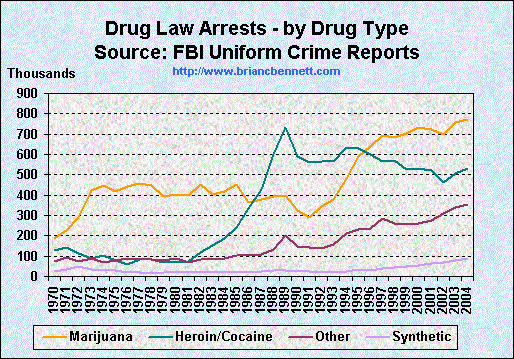
829,625people were arrested for marijuana law offenses in 2006 for possession and we, the taxpayers are stuck with the multi- billion-dollar bill for these marijuana arrests, which "consume 4.5 million law enforcement hours — the equivalent of taking 112,500 law enforcement officers off the streets". I guess this is part of America's "Tough on Crime"
policy...locking up the truly dangerous...terminal patients and chilled out potheads.

Barney Frank (D-Mass.) announced the details of the legislation to eliminate federal criminal sanctions for possession of small amounts of marijuana.

"The U.S. should stop arresting responsible marijuana users. Current laws targeting marijuana users place undue burdens on law enforcement resources, punish ill Americans whose doctors have prescribed the substance and unfairly affect African-Americans, said Frank, flanked by legislators and representatives from advocacy groups." -- Barney Frank
So, why couldn't the billions of dollars we spent/spend on tracking down and prosecuting harmless potheads and sick people, whose only transgression is getting ill, go toward supplying health care for those who legitimately can't afford it? As we all know actions speak louder than words. Although no one likes illness or disease, it seems Americans fail to distinguish between the pathogen and the person unfortunate enough to encounter the pathogen. We've already "settled" the West, therefore, we no longer need to cast aside the weak in order to survive, yet, that's exactly what we do. Once again, I wonder if we've evolved all that much.

Send a message to your Congressional Representative.

Read more...

Wednesday, October 10, 2007

One American Arrested Every 38 Seconds for Marijuana.

Possible Clinical Applications for Cannabis:

Our current marijuana laws cost US taxpayers $42 billion dollars a year.

Could it be that the reason the government is trying so hard to make us believe marijuana is our most dangerous enemy is because it may be a cure for most of what ails us? Just think...doctors would cease to be gods; our pharmaceutical and health insurance industries might collapse, and "we the people" might be healthy enough to take our country back if we discovered natural, cheap methods of healing.

Read more...

Monday, October 01, 2007

Marijuana is the Least of Our Problems!

Considering I have posted several times about decriminalizing marijuana, many may think I'm a big pot-head, but the truth is I never smoked it...the smell alone makes me sick. But, I have known many people who have smoked it over the years and I've read a lot about the issue and there is no doubt in my mind, marijuana laws, and the time and money we use to implement them are a waste of valuable resources.

Over 10.4 million Americans have been arrested for "pot" since 1990. The resources required to incarcerate that many individuals is enormous, especially when compared to the "harm" marijuana possession does to society, which is minimal, at most...I would argue alcohol is much more harmful.

Last year alone, a record 829,625 Americans were arrested for violating marijuana laws. 89 percent of that total number arrested was charged with possessing marijuana ...nothing else! 2006 will be a year that will go down in history -- unless this trend continues -- as the year for most Americans arrested for violating marijuana laws, tripling the total number arrested in 1990.

The impact, arrest for violating marijuana laws has on people's lives, greatly exceeds the transgressions of possessing or smoking pot. The "collateral consequences" can be far greater than for those arrested for violent crimes.

We are barraged with misinformation and manipulated statistics about marijuana's link to violence; that it is the "gateway drug" that will lead our young astray. We are presented with studies proving marijuana's medical efficacy, but still consider it more threatening than the simple process involved in acquiring an AK-47. The purpose of creating and distributing anti-marijuana propaganda is to distract us from what is truly perilous and to protect the pharmaceutical industry for one.

How can we focus in on the pharmaceutical industry when we are all concentrating so hard on how this innocuous inexpensive little plant will cause the destruction of mankind? What about all the expensive, dangerous drugs that are advertised on TV and shoved down our throats on a daily basis? After the ad finishes disclosing all the side effects, I would think people would start to question why the government focuses so much on criminalizing pot but could care less about the drugs we end up spending our life savings on. We don't question because it's legal and whatever is legal must be beneficial to us, right? Wrong. That's what "they" want us to believe and we have been conditioned through our educational system and by our families to accept and not question.

Most of us have been raised in an environment of nebulous authority, where the most important rule was to obey those in charge without compromise. We were not encouraged to analyze or scrutinize why we should conform to oftentimes vague, arbitrary and misguided rules that did not make any sense. Thinking for oneself is normally was a punishable offense in most households and classrooms, therefore most people avoid employing one's mind rationally and objectively in evaluating or dealing with any given situation no matter how big the elephant in the room is.

Read more...

Friday, May 25, 2007

Medical Marijuana One Step Away from FDA Development Process

WASHINGTON D.C. – A U.S. Department of Justice-appointed judge submitted her final recommendation to the U.S. Drug Enforcement Administration (DEA) on May 15, calling on the agency to end a forty-year government monopoly on the supply of research -grade marijuana available for Food and Drug Administration (FDA)-approved studies. With this monopoly broken, new studies could lead to medical marijuana’s availability in pharmacies as a legal, prescription drug. DEA Deputy Administrator Michele Leonhart must now accept the judge’s recommendation in order for the ruling to take effect, though she has no deadline for doing so and may choose to reject the recommendation.

“Medical marijuana is one step away from the FDA development process, where it should be. Science, not politics, needs to determine whether medical marijuana should be made legal, and the DEA has so far tried to block the scientific process,” said University of Massachusetts-Amherst Professor Lyle Craker, who six years ago petitioned DEA for a license to grow research-grade marijuana for use in privately-funded, FDA-approved studies that aim to develop the plant into a legal, prescription medicine. “I hope that the Deputy Administrator acts quickly to allow this critical research to move forward.”

On May 15, DEA Administrative Law Judge Mary Ellen Bittner submitted her recommendation to the DEA’s Deputy Administrator in which she found that it is “in the public interest” to end the federal monopoly on the supply of marijuana that can be used in FDA-approved research, held by the National Institute on Drug Abuse (NIDA).

Following nine days of hearings, testimony and evidence from both sides, including from researchers who reported that the government denied their requests for marijuana for use in FDA-approved research protocols, Judge Bittner concluded that, “NIDA’s system for evaluating requests for marijuana has resulted in some researchers who hold DEA registrations and requisite approval from [HHS and FDA] being unable to conduct their research because NIDA has refused to provide them with marijuana. I therefore find that the existing supply is not adequate.” She added, “Respondent’s registration to cultivate marijuana would be in the public interest.”

The American Civil Liberties Union (ACLU) represents Craker in the proceedings, and pointed to the groundswell of support for medical research and calls for marijuana to go through the FDA development process without delay to determine whether it could be made available to patients in pharmacies.

“The DEA has forced patients to get their medicine from the street corner instead of from pharmacies by blocking the very research that would put the medical marijuana issue through proper regulatory channels,” said Allen Hopper, legal director of the ACLU Drug Law Reform Project. “The time has come for the government to stop putting politics before science and to allow the research, not the politicians, to decide whether medical marijuana should be made legal.”

Legal papers filed throughout the proceedings pointed to the fact that marijuana is the only Schedule I drug the DEA has prohibited from being produced by private laboratories for scientific research. Other controlled substances, including LSD, MDMA (also known as "Ecstasy"), heroin and cocaine, are available to researchers from DEA-licensed private laboratories.

In contrast, NIDA has remained scientists’ sole source of marijuana, despite the agency’s repeated refusal to make marijuana available for privately-funded, FDA-approved research that seeks to develop smoked or vaporized marijuana into a legal, prescription medicine. During the legal proceedings, the ACLU and others argued that such research conflicts with NIDA’s core mission, which is to study the harmful, not potentially medicinal, effects of drugs of abuse. In addition, researchers report that marijuana available through NIDA is of low quality and variety and is not optimized to meet FDA standards for prescription drug development.

Professor Craker’s proposed facility to grow high-quality medical marijuana for research purposes will be funded by the Multidisciplinary Association for Psychedelic Studies (MAPS), a non-profit pharmaceutical company with plans to develop marijuana into a fully legal, prescription medication.

“For decades, we’ve been told by the politicians that marijuana has no proven medical value while scientists have been denied the ability to prove otherwise,” said Rick Doblin, Ph.D., president and founder of MAPS. “Judge Bittner’s recommendation marks a shift in this debate. I look forward to facilitating for marijuana the same rigorous, scientific research required to bring all other prescription medicines to market.”

Thirty-eight members of the U.S. House of Representatives, Massachusetts Senators John Kerry (D-MA) and Edward Kennedy (D-MA), and a broad range of scientific, medical and public health organizations have joined Professor Craker in challenging the federal government’s policy of blocking administrative channels and obstructing research that could lead to the development of marijuana as a prescription medicine. These organizations include the Lymphoma Foundation of America, the National Association for Public Health Policy, the Multiple Sclerosis Foundation, as well as several state medical and nurses’ associations.

Despite federal prohibition, 13 states have enacted legislation protecting patients who use medical marijuana with a physician’s recommendation from prosecution under state law, and national polls consistently find that roughly 75 percent of Americans support the use of medical marijuana.

Read more...

Monday, April 02, 2007

The Economics Behind Marijuana and Its Illegality

Marijuana is one of the most commonly used illicit substances in the United States. However, the history of the drug is ripe with controversy ranging from its use to its illegalization. To truly understand the situation regarding marijuana it is only proper to look at the root of the controversy surrounding it.

Once the 1930s rolled around, and the prohibition of alcohol had failed tremendously, there was a feeling of failure in most prohibitionists' minds. One of the jaded prohibitionists, Harry J. Anslinger, soon found himself at the forefront of yet another prohibition movement in the United States. During the latter years of alcohol prohibition many Southwestern states were pushing for a law against marijuana as a means to persecute the Mexican immigrants who offered cheap labor during the Depression.

In response to the public's outcry for action, the Federal Bureau of Narcotics (FBN) was founded in 1930 as an agency of the United States Department of Treasury. Secretary of the Treasury, Andrew Mellon, felt his nephew-in-law, Harry J. Anslinger, was the perfect candidate for the job of FBN commissioner. While Anslinger was upset over the failure of the prohibition of alcohol, the cries for action against marijuana enabled Anslinger to focus his attention on a new scapegoat substance.

For the first 4 years of the FBN, Anslinger never felt cannabis to be a real threat, but he eventually changed his mind and began one of the most heinous campaigns of propaganda in the history of the United States. At the time the campaign began, accurate scientific studies of marijuana had not been conducted; in fact, marijuana was not properly studied until the 1950s, long after the Marihuana Tax Act of 1937 was passed. Most of the evidence used to lead the Supreme Court in their decision to pass the Marihuana Tax Act was created and distributed by the FBN.

The evidence provided by the FBN has since then been proven to be completely false and entirely bias driven. Anslinger was known to publish marijuana-related stories in American Magazine. One such story claimed that a boy axe-murdered his family as the result of smoking marijuana one time. What Anslinger neglected to mention was the fact that a year prior to the murder, the boy's parents tried to have him institutionalized for mental insanity. Many other stories were not only used to demonize marijuana but were vehicles of racist inculcation. A few of these accounts were of a Mexican woman who ingested cannabis leaves resulting in immediate insanity. Another involved two black men who held a 14 year old girl hostage and forced her to smoke marijuana; upon her release she was found to be suffering from syphilis. When asked to provide evidence for these stories Anslinger failed to do so, but insisted they had happened-they had not.

But why fabricate a slew of misinformation in order to make marijuana illegal? According to insider information the reason for the war against marijuana was the result of growing demand for hemp-the male and non-euphoria producing version of the cannabis plant. At the time hemp was on its way to becoming the nation's biggest cash crop due to its ability to produce a variety of exportable goods such as: rope, paper, clothing, food and even fuel. Since hemp can grow at a much faster rate and in larger quantities it was ideal for the production of paper, clothing and rope. However, Secretary of the Treasury, Andrew Mellon, was a prime-backer for the DuPont Petrochemical Company who had a lot to lose if hemp became the country's number one cash crop. It is believed that Mellon's company, Mellon Financial Corporation, who was associated with DuPont, pushed the FBN to pursue legislation against marijuana.

The propaganda campaign led by Anslinger and encouraged by Mellon and DuPont succeeded in 1937 when the Marihuana Tax Act was passed. While the act did not criminalize marijuana it made it extremely difficult and risky to deal with the substance. In 1951 Anslinger openly admitted to having no solid evidence to back up his claims that led to the Tax Act, but by then there was a push for different legislation and by 1970 the Comprehensive Drug Abuse Prevention and Control Act was passed. During this time marijuana among many other psychoactive substances were being studied for their potential uses and dangers. LSD was given out by the Federal government as a means to determine if it had any tactical usage. At the same time the use of marijuana was at an all-time high, and some believe the reason for the 1970 Controlled Substances Act was a legal tactic meant to enable police officers to arrest many of the people involved in the Consciousness Movement of the 1960s and 70s.

While the motives of the CSA vary based on who you talk to, there is one bit of information that has been consistently proven to be true. That of course is the fact that marijuana is not a dangerous substance. In fact, all the unbiased studies from the 1950s to the present day have conclusively proven that marijuana is safer than most legal alternatives (i.e. alcohol, tobacco, prescription medications, etc.). Not only have the studies produced similar results, but they have managed to shatter and put to rest many of the ill-conceived social beliefs about the drug.

One of the most fear-invoking and commonly held beliefs is that marijuana kills brain cells. Numerous studies have shown this to be entirely untrue. THC is actually a neuroprotectant, which coats the cerebral cortex slowing down the communication between different regions in the brain. This is why marijuana users often experience slow reaction time, paranoia or social anxiety and temporary memory loss. One study that puts the brain cell myth to bed is a 6 month long study that was conducted using Rhesus monkeys. Every day for the 6 month period, the monkeys were exposed to excessive amounts of marijuana smoke, which concluded with the finding that the monkey's brains were unharmed. In all of the studies done regarding the issue of brain damage and marijuana use there has not been a single incident where permanent brain damage was found to be the result of marijuana.

Another study enacted to determine personality changes as the result of marijuana use, was conducted by the Harvard School of Mental Health in countries where marijuana is socially accepted: Denmark, Jamaica and the Netherlands. The tests were done using moderate to excessive users, and they found that none of the test subjects experienced personality changes over an extended period of marijuana use. They then brought the study to three US cities and found that 7-out of-10 participants showed signs of laziness and loss of motivation. The conclusion was made that the social conventions held about a drug are in turn transferred to a user in that society. Since the United States has a long history of dishonest education and misinformation when it comes to marijuana, and drugs in general, it is no surprise that such findings were made.

To deny any negative effects of marijuana would be as ignorant as most of the claims against it. However, the negative effects are minimal when compared to the neutral or positive effects. Studies have shown a decrease in cognitive growth when marijuana is used by people under the age of 18, which is to be expected, considering a child is still in the developmental stages during this time of their life. Another negative effect is respiratory problems as the result of inhaling smoke, which is common among all carcinogens.

Nevertheless, most of the commonly held social beliefs in regards to marijuana are often extreme exaggerations that are meant to scare people away from use. Ironically, the United States has reported more use among teens when compared to countries such as Denmark who have lax laws concerning the drug. In a recent study 33% of American teens had reported using marijuana on a weekly basis while only 17% of Denmark teens exhibited similar use. But shouldn't the illegality of the drug lower use? If we look at most instances of prohibition in America and around the world we can see that prohibition actually increases certain activities, mainly drug use. Maybe it has to do with an innate mentality, which causes people to do things they are told not to do. The story and idea of Original Sin is a perfect example of such a perspective.

So why is marijuana still illegal with all this scientific evidence proving marijuana is not the danger most believe it is? There are a variety of reasons as to why it remains illegal and to no surprise they are economic just like the original reason for its criminalization. The privatization of the prison industry has opened the doors for money to be made off of crime. Considering that a large portion of United States' inmates are non-violent offenders, often arrested for drugs such as marijuana, it makes sense to try and keep it illegal. Not to mention the amount of money generated in fines and expenses as a result of drug charges is astronomical. A 1st offense for someone arrested for minor possession of marijuana will often result in 1 year probation, 6 months loss of license, court fees and fines ranging from $500-$1000. With probation comes drug testing and with drug testing comes lab fees. Don't forget about the employees needed to operate all the drug-related agencies. Some could argue that due to the expensive housing costs of inmates (roughly $30,000 a year per inmate) that there is no possible way the government profits off of imprisoning drug offenders. While a strong case is made we have to look at where that money comes from: tax payers. It is an unnecessary waste of tax money to house people who are not a legitimate threat to society.

The influence of the Black Market, mainly drug cartels, plays a huge role in marijuana remaining illegal. It has been reported that drug cartels have grown substantially in size and often have warehouses stacked to the ceiling with money because it can't be laundered fast enough. There have been numerous instances where our government has been caught selling weapons and technology to such groups. To make the suggestion that our government keeps marijuana and drugs illegal as a means to remain in good standing with drug cartels is not as crazy as it sounds.

The most disturbing thing about marijuana remaining illegal is the fact that not a single death has resulted from the usage of marijuana while many have been caused by the War on Drugs (1971-present). In fact, the only THC related death was during the testing of a synthetic THC pill, Marinol, in December 2003. Strangely enough that pill is being considered as an alternative to medical marijuana, which has been well-received in states such as California, Alaska and Colorado. The consideration of legalizing a prescription THC pharmaceutical only strengthens the argument that the reason for keeping marijuana illegal is strictly economic. Some contend that by legalizing marijuana the government would be able to make just as much as they do by keeping it illegal; however, due to the simplicity of marijuana growth many people would simply grow their own.

The solution to the illegalization of marijuana is not simple, but to allow thousands of Americans to be incarcerated every year for a substance that is less harmful than alcohol and cigarettes makes a mockery of the values America was founded on. In the grand scheme of things the legalization of marijuana seems like a meaningless cause, but we must remember that in order to be able to solve the big problems we must first resolve the small ones; especially when the small problems are resulting in numerous injustices in our country everyday. The War on Drugs has cost this country billions of dollars and is a war that cannot be won. In order to take steps towards a country of rational human beings we must approach every bit of legislation rationally and the drug control laws in the United States are the direct opposite of rational action. Our prisons are crowded, our tax money is being wasted and our freedoms and liberties are under attack. Act now or see the injustices of drug laws spread to other aspects of the American way of life.

Read more...

Friday, March 30, 2007

Marijuana


I never gave marijuana or marijuana policy much thought until recently. All the money, time, and effort spent on criminalizing marijuana could be put too much better use in so many other areas. Not only does criminalizing this herb waste time, effort and taxpayer money; it unfairly targets those who are for the most part law-abiding citizens, many of whom are only trying to relieve their pain. Patients with cancer, HIV, and many other diseases are able to have a better quality of life, without any additional risk. It's barbaric to make criminals out of these patients, many of whom are dying, for seeking relief from pain using a safe, natural and scientifically proven naturally grown herb.

What about the people arrested for smoking marijuana with children who need to be taken care of when their parent(s) are arrested for using this fairly innocuous herb? Which is the bigger cost to society? Smoking marijuana? Or separating children from the only parent they know, many times to be placed in a much more unstable environment provided at taxpayer cost?


Marijuana has been proven to be safer than alcohol and most of the drugs prescribed by doctors today. Eleven states have passed laws that allow marijuana to be used medicinally, but the Supreme Court ruled in 2005 that those laws do not overrule the federal ban.

"Isn't it interesting that when a natural herbal medicine is scientifically shown to have a medicinal benefit, the Bush Administration immediately attacks it for political reasons?" said consumer health advocate Mike Adams, author of Natural Health Solutions and the Conspiracy to Keep You From Knowing About Them. "The power brokers in the United States who control health policy, drug policy and law enforcement policy simply cannot admit to the fact that a medicinal plant has the power to do what no prescription drug comes close to doing: easing the suffering of human beings without causing liver damage or other deadly side effects.

Marijuana Policy Project (MPP) believes that the greatest harm associated with marijuana is prison. To this end, MPP focuses on removing criminal penalties for marijuana use, with a particular emphasis on making marijuana medically available to seriously ill people who have the approval of their doctors.

Read more...

  © Blogger templates The Professional Template by Ourblogtemplates.com 2008

Back to TOP