Showing posts with label child soldiers. Show all posts

Sunday, January 13, 2013

Ender's Game, Army Crack and The Game That Became Real

The $67 billion video game industry now generates more than twice as much as the Hollywood's box office. In fact, video games are inspiring Hollywood movies rather than the other way around. Good news for the gaming industry, bad news for our future as human beings. Why? Well, simply put, the "Playstation mentality" in modern warfare. In an age where almost anyone can be taught to use a joystick and fly unmanned aircraft capable of taking out large groups of people using remote control, being raised on video games like "Call of Duty" or "Halo" are literally training and desensitizing these children to the blood and guts-- a trophy in "Call of Duty: Black Ops: Declassified," requiring the player to earn 3 stars in each Operation--of warfare.

Take the futuristic tale, Ender's Game, a "science fiction" novel by Orson Scott Card, where government agencies breed child geniuses and train them as soldiers in an artificial or virtual community of young boys, aged 5-12-years old. The ultimate agenda is to create military leaders, some might even say genocidal dictator superheroes, albeit, with "good" intentions, who will, one day,  save the Earth from an alien enemy.  The problem with this sci-fi novel is that the ultimate sacrifice is made: all the qualities that make us human, and separate us from not only animals, but machines. Unfortunately, this book is not unique. The negation or degradation of that which makes us human is a theme that permeates pop culture today.

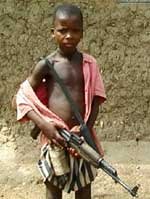
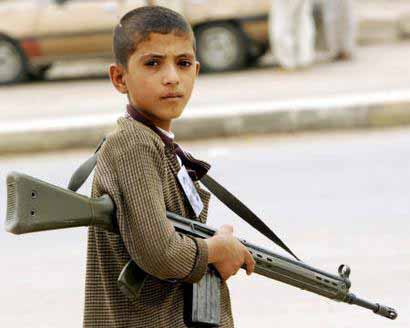
Remember, it is said that the most dangerous "soldiers" are child soldiers, more specifically, 6-year old boys with guns. Why? Guns are toys to 6-year old boys, and "killing" people is fun because they have not yet grasped the finality of death. So immersing them into a virtual reality of "kill or be killed" will almost certainly prepare them for the military, making it much easier to condition these young men to kill, especially when situated 7,000 miles away, in what appears more like a theater of war, where the victims are reduced to the status of players in a video game, shielded from the dismembered body parts in the aftermath of strikes, rather than plunged into the blood and guts warfare of the front line.

In a nutshell, movies, books, television, and most disturbingly of all, violent video games, condition concepts of profit, status, technology/technological development, violence, and/or anything that defines our materialistic, scientific world trumps humanity every time.

Army crack

"You don't have to be a qualified fighter jet pilot anymore to be allowed to fly these things - or an officer. Thousands of young enlisted soldiers - many as young as 18 - are being trained to fly these aerial vehicles and the US military just can't get enough of them.

"Is it a bit like playing a video game?" I asked as I handled the joystick. It is they admitted - although everyone was at pains to stress that doesn't mean they don't take their job seriously.

Even the trainer admitted its easier to teach the "video game generation" and told me that all those hours they'd spent in their bedrooms - being nagged by their mothers to do something more productive - was now paying off.
"Is it a bit like playing a video game?"
The US military are now so addicted to the use of these drones they call them "army crack". One hit and you are hooked they say. Ground forces now don't want to leave their bases in Iraq and Afghanistan without those "eyes in the sky" above their heads.
So is "Ender's Game" really science-fiction? Maybe when it was written, but certainly not now. The book’s premise—that training children for war through  playing video games —has left the realm of science fiction and has,  in fact,  become a reality.

Links:

“Zero Dark Thirty” And The CIA's Hollywood Coup

Read more...

Saturday, May 02, 2009

300,000 Child Soldiers Simply Dream of Being Children

Read more...

Wednesday, June 25, 2008

What do Gecko Band Aids Have to do with Mental Health Care, Child Soldiers and the Third World?

Just as two beings must intertwine in order to produce another complete being, physical and mental health must intertwine in order to produce a healthy state of wellbeing. The exclusion of one type of health care - physical or mental - is detrimental to type of care.

Although, it may be true physical health issues are usually more urgent and life threatening, the overall health of the individual cannot be maintained without both. Poor mental health can affect everything in society from the labor force, economic infrastructure and crime rate to the quality of life and interpersonal relationships.

Good health care of any kind is expensive and hard to obtain among the poor all around the globe. In the United States, with almost half of our population uninsured or under-insured, health care, although conducive to pleasure and comfort, is obviously considered by many as inessential. And as for mental health care? Even less essential as mental health parity has a long way to go. Federal law still allows insurers to discriminate between physical and mental illness by allowing them to set higher co-payments and/or stricter limits on mental health benefits.

Bearing in mind the richest country in the world, "US", is just starting to emerge from the dark ages regarding mental health, it is "reasonable" to assume mental health care is non-existent in the third world. The West African country of Sierra Leone, one of the poorest countries in the world, has one psychiatrist per five million people...so; yes, mental health care is, for all practical purposes, non-existent in third world countries.

Back to the third world countries. Nearly eighty percent of all fighters in Sierra Leone's decade-long civil war were aged seven to fourteen. These children were kidnapped, forced into the fighting and made to perpetuate the worst atrocities imaginable. They were typically provided with mind-altering drugs. Some were forced to snort a mixture of cocaine and gun powder to lower inhibitions against violent behavior and firearms in order to carry out the mission of their soulless leaders.

In Uganda, Lord’s Resistance Army (L.R.A.) rebel leader Joseph Kony kept child soldiers in line by forcing cannibalism on them, forcing them to kill each other, kill the weakest in the group, using them as mine detectors and amputating limbs.

Many of these children were forced to go back into their villages to amputate the limbs of family members so that they would not be allowed back into their family, to ensure they would remain outcasts.

"The rebels told me to join them, but I said no, then they killed my smaller brother. I changed my mind." a child soldier quoted in Peter Singer's book Children at War
How can a country begin to rebuild with so many of its citizens shaped and socialized in what can only be called, Hell? A brutal environment, completely devoid of humanity, where young, innocent, obedient, trustful, beings with limited understanding, easily indoctrinated, play both the role of perpetrator and victim.
When I was child. I spake as a child, I understood as a child, I thought as a child; but when I became a man, I put away childish things. --1. Cor. xii. 11.
What do these children do when they become "men"? What kind of mental health care could possibly erase the deeply embedded scars "permanently" etched on the soul and psyche of each one? The task seems insurmountable, like using a box of "Dora the Explorer" or "Sponge Bob" band aids to close a person up after open heart surgery.

Currently, the one psychiatrist administering to five-million people and the few people that are given one day of mental health training are equivalent to applying the "Dora the Explorer" band aids in surgery or to cover a bullet hole, in other words, totally useless. However, upgrading from "Dora the Explorer" to let's say, Gecko ultra sticky "internal band-aids" with glue that coats the underlying structure designed to stick to living tissue might just be doable.

Dr. Suzan Song is a psychiatrist working with the Harvard School of Public Health to deliver mental health care to these adolescents in Sierra Leone.

Read more...

Monday, April 30, 2007

U.S. Provides Military Assistance to Eight out of Ten Countries that use Child Soldiers.

Around the world, an estimated 250,000 children are exploited in state-run armies, paramilitaries, and rebel groups. Serving as combatants, porters, human mine detectors, and sex slaves, their health and lives are endangered and their childhoods are sacrificed.

World Vision works in several countries where children are forced to be soldiers and is calling on the U.S. government to help stop the use of child soldiers.

Ten Countries Use Child Soldiers

Although many child soldiers are found in non-governmental armed opposition groups, the U.S. State Department reports that governments in nine countries are implicated in child soldier use.

The U.S. government provides military assistance to eight of them. They include:

* Burundi
* Chad
* Colombia
* Cote d’Ivoire
* Democratic Republic of Congo
* Sri Lanka
* Sudan
* Uganda

U.S. military assistance to these countries ranges from small amounts of funding for military training to hundreds of millions in weapons, training, and military financing.

Read more...

Wednesday, February 07, 2007

Nations Pledge Not to Use Child Soldiers.


PARIS — African, Asian and South American nations where child fighters have been used in war endorsed a new international agreement Tuesday that commits them to stopping the practice and punishing those who recruit youngsters as combatants.

Some nations hailed the text, which carries moral but no legal weight, as a breakthrough. But others said it may be no more than empty promises and that more than words are needed to rehabilitate children mentally and physically scarred by war.

"We've lost a whole generation of children," said Liberia's deputy minister of education, Hawa Goll-Kotchi. "It's scary."

Sierra Leone, Liberia, Congo, Sri Lanka, Colombia, Sudan and Somalia — just some of the nations where children have been recruited as fighters — were among nearly 60 countries that approved the so-called Paris Commitments, although it was not formally signed. All 27 nations of the European Union also endorsed the text. The United States did not, and American officials in Washington couldn't immediately be reached for comment.

At least 250,000 boys and girls are believed to still be fighting in about a dozen conflicts worldwide, according to the United Nations. They are used as soldiers, messengers, spies and porters and sometimes forced to provide sexual services.

The document requires its backers to "spare no effort" to end the use of soldiers younger than 18 and stipulates that countries must demobilize underage fighters, even during wartime. It also says that anyone who recruits children may not receive amnesty under peace agreements.

Ivory Coast's foreign minister, Youssouf Bakayoko, called the pledge a "breakthrough."

"Countries will now have to do their all to make sure this text is respected," he told The Associated Press.

Ivory Coast was one of seven countries monitored under a 2005 U.N. Security Council resolution aimed at preventing child recruitment. The West African nation has been split between the government-controlled south and rebel-held north since a failed coup in 2002 sparked a civil war.

French Foreign Minister Philippe Douste-Blazy insisted the document is more than just "good words" and "will have a great political value."

Others were less optimistic.

Former child soldier Ishamel Beah, who made an emotional appeal Monday for strong action to keep children from returning to battle, told AP he fears the text will prove just more "empty promises."

"It's more concrete than past documents and that's good, but I'm worried it won't be properly applied," said Beah, who at 13 joined an armed faction after his mother, father and two brothers were killed in Sierra Leone's civil war in the 1990s.

On Monday, the now 26-year-old Beah told delegates from 58 countries and about 100 international agencies and non-governmental groups that once he started fighting, "taking a gun and shooting someone was as easy as drinking a glass of water."

He pleaded for rehabilitation programs to help former child soldiers recover from the trauma of the battlefield. Beah himself went through such a program in Sierra Leone's capital. He now lives in New York and has written a book about his experiences.

Participants at the conference also drafted another text — a guideline that gives governments, aid groups and educators concrete recommendations on how best to prevent the recruitment of children and reintegrate former child soldiers into society.

The 31-page document urges caregivers to try to rekindle former fighters' family bonds and offer a wide range of educational and vocational training, from literacy classes to apprenticeships.

Goll-Kotchi, the Liberian deputy minister, said the guidelines are a good step but she is skeptical about the recommendations and holds little hope for rehabilitating many former fighters.

She said Liberia, which is recovering from a 1989-2003 civil war, is grappling with how to return former child soldiers to civilian life. Reinsertion programs like those recommended in the guidelines often create more problems than they solve, she said.

"In communities where the former child soldiers are going through rehabilitation there's a lot of resentment, because people think it's unfair these kids are being rewarded for killing and destroying property while their children get nothing," Goll-Kotchi said.

An estimated 95,000 former child soldiers have taken part in recent demobilization programs in countries from Asia to Latin America, including Afghanistan, Haiti, Somalia, Sri Lanka and Congo.

The recommendations also focus on strategies to help girls, who account for nearly 40 percent of recruits in certain armed groups and are particularly vulnerable to sexual abuse, conference organizers said.

Such girls are frequently rejected by their families and have an especially hard time returning to society. They also have regularly been overlooked in prior rehabilitation programs the world over, organizers said.

As a way of combatting such treatment, the guidelines recommend hiring female staffers throughout the rehabilitation process and making reproductive health care facilities available at rehab sites.

Last week, the International Criminal Court took up the issue of child soldiers by ordering Congolese warlord Thomas Lubanga be tried on charges of recruiting children and sending them to kill and be killed in a bloody tribal conflict. The court, set up in 2002, has expanded its definition of war crimes to include the drafting of children under age 15 into armed conflict.

Read more...
Iraq Deaths Estimator
Petitions by Change.org|Start a Petition »

  © Blogger templates The Professional Template by Ourblogtemplates.com 2008

Back to TOP