Showing posts with label cyber. Show all posts

Monday, February 18, 2013

Resubmitting CISPA Under the Guise of National Security

Imagine, if you will, an Internet surveillance grid of the future that includes an Internet ID system, Internet licenses, Internet blacklists, an Internet taxation system, giant firewalls used as a blockade to information, etc. Imagine biometric gate-keeping sensors that control and watch everything you do on the Internet. Imagine being accountable and responsible to the Big Brother Internet. This might sound far out, but that's what DARPA had in mind when they created the Internet. Now, they just need the legislation in place to make it happen. What's more is that the same tech corporations that claim they believe in an open Internet and online freedom--Facebook (who overtly supports CISPA) Google, Yahoo, etc.-- will aid and abet the government when it comes time to install these restrictions. However, the powers that be, know that in order to accomplish this goal, they must gradually increase the heat on the proverbial pot of water, rather than switch it to boil right away.

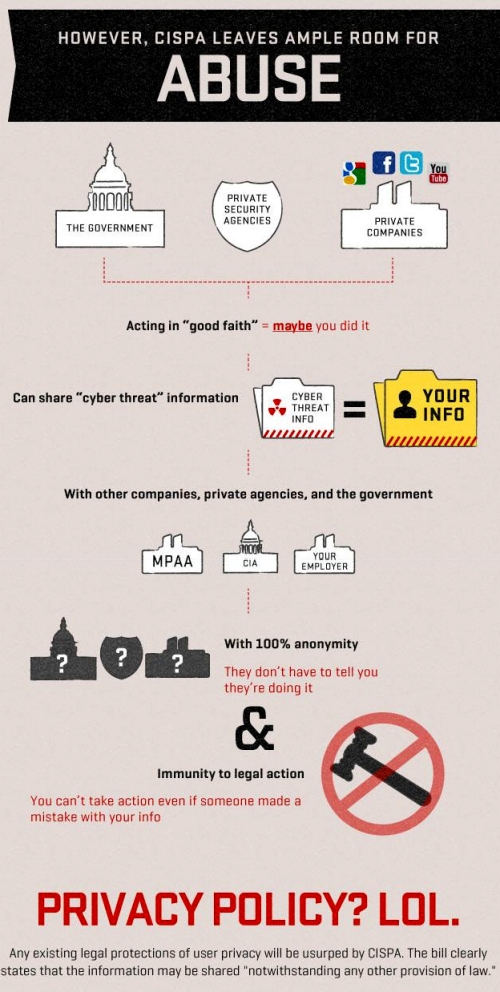
Which brings us to the latest State of the Union address, where President Obama said he signed an executive order to strengthen the nation's cyber defenses by increasing information sharing and by developing standards to protect our national security, our jobs and our privacy. Sure, on the surface, that sounds good, because, of course, our national security infrastructure should be protected. But, guess what? It already is. I mean, do you really think our national security infrastructure is available online...on the same Internet, we the people, surf? Hell no! So what is this CISPA (Cyber Intelligence Sharing Protection Act) legislation the Obama administration claims must be passed to secure our networks and prevent attacks? Well, it basically provides a framework of legal authority to, for example, give the "trustworthy" corporations, immunity from their actions. In fact, the text of this legislation states that private information may be shared "notwithstanding any other provision of law."
You know, provisions of law like the the Fourth amendment.

Anyway, the very next day, after the State of the Union address, Mike Rogers, chairman of the House Intelligence Committee, along with other members of Congress resubmitted CISPA--a rehashed version that has not been released yet. Yes, the one that failed to reach the Senate during the last Capitol Hill session. The problem is that the language of this bill is so vague and so broad that once this framework is put in place, the potential to destroy our civil liberties--yes, even more than they've already been destroyed--is boundless, possibly resulting--at some time in the future-- in the aforementioned scenario.

As President Obama told us, he has already signed the executive order to lay the groundwork for the cooperation between the private and the public sectors, which like I said before, gives full immunity to the private sector, so if the private sector uses your information for whatever reason, you cannot sue them. And it's not just the government that has an interest in eliminating what's left of "freedom" on the Internet. The large corporations want to control what information is allowed to flow on the internet as well. They too don't want disgruntled consumers, dissenting opinions, whistle blowers, and fact checkers alerting the public of their nefarious activities. The bottom line is this bill is not about security, this is all about the wealthy and powerful struggling to maintain the status quo, to maintain their place of privilege and authority in a world that, given enough freedom, could severely threaten and/or undermine their sense of entitlement and position of great advantage.

"Shall the throne of iniquity have fellowship with thee which frameth mischief by a law." -- Psalm 94:20

From CISPA is Back:


Read more...

Tuesday, July 12, 2011

U.S. Wants to Build New Safer Internet Infrastructure

Say good-bye to anonymity. The US is seriously considering building a new Internet infrastructure to prevent cyber attacks.


General Michael Hayden’s presentation begins at approximately 42:20 into the video.

Several current federal officials, including U.S. Cyber Command chief Gen. Keith Alexander, want a “.secure” network for critical services such as banking that would be walled off from the public Web. Unlike .com, .xxx and other new domains now proliferating the Internet, .secure would require visitors to use certified credentials for entry and would do away with users’ Fourth Amendment rights to privacy. Network operators in the financial sector, for example, would be authorized to scan account holders’ traffic content for signs of trouble.

Nations with fewer civil liberty protections, including China, use “deep packet inspection” to search all Internet traffic for viruses — as well as anti-government content, noted James Mulvenon, a China and cybersecurity specialist. Due to privacy laws, the United States cannot monitor private network traffic using this approach. Mulvenon questioned whether such restrictions give other nation states the upper hand in cyber defense. “We still believe that anonymity is possible,” he said of America’s attitude toward freedom of expression on the Internet.

Read more...

Tuesday, August 03, 2010

Wikileaks Julian Assange: Hero, Egomaniac or a Little of Both?

Daniel Ellsberg, the prime player in the release of the Pentagon Papers  in 1971, who was a true hero, not only because he exposed the truth of the Vietnam war, but because he did so with the knowledge he could face the rest of his life in prison is a fan of Wikileaks.

John Nichols of Capital Times interviewed Daniel Ellsburg last month.  He said that "Ellsburg is a fan of WikiLeaks, in particular, and whistle-blowers, in general. He argues that WikiLeaks founder Julian Assange “is serving our democracy and serving our rule of law precisely by challenging the secrecy regulations, which are not laws in most cases, in this country.”

“I felt that as an American citizen, as a responsible citizen, I could no longer cooperate in concealing this information from the American public.” -- Daniel Ellsberg as he surrendered to authorities in 1971
Julian Assange, founder of Wikileaks, like Ellsburg, exposed 92,000 documents that may call into question America’s policy toward Pakistan and Afghanistan. Assange also believes he and/or Wikileaks may be in danger, as Wikileak's servers are located in different countries, and there is no headquarters. As for Assange, he never stays in one place, depending on the goodwill of people around the world to lend him a sofa to sleep.


Is Wikileaks, as it claims,  "a multi-jurisdictional organization to protect internal dissidents, whistleblowers, journalists and bloggers who face legal or other threats related to publishing" whose  primary interest is in exposing oppressive regimes in Asia, the former Soviet bloc, Sub-Saharan Africa and the Middle East... assistance to people of all nations who wish to reveal unethical behavior in their governments and corporations?

Or as others claim, is Wikileaks  part of a U.S. cyber-warfare and computer espionage operations?  Or a CIA front?  A stalking horse for George Soros? Next to secrecy, authoritativeness is the most dangerous to an open society, and Wikileaks "sells" both.

In January 2007, John Young, who runs cryptome.org, a site that publishes a wealth of sensitive and classified information, left Wikileaks, claiming the operation was a CIA front. Young also published some 150 email messages sent by Wikileaks activists on cryptome. They include a disparaging comment about this editor by Wikileaks Dr. Julian Assange. Assange lists as one of his professions "hacker." His German co-founder of Wikileaks uses a pseudonym, "Daniel Schmitt."
"Those who get the truth to the American people show better judgment in putting it out than the people who keep it secret from the American people.” - Daniel Ellburg

Read more...

Thursday, May 28, 2009

President Obama Will Choose Cyber Czar.

Tomorrow, after President Barack Obama releases the final report following a 60-day review of U.S. cyber security policy, he will announce the creation of a "cyber czar" position, in order to protect the nation's computer networks living up to his presidential campaign pledge to
"elevate the issue of cybersecurity to a "top priority" and to appoint a national cybersecurity adviser "who will report directly to me."

Read more...
Iraq Deaths Estimator
Petitions by Change.org|Start a Petition »

  © Blogger templates The Professional Template by Ourblogtemplates.com 2008

Back to TOP