Showing posts with label death row. Show all posts

Monday, August 21, 2017

Meet the Should Be Exonerated: Crosley Green

Crosley Green
Update: (August 19, 2017):

Despite a mountain of evidence that proves Crosley Green's innocence, in January 2016, due to a trivial procedural technicality (one day late), Green's petition for a new trial was denied. So, in other words, 59-year old Crosley Green could stay in prison for the rest of his life even though there is very clear evidence of his innocence and very clear evidence that he should never have been convicted in the first place.
"People are alarmed to find out that courts have no problem at all saying you filed one day late… we're gonna use that as a basis to keep you in prison for the rest of your life not withstanding the fact that you can prove a clear miscarriage of justice," -- Seth Miller, runs the Innocence Project of Florida.

And then, in June 2017,the 11th Circuit Federal Court of Appeals will allow Green's attorneys to argue in person why his case should not have been dismissed. If the three-judge panel agrees, Crosley Green will finally get his case heard in federal court.

Please watch the the most recent 48 Hours episode which also features three similar cases of wrongful convictions from Brevard County Florida in the 1980s that were subsequently overturned.

Please sign this petition for clemency (or new trial) on Change.org.


-----------------------------------------------------------------------------------------------------

Something new and different, a Florida man convicted for murder and sentenced to death simply because he was black. As attorney, Keith Harrison said, "an example of race being a substitute for evidence,race substituted for evidence.

For more than 16 years, 48 Hours has investigated the case of the 1989 murder of 22-year old Charles "Chip" Flynn because they believed it involved prosecutorial misconduct, which resulted in the conviction of Crosley Green (left) who was later sentenced to death, an absolute travesty of justice not uncommon as I have documented repeatedly.

It all began on April 4, 1989 when Flynn's former girlfriend, Kimberly Hallock called 911 saying she thought her boyfriend had been shot by a a black man with a gun who had hijacked and drove them to a remote Florida citrus grove. Keep in mind, this black guy would've had to steer and shift gears all while he was holding the gun on them. Oh, and after her ex-boyfriend, with his hands tied behind his back, grabbed a gun and shot the assailant, she alone managed to get back into the truck and escape.

Despite a story that kept changing, littered with troubling inconsistencies:
  • Crosley didn't match the original description of the assailant;
  • ex-girlfriend waiting almost an hour to call for help;
  • a truck that was hard to handle because it had a custom gear shift;
  • shoe prints that did not match...that tracked in different direction than testimony indicated;
  • no gun powder residue on Flynn's hands; no shell casings from Flynn's testified to gunshots;
  • no bare footprints or knee prints of either Flynn and Hallock at scene
  • witnesses who later said they were coerced into testifying recanted their testimony
  • a police dog, despite not having an item of Green's to scent upon, somehow connected him to the crime scene
  • no fingerprints or any physical evidence that linked Green to the crime
  • ten alibi witnesses who place Green miles away from the murder,
Crosley Green was arrested and charged with kidnapping, robbery and murder. It took the all-white jury just three hours to convict Crosley Green; the judge sentenced him death.

Crosley Green, top row center, target with a bull's eye...the black spot you focus on.
That's a target with a bull's-eye for Crosley Green. ...His picture is smaller and darker than the other pictures," Harrison said of the photo lineup. "Anybody involved in police investigation and prosecution knows this. ...the position that your eyes are normally drawn to are right in the middle."

"It's a black spot," Green said of the photo. "That's what you focus on, that black spot." [...]
When I went to homicide school ... they told us that this spot is the most likely that someone will pick a picture from," Mark Rixey said of the photo lineup.

"And where exactly is Crosley Green in that--"

"That's Crosley Green right in that spot," Green said, pointing to the second of three images in the top row.

"Anything that strikes you about this lineup?" Moriarty asked Christopher White.

"You can't see the guy in the top middle very well at all," he replied. "Crosley Green's photo is the darkest."

"If you don't specifically know who you're looking for, then that's the spot you will pick nine times out of 10," said Rixey.
And why was Kim Hallock eliminated as a suspect when it's normal procedure to investigate the last people to see victim alive...everyone closest to the scene? No one knows.
That's homicide 101, anybody who is present at the scene of a shooting ... gets their hands tested for gunshot residue," Rixey explained. "That should have been the very first thing that was done. ...That was never done."
Moreover, the Brevard County State's Attorney's Office had a history of pressuring, coercing witnesses into lying. In the 1980s, Brevard County put away three men whose convictions have since been overturned.
They coerced witnesses ... to lie and it's really as though you see -- a deliberate pattern of the state creating evidence to achieve a result that they wanted to achieve and that's what they got," said Jeane Thomas.
In 2009, Green received a reduced sentence (life in prison)  due to an error in sentencing. In total, Crosley Green has spent almost 26 years incarcerated for a crime he did not commit.  Three witnesses recanted their testimony. 
Every witness recanted their story," Moura explained. "And every one of them had reason to be afraid of the police. ...They were squeezed. ...And they were squeezed hard."
As it stands now, undeterred by exculpatory evidence withheld by the prosecution, the recantations of four of the prosecution's star witnesses, not to mention, more inconsistencies than a government's official story, the Florida Attorney General's Office is fighting to uphold Crosley Green's conviction. It says Green failed to meet a filing deadline for his appeal.

Links:

Investigators say condemned man not guilty

Former Florida Death Row Inmate Crosley Green Asks Orlando Federal Court To Overturn His Conviction: Crowell & Moring Files Habeas Corpus


Read more...

Thursday, February 06, 2014

The Science of Killing a Human Being.

In the documentary below, former Conservative MP, Michael Portillo pushes his body to the brink of death in an investigation into the science of execution. At the very beginning he states, "If the state's going to kill people, you want to do it as humanely as possible, I think most people agree on that." I'm not so sure. From my very limited perspective, I think the man who invented the lethal injection protocol, Dr. Jay Chapman's response,  "My basic attitude is so they suffer a little pain, who cares?" might just be the attitude shared by most.

Of course, as I've stated repeatedly, I do not believe in the death penalty under any circumstances, but if the state insists upon executing people, the least they could do is spare the doomed individual as much pain as possible. As I have also stated many times before, I think the lethal injection protocol is, as they say in the film "torture disguised as a medical procedure." And that's whether they carry it with two or three drugs. I mean, just imagine not getting enough of the drug that is supposed to cause unconsciousness, before getting the paralyzing drug (most likely used for aesthetic reasons) that renders you unable to signal your distress, followed by a heart-stopping drug, which "feels like a fire traveling through the vein to the heart.” The chance of this occurring is extremely high because it is administered by ill-trained staff.  After all, doctors and nurses are supposedly bound by the "Hippocratic Oath" or take a pledge to do no harm.

It's not just a lack of expertise that contribute to the controversy over lethal injection; it's the second drug in the cocktail: pancuronium bromide, the paralyzing agent  Carol Weihrer, who has testified in 15 court cases against lethal injection, knows all too well the pain this drug can cause. During a routine eye operation, in which she was given anesthesia and then pancuronium bromide, the anesthesia failed to work, leaving her fully aware of the excruciating pain as the pancuronium bromide coursed through her veins, but unable to tell anyone or move. She said if felt like "ignited jet fuel going through your body feeling like you're absolutely on fire." Carol believes that most executed inmates go through the same experience as she did.  She states that the anesthetic used in the lethal injection protocol is  "short-acting, five minute version" and that that lethal injection "takes between 10-12 minutes on a good day."  In other words, the inmate is put out for a couple of minutes, and then conscious, thus feels the pancuronium bromide painfully charge through their veins without being able to alert anyone and dies from suffocation before their heart is stopped.

One example:

Angel Diaz
On December 13, 2006,  Angel Diaz took more than a half-hour to die and required a second dose of the chemicals. After the first injection, he continued to move and was squinting and grimacing as he tried to mouth words.  The medical examiner stated that the needle had gone through Mr. Diaz's vein and out the other side, so the deadly chemicals were injected into soft tissue rather than the vein.


Read more...

Monday, January 27, 2014

Update: Is There a Difference Between Capital Punishment and Human Sacrifice?

Update::  Dennis McGuire surpassed the projected five minutes--experiencing the "agony and terror of air hunger as he struggles to breathe for five minutes after [executioners] intravenously inject him with the execution drugs"--before he loses consciousness and expires--his lawyers said it would take to die,  It took 15 minutes for him to die, as he "gasped, snorted and snored during a prolonged execution" from "air hunger" on January 16, 2014, when the state used the controversial, never-before-tried lethal injection after supplies of the state's previous drug dried up.

The 53-year-old's attorneys had argued against using intravenous doses of the sedative Midazolam and the painkiller Hydromorphone, claiming the combination would cause 'air hunger' - where someone experiences immense terror and agony as they strain for breath during the execution."
[...]
He was then still for five minutes before emitting a loud snort as if snoring and continued to make this noise for several minutes. His stomach rose and fell several times as he repeatedly opened and shut his mouth, making what the Columbus Dispatch described as 'deep, rattling sounds.'

His family sobbed as they watched him slowly die. At one point, his daughter exclaimed 'Oh my God' as she observed her father's final moments.

A coughing sound was Dennis McGuire's last apparent movement, at 10:43 a.m. He was pronounced dead 10 minutes later. McGuire as first injected with the drugs at 10:29 a.m."
Why can we put a dog/cat to death in less than 10 seconds but can't seem to do it when it involves putting a human-being to death. The answer is we can but the sequence of the "lethal cocktail" that enters the body is designed to provide the condemned with a feeling of terror, otherwise why not just inject a general anesthetic followed by whatever it is that stops the heart immediately?

Moreover, McGuire's children watched their father die in such an inhumane and terrible way. They weren't to blame for his crimes but they will now suffer with flashbacks of his horrible death until their last days. Even the victim's family may suffer--if not from watching this man's terrible death--from the memories of his children's reactions. I mean, people who takes enjoyment or satisfaction from this man's suffering only makes them as barbaric as the people they claim deserve this type of suffering.

Make no mistake, Dennis McGuire was guilty for the 1989 rape and fatal stabbing of Joy Stewart and her unborn baby in Preble County in western Ohio. His victims suffered unimaginable terror. However, revenge has no place in a truly civilized system of justice, because not only does the outcome contribute to an unending cycle of violence, its example teaches the public that malice, retaliation, and violence are appropriate means of handling problems. In other words, when government goes beyond the steps necessary to protect society, and sinks to the level of using vengeance and hatred, the wrong message is sent, and the results are demeaning and destructive.

Judge Rules 'Not Entitled to Pain Free Execution'.

Over the past six years, six states — Maryland, Connecticut, Illinois, New York, New Jersey and New Mexico — have done away with capital punishment, but one state in particular, Ohio, is planning to go through with a never-before-tried combination of two drugs, which defense lawyers say threatens to leave convicted murderer and rapist, Dennis McGuire, 53, writhing in agony from “air hunger”--"McGuire will experience the agony and terror of air hunger as he struggles to breathe for five minutes after [executioners] intravenously inject him with the execution drugs"--before he loses consciousness and expires. This  "death chamber 'experiment' by the state" will occur on Thursday, January 16, 2014.

Why only two drugs? Well, it's becoming harder and harder to get the three drugs needed for the three-drug cocktail used in lethal injection. Many of these drugs are manufactured in Europe, where opposition to the death penalty has led to a ban on exporting drugs for that purpose, according to the Death Penalty Information Center's (DPIC) report. This has led to states — including Ohio — turning to compounding pharmacies, which were not regulated by the U.S. Food and Drug Administration until November 2013.
Ohio and other death penalty states have been struggling to keep executions going because supplies of pentobarbital traditionally used in a three-drug mix have all passed their sell-by dates thanks to its Danish manufacturer prohibiting its sale to US prison services. The European Union has also threatened to restrict sales of Propofol, a leading anaesthetic used in hospitals, were US death chambers to use it instead."
I feel my whole body burning.

So  how are we to determine what is "cruel and unusual punishment?"  What about experiencing "air hunger" for five minutes that probably feels like five hours or more?   And what about the execution in Oklahoma last month, where about 20 seconds into the execution of Michael Lee Wilson, he uttered “I feel my whole body burning?” Potassium chloride, which is used to stop the heart, is known to cause an excruciating burning sensation should the prisoner be partially conscious at that stage, but because execution records are normally shrouded in secrecy, the precise cause of Wilson's apparent agony will never be known.

These are only a couple examples of many, yet, we claim to live in a civilized society.  DNA has proven that our "justice" system too often convicts the innocent,  not to mention the economic cost of capital punishment to society  is astronomical, so how can anyone claim state sanctioned murder is in anyway beneficial, except maybe to those who still believe in human sacrifice...because that's exactly what it is.

Outrageous, you say?

Well, the practice of human sacrifice is as old as humanity.  The oldest recorded human sacrifice dates back to somewhere between 3,700 and 3,400 BC. and, more than likely, even dates further back than that.  Yet, despite the Eighth Amendment that bars "cruel and unusual punishment"which “must draw its meaning from the evolving standards of decency that mark the progress of a maturing society,” here we are, more than 5,000 years later, supposedly the most civilized of societies, sacrificing humans--the majority of them, poor people of color--on the altar of so-called "justice" and social order.  So it follows, just as it was believed  thousands of years ago that the ancient gods  demanded human blood to pacify and appease, the same must hold true today.  The modern day secular "gods" of justice are just as bloodthirsty as their ancient counterparts, because  even if you eliminate the morality issue, the highly ritualized practice of state sanctioned execution offers no additional benefit to society that would justify its use.  It is more expensive than life in prison.  It is not a necessity or an additional deterrence for the prevention of crime and needless to say, but I'll add it anyway, it's not rehabilitative!

Then, there is the arbitrary way in which it is applied.  The only rhyme or reason to its application is that it's almost exclusively administered to the most marginalized members of society, while men of means who are convicted of sometimes much greater crimes almost always escape the gallows

Read more...

Friday, June 14, 2013

Meet the Exonerated From Death Row Updates Alabama through Louisiana


Daniel Wade Moore [Alabama Conviction: 2002, Acquitted: 2009]  spent six years on death row for a crime he did not commit.  He was acquitted of all charges by a jury in Alabama on May 14. .

Moore was originally found guilty of the murder and sexual assault of Karen Tipton in 2002. The judge overruled the jury’s recommendation of a life sentence and instead sentenced him to death in January 2003, calling the murder one of the worst ever in the county.

A new trial was ordered in 2003 because of evidence withheld by the prosecution. (See State V. Moore, No. CR-04--0805, Ala. Ct. of Crim. App. (2206) (providing procedural summary at pp.2-3; the circuit judge's order for a new trial was upheld by the Ala. Supreme Court, State v. Moore, No. Ms. 1030218, Nov. 6, 2003)). A second trial in 2008 ended in a mistrial with the jury deadlocked at 8-4 for acquittal.

Judge Glenn Thompson, who originally sentenced Moore to death, ordered a retrial upon discovery that the prosecution had withheld important evidence. "Orders were entered in any capital case, that whatever the state has, whatever the prosecutor has, whatever the investigation has they should provide that to the defendant," said Judge Thompson. The evidence missing was a 256-page F.B.I. report.
The prosecution, Mr. Valeska specifically, looked me in the eye and said, quote, 'there ain't no such thing as an F.B.I. report.' Well, there probably wasn't a report, but there were 256 pages of information collected by Decatur police officers that were sent to the F.B.I.," -- Judge Thompson
According to Judge Thompson, Assistant Attorney General Don Valeska later came to him confessing there was withheld information. "Mr. Valeska came forward with the information after the conviction," said Judge Thompson. “Clearly, the only remedy was to grant him a new trial and I did," he said. "It frustrated and angered me that he would be willing to lie to the court," he continued.

Meanwhile, the Alabama Court of Criminal Appeals ordered Judge Thompson to stand down from the trial and continued to let Valeska prosecute Moore. Upon hearing the jury’s not guilty verdict, Judge Thompson responded, "I felt like it was the only conclusion that a jury could reach if they actually followed the law." Thompson also said that the problems with the prosecution withholding evidence continued throughout the 10 years of the case. Just days before the current trial started, the prosecution called the defense saying they had just found new evidence from the victim's home computer.


Seth Penalver, [Florida conviction: 1999, Acquitted: 2012] spent 13 years in prison, seven of which were on death row.

On December 21, Seth Penalver was acquitted of all charges and will be freed from Florida's death row, 13 years after being sentenced to death. He was originally charged with a triple murder and armed robbery that occurred in Broward County in 1994. His first trial ended with a deadlocked jury. At his second trial in 1999, he was convicted and sentenced to death. In 2006, the Florida Supreme Court (Penalver v. Florida, No. SC00-1602, Feb. 2, 2006) overturned his conviction because the prosecution had introduced improper evidence at his trial. A co-defendant, Pablo Ibar, was also sentenced to death and remains on death row. A video from the crime scene helped convict Ibar, but images showing another suspect were inconclusive. Penalver has always maintained his innocence. At Penalver's most recent trial, which began 5 months ago, the jury was deadlocked 10-2, and both the prosecution and defense agreed to replace two jurors with alternates who had attended the proceedings. The newly constituted jury began deliberations afresh and found Penalver not guilty of all charges. Penalver is the 142nd person to be exonerated and freed from death row since 1973, and the 24th such person in Florida, the most of any state.


Nathson Fields [Illinois Conviction: 1986, Acquitted: 2009] spent nearly two decades behind bars, including more than 11.5 years on Death Row for a crime he did not commit.

 Nathson Fields,  and a co-defendant were sentenced to death for the 1984 murders of two rival gang members. The original trial, however, was marred by corruption, as the the judge in the case, Circuit Judge Thomas Maloney, accepted a $10,000 bribe during the trial.

Thomas Maloney, who died in 2008, was ultimately convicted and spent 13 years in prison for fixing murder trials. As a result, Fields and co-defendant Earl Hawkins were granted new trials in 1998. Hawkins, who had admitted to killing 15 to 20 people, testified against Fields in exchange for a lesser sentence. However, at Fields' retrial, Judge Vincent Gaughan found Hawkins "incredible," saying that "If someone has such disregard for human life, what regard will he have for his oath?"

Fields spent almost twenty years in prison, including 11.5 years on death row. He was released on bond in 2003 while awaiting retrial and has been residing outside of Chicago. This is the 19th exoneration from death row in Illinois since 1973, which is second only to Florida in the number of exonerations.

Following the not guilty verdict handed down by Judge Gaughan, Fields said,
I feel like my prayers have been answered...It's been 24 years of this ordeal for my family and my friends, and now with it coming to an end, it's like a dream come true." -- Nathson Fields
(M. Walberg, “23 years after judicial misconduct, ex-gang leader freed," Chicago Tribune, April 9, 2009). (R. Hussain, Man formerly on death row acquitted in retrial,” Chicago Sun-Times, April 8, 2009). See also People v. Hawkins, et al., 181 Ill.2d 41 (January 29, 1998) (upholding a circuit court's reversal of Fields' and Hawkins' convictions).


Damon Thibodeaux [Louisiana conviction: 1997, Charges dismissed: 2012] spent 15 years on death row convicted for a crime he did not commit.

On September 28 2012, Damon Thibodeaux was freed from death row in Louisiana after an extensive investigation, including DNA testing and the cooperation of Jefferson Parrish District Attorney Paul Connick. Thibodeaux was sentenced to death for the 1996 rape and murder of his cousin. He at first confessed to the attack after a nine-hour interrogation by detectives. He recanted a few hours later and claimed his confession was coerced. In releasing Thibodeaux, Connick said, "I have concluded that the primary evidence in this case, the confession, is unreliable. Without the confession the conviction can't stand, and therefore in the interest of justice, it must be vacated."

Thibodeaux spent 15 years on death row in Angola. The reinvestigation of the case cost more than $500,000, an expense shared by the defense and prosecution. Regarding his early statement to the police, Thibodeaux noted, "They look for vulnerable points where they can manipulate you, and if you’re sleep-deprived or panicked, or you’re on something or drunk, it makes it that much easier to accomplish what they want to accomplish.... I was willing to tell them anything they wanted me to tell them if it would get me out of that interrogation room.”

Read more...

Wednesday, June 12, 2013

Meet the Exonerated: Massachusetts Death Row

Laurence Adams spent 30 years in prison--one of those years on death row--for a crime he did not commit. Adams escaped execution because Massachusetts had abolished capital punishment soon after he was sentenced.

In March 1974, Laurence Adams was convicted and sentenced to death as one of allegedly three men who had beaten, robbed, and killed a subway porter in Boston in 1972.

In March 1973, Harry Ambers confessed to the crime and implicated Adams along with his own brother, Warren Ambers as his accomplices. The Commonwealth of Massachusetts eliminated the death penalty one year after Adams’ conviction and his sentence was changed to life imprisonment.

Adams was further implicated in the murder by the testimony of Prosecution witnesses, Wyatt Moore and his sister Lynne (Suzie) Moore, who testified that Adams had admitted to committing the crime with the Ambers brothers. Exculpatory evidence in the files of the Boston Police Department was not revealed until decades later. This included the fact that Suzie recanted her trial testimony, admitting that she had testified to help get her brother out of jail. Wyatt was being held on serious felony charges, (and he was released the day after Adams’ trial). In fact, Wyatt Moore was in prison on the same date Adams allegedly confessed his participation in the crime to the Moores. Police further withheld a sworn statement from a witness who said that Harry Ambers had confessed that he and his brother Warren alone had committed the murder.

In May, 2004, the Superior Court Justice allowed a Motion for Postconviction Relief and ordered a new trial because records, witness statements, and police reports that had not been disclosed were considered newly discovered evidence. However, in June the district attorney announced that, “the state was dropping the case because witnesses are dead and physical evidence is lacking,” (Boston Herald, June 8, 2004, at 26). Adams was released after 30 years of incarceration.

Lawyer Johnson Massachusetts Conviction: 1971, Charges Dismissed: 1982
Lawyer Johnson was sentenced to death by an all white jury for the murder of James Christian, a white victim. In 1982, the charges were dropped when a previously silent eyewitness, Dawnielle Montiero, who was 10 years old when the murder was committed, says the real killer, Kenneth Myers, was the man who testified against Johnson in two previous trials, the state's chief witness as the actual killer.

Johnson has said all along that he was not at the scene, but in two trials could not prove it so he spent ten years incarcerated for a crime he did not commit.

In 1983, a bill was filed to obtain compensation for Johnson's wrongful conviction. (Commonwealth v. Johnson, 429 N.E.2d 726 (1982)).
In an interview yesterday in his mother's house, where he has lived since he was released in February on bail, Johnson said that "anger destroys," but still he is bitter about the legal system that twice convicted him, once to death, and once to life in prison. He accused prosecutors of manipulating both the jury and the testimony because they cared only about getting a conviction, not about the truth.

"It was a legal lynching," he said. The prosecution, he said, "fabricated and conspired" with Meyers. Both juries were all white; the murder victim was white, too, and Johnson, who is black, said the racial fears of the jurors were played on by the prosecution.

"I totally believed in the system of justice," he said. "My faith in the system is gone."
 
Louis Greco died in prison following a 1965 Chelsea murder conviction and was posthumously exonerated.

Louis Greco joined the Army before World War II, became a professional prizefighter, and was sent off to combat in the South Pacific. He won two Bronze Stars, a Purple Heart and came back disabled for life with a shattered ankle and no future in the ring.

With a sixth grade education, he did what a lot of broken-down fighters did in that era, he sold his muscle as an enforcer and worked as a repo man for the mob.

In 1965, Louis Greco and his co-defendants were convicted in the murder of a small-time hoodlum named Teddy Deegan in a Chelsea alley. The prosecution charged Louis Greco with being the shooter and the three others as accessories to conspiracy. Greco was sentenced to death, as were Limone and Tameleo.

Greco submitted himself to eight different lie detector tests administered by outside experts and passed all eight of them. He wasn't even in Massachusetts at the time of the shooting; he was in Florida. Judge Gertner would declare that the FBI had deliberately withheld exculpatory evidence at the 1968 trial: namely, that its star witness, a contract killer for the Mob, was telling considerably less than the whole truth. The Justice Department task force's discovered compelling new evidence that Greco and his co-defendants were actually innocent of the murder of Edward Deegan.

Peter Limone Massachusetts Conviction: 1968, Charges Dismissed: 2001
Thirty -three years after being convicted and sentenced to death for a 1965 murder, Peter Limone's conviction was overturned (Commonwealth v. Limone, 2001 Mass. Super. LEXIS 7 (2001)) and the case against him officially dropped.

The move came as a result of a Justice Department task force's discovery of compelling new evidence that Limone and his co-defendants Joseph Salvati, Henry Tamelo, and Louis Greco were actually innocent of the murder of Edward Deegan.

In 1968, all four were convicted and Limone was sentenced to die in Massachusetts' electric chair, but was spared in 1974 when Massachusetts abolished the death penalty and his sentence was commuted to life in prison. Salvati, who was released from prison in 1997 when the governor commuted his sentence, received word from prosecutors that they were dropping the case against him as well. Tamelo and Greco both died in prison.

At trial, the main witness against the four men was Joseph Barboza, a hit man cooperating with prosecutors, who later admitted that he had fabricated much of his testimony. The recently revealed FBI documents show that informants had told the FBI before the murder that Deegan would soon be killed and by whom, and a memorandum after the crime listed the men involved. Neither list included Limone, Salvati, Tamelo or Greco. (New York Times, 2/2/01 and Boston Herald, 1/21/01)

Henry "The Referee" Temeleo  was one of the founding members of the Boston criminal activities along with Phil Buccola and Joe Lombardo. Henry Tamaelo was also a member of the Bonanno Family and was the underboss of Family boss Raymond Patriarca in the 1950's till the end of the 1960's. In 1967 he and Patriarca were arrested for the murder of bookmaker Willie Marfeo. Before the trial's conclusion, Tameleo, along with Peter Limone, Louis Greco and Jospeh Salvati were indicted for the murder of Edward "Teddy" Deegan on March 12, 1965. In 1968, all four men were found guily of the Deegan murder in the Superior Court of Suffolk County, Massachusetts, and sentenced to death by the state. This penalty was later reduced to life in prison, where Tameleo died in 1985.

By 2000, all charges were dismissed against Tameleo and the other accused men, amid a flurry of accusations of a government frame-up and cover-up extending over thirty years. In 2007, a federal judge in Boston awarded damages of $101.7 million to the four men who were wrongly convicted for Deegan's murder in 1965 after Federal Bureau of Investigation (FBI) agents H. Paul Rico, Dennis Condon, John Morris, and John Connolly took affirmative steps to withhold evidence of their innocence in order to protect FBI informants Vincent Flemmi and Joseph Barboza. $13 million went to the estate of Enrico Tameleo, specifically his son, Saverio, as administrator of the Tameleo estate, and Tameleo's wife Jeanette.


Read more...

Tuesday, June 11, 2013

Meet the Exonerated: California Death Row

Update: 

Ernest (Shujaa) Graham . Shujaa Graham was born in Lake Providence, LA, where he grew up on a plantation. His family worked as share-croppers, in the segregated South of the 1950s. As a teenager, Shujaa lived through the Watts riot and experienced the police occupation of his community. In and out of trouble, he spent much of his adolescent life in juvenile institutions, until at age 18, he was sent to Soledad Prison. In 1961, he moved to join his family who had moved to South Central Los Angeles, to try to build a more stable life.

In prison, Shujaa, mentored by the leadership of the Black Prison movement, he taught himself to read and write, and studied history and world affairs, becoming a leader of the growing movement within the California prison system, as the Black Panther Party expanded in the community.

In 1973, Shujaa was framed in the murder of a prison guard at the Deul Vocational Institute, Stockton, California. As a recognized leader within and without the prison, the community became involved in his defense, and supported him through four trials. Shujaa and his co-defendant, Eugene Allen, were sent to San Quentin's death row in 1976, after a second trial in San Francisco.

Shujaa spent three years on death row, but he and Eugene Allen continued to fight for their innocence. A third trial ended in a hung jury, and after a fourth trial, they were found innocent in 1979, after discovering that the District Attorney excluded all African American jurors, the California Supreme Court finally overturned the death conviction. As Shujaa often says, he won his freedom and affirmed his innocence in spite of the system. He was released and exonerated in March, 1981, and continued to organize in the Bay area, building community support for the prison movement, as well as protest in the neighborhoods against police brutality.

In the following years, Shujaa moved away from the Bay area. Shujaa learned landscaping, and created his own business. He and his wife raised three children, and became part of a progressive community in Maryland.

In 1999, Shujaa was invited to speak about his experiences on Death Row at fund raiser for the Alabama Death Penalty project, sponsored by the New York Legal Aid Foundation. This was a new beginning, and provided Shujaa the opportunity to begin to tell his story, his experiences and grow through work with other death penalty opponents.

------------------------------------------------------------------------------------------

Oscar Lee Morris was wrongly convicted of murder in 1984 and sentenced to death. He spent six years on death row and re-sentenced to life in prison in 1990 and was finally freed in 2000 after 16 years in prison.

Early on the morning of September 3, 1978, William Maxwell was shot to death at a Long Beach, California bathhouse, which was known to be a popular meeting place for homosexuals. Police arrived at the scene moments after the shooting, and questioned a witness who saw the back of the shooter, but no one was arrested.

Several months later, a man named Joe West contacted the police to tell them that his friend Oscar Lee Morris had murdered Maxwell. West said he had dropped Morris off at the bathhouse that day and given him the murder weapon; he claimed Morris said he “had to kill” a homosexual. West had known Morris since childhood, and the two men had a falling out shortly before West went to the police. Police began investigating Morris, but in 1979 the detectives were pulled from the case, and it was mistakenly filed as a closed case. Investigation came to a halt until 1982, when Joe West was arrested for auto theft and joyriding. He once again told police that Morris had killed Maxwell. Morris was charged with Maxwell’s murder shortly afterwards.

West was the key witness for the prosecution at Morris’s trial. He testified that he received nothing from the state in return for his testimony, though it was later revealed that in fact West’s sentence for an auto theft charge had been reduced and his sentence for a parole violation had been terminated. Morris was convicted of first-degree murder and sentenced to death in March 1983.

In 1988, the Supreme Court of California reduced Morris’s death sentence to life without parole, finding that there was no evidence that the murder had been committed during a robbery, a necessary condition for his capital sentence.

In 1997, on his death-bed, West recanted his testimony against Morris. Based on this new evidence, the Supreme Court of California ordered an evidentiary hearing in 1998, and the Los Angeles County Superior Court granted Morris a new trial. Prosecutors declined to retry the case, and Morris was freed in 2000. Morris filed a lawsuit against the city in 2002, but received no relief.
Morris’s case was marked by the controversial use of testimony from a felon granted leniency for his testimony, and the prosecution’s failure to divulge this special relationship to the defense during the trial. The star witness later confessed that he had fabricated the entire case against Morris in return for favorable treatment in at least two criminal cases he was involved in.
The chief prosecutor in the case, Arthur Jean, Jr., is today a Los Angeles County Superior Court Judge. In a deposition about the case, Judge Jean said, “I wish I wasn’t on record having participated in giving him [Morris] something less than a perfect trial, but I am. It’s an embarrassing situation that I didn’t do well at the trial, and I didn’t handle things well. And misjudgments occurred, and I made them. And it’s tough to look people in the eye and ‘fess up with them sometimes.”
.... As a prosecutor, Mr. Jean had told the jury in Morris’s case that “there is no evidence, not a shred, and you would know if it existed, if Mr. West [the witness] got any benefit from the handling of his criminal case.” Records show that Mr. West in fact received a reduced sentence on a felony auto theft charge in return for his testimony against Mr. Morris, as well as termination of his prison sentence for parole violation. Mr. Jean’s handling of the Morris case drew the wrath of the California Supreme Court when it considered Morris’s automatic capital appeal and vacated his death sentence in 1988. Mr. Morris spent another 11 years in jail, until Mr. West recanted his testimony and Mr. Morris was released. (LA Daily Journal, Oct. 29, 2002)"
-------------------------------------------------------------------------------------------------

Ironically, California, the epitome of over-incarceration, who has been ordered by the courts to bring down the population of its prison system - due mostly to the state's deeply misguided three-strikes law, which puts people behind bars for 25 years to life if they commit a third felony, even a nonviolent one - to alleviate its badly overcrowded conditions, is also the state where the Supreme Court declared, in California v. Anderson (Cal. 1972), that the Death Penalty was unconstitutional, and in violation of what was then Article 1, Section 6 (now Article 1, Section 17) of the State Constitution, and that the decision was retroactively effective to all persons on Death Row in the State. Later that year, the U.S. Supreme Court in Furman v. Georgia (1972) would also find the death penalty unconstitutional.

--------------------------------------------------------------------------------------------
Jerry Bigelow (California, Conviction: 1980) Bigelow, sentenced to death, the only evidence, the statement of a man who escaped the death penalty in exchange for his testimony.

Jerry Bigelow and a companion were hitchhiking when the victim gave them a ride. In exchange for immunity from the death penalty, his companion testified that Bigelow shot the victim.

After the companion accused Bigelow of the murder, the police persuaded him to confess by promising him leniency — a promise that would not be kept. Bigelow eventually was exonerated by several witnesses who testified that the companion had admitted committing the crime while Bigelow was sleeping and without Bigelow's knowledge.The California Supreme Court opened the way for the release from Death Row of a once-condemned inmate who won a disputed acquittal in his court-ordered retrial for a 1980 murder in Merced County.

Over one dissent, the justices refused to review a challenge by state prosecutors to an appeals court ruling upholding a jury's verdict in May acquitting Jerry D. Bigelow, an eight-year resident of Death Row who at one point in his legal odyssey confessed the killing and demanded his own execution.

-----------------------------------------------------------------------------------------
Patrick Croy In 1978, Patrick "Hooty" Croy was working as a logger in Yreka. A weekend of partying led to an ill-fated shoot out between police and a group including Croy. By the end, Officer Hittson was dead. Croy was convicted of attempted robbery and Officer Hittson's murder. The jury did not convict Croy of intentionally killing the offer, but, rather, convicted him based on the theory of felony murder -- that is, that he intentionally committed a robbery that resulted in the officer's death. Croy was sentenced to death.

In 1985, Croy's conviction and death sentence were overturned. The California Supreme Court found that the trial judge had read the wrong instructions to the jury, allowing the jury to convict Croy of robbery even if he did not intend to steal. Because the murder conviction was based on the theory that Croy had intentionally committed a robbery that had caused the officer's death, the murder conviction too was reversed.

The case was re-tried and Croy presented evidence that he acted in self-defense during the shoot out. The jury found him not guilty of the crime for which he had previously been sentenced to death. Croy was released in 1990 and today still lives in Yreka.

In his own words:
I am Norma Jean's brother Patrick "Hooty" Croy. I was convicted at the same time as my sister. I was sent to death row where I spent many years awaiting execution. In my retrial it was proven that I shot Officer Bo Hittson in self-defense. This acquittal has clearly exonerated my sister. The prison parole board refuses to recognize any evidence surrounding the acquittal. Norma Jean is the only one still doing time.

July 16, 1978: It was high summer in Yreka, California and the town was celebrating the weekend with a street fair and dance. Norma Jean Croy was 24. Along with some friends and relatives, this Native Shasta woman was also enjoying the weekend. Visiting from home to home, laughing, watching movies, relaxing on

the hot summer night. They decided it would be good to go get pufitch night at her Grandma's place out in the country. First off, they needed some food and cigarettes at a local all-night store. It was near midnight.

The clerk at the convenience store was working the night shift, hoping his application at the police department would be approved soon. It was hot that night, maybe too hot. When Norma Jean, her brother Patrick Hooty Croy and three of their relatives (ages 17- 26) stopped at the store the clerk became verbally abusive, mistakenly accusing Hooty of short-changing him. Norma and 18-year-old Carol Thom defended Hooty against the verbal onslaught. Hooty did not want any trouble, he left the store. The clerk became physically and verbally abusive with Norma Jean and Carol. A scuffle broke out.

A squad car rolled into the parking lot. One of those coincidences. The clerk yelled "Get them", and then came the chase. "There's a carload of Indians," the police radio barked across Siskiyou County. One cousin, Darrell, just waking up in the back seat had the bright idea that he'd shoot out the headlights of the pursuing squad car. He picked up the .22 rifle as Hooty drove the old Pontiac. By the time they reached Grandma's, Darrell had managed to fire one bullet. He hadn't even hit the squad car, much less his target.

When the got to Grandma's, Norma Jean, Hooty and Darrell fled into the hills. The other two, Carol and 17-year-old Jasper (who had been asleep until arrival at Grandma's) attempted to turn themselves in to the police. The police responded by beating Jasper and handcuffing him and Carol in the line of fire.

Fifteen squad cars and 27 officers came to the scene. The police had military style semi-automatic weapons: M-16's, AR-15's, "riot shotguns", and .357 magnum pistols, shooting at "ANYTHING that moved". The Indians had one .22 caliber rifle and a handful of bullets. Memories of Captain Jack and the Modoc nation standoff against the US Cavalry whispered in the air.

Norma Jean, Hooty and Darrell continued to try and find cover in the sagebrush. Norma Jean got hit first, shot in the back. An officer was hit in the hand.

Trying to surrender, Darrell was shot in the groin. During a de facto cease-fire, Hooty approached the cabin to check on his Grandmother and Aunt.

There was a death. Yreka police officer Bo Hittson, who had been drinking prior to arriving on the scene saw Hooty attempting to get into the window of the cabin. One bullet hit Hooty in the lower butt and traveled down his leg, where it remains to this day. The other bullet entered through the back of his upper arm, bursting out the front. Hooty turned and shot-- one bullet from the .22 which hit the officer in the heart. The officer died instantly.

Hooty crawled to some storage shacks by the cabin, seeking shelter. Several police officers opened fire with semi-automatic weapons. Twice they spewed the bullets into the area where Hooty lay bleeding. By some miracle, Hooty survived. By dawn the dust cleared. The police had fired an excess of 200 rounds into the area. Only 6 .22 shots had been fired by the Indians.

Hospitals...Jail time...Trials. Penitentiaries. Jasper (a juvenile who ended up in adult court), got six years. Carol Thom was turned over to the California Youth Authority and separated from her baby daughter for 3 years. Darrell got 6 years. Norma Jean got life. Hooty got the death penalty. That was a long time ago. Today, all the Indians except for Norma Jean are out of prison. Hooty, in 1985, was granted a new trial by the California Supreme Court, and was found NOT GUILTY by reason of self-defense in May of 1990. With no release date, Norma Jean has been in prison for 12 years. [pg: at the time this was written. It's 17 years now.] A victim of gross miscarriage of justice, Norma Jean, unarmed in the racially-charged encounter, is still behind bars.

Here's what Hooty's (second) trial judge said:
"I think that when Norma Jean comes up for a parole hearing again, that the board should take into consideration the fact that this court, at least, believes Normal Jean Croy would have been found Not Guilty....I want the record to be clear that this is my judgement, my opinion, having heard the evidence in this case." -- Judge Edward Stern, Hooty's trial judge, San Francisco, May, 1990
But when Norma Jean went before her parole board, they refused to consider the evidence which had come out at the new trial, or the trial judge's opinion.

She was given no release date then, told to return in several years for another hearing. She was denied release date in 1992, 1993, 1994. Should have another hearing in 1995, but her attorney believes prison crowding will delay it till Spring, 1996. Also believes no release will be set then.

Norma Jean and Hooty were both convicted in Placer County by an all-white jury of first degree murder, conspiracy to commit murder, attempted murder, assault on officers, and robbery in August of 1979. Norma Jean was sentenced to life, on some of the charges, long terms on others. Hooty received the death penalty. Their appeals went to different courts with different results. Hooty was granted a new trial at the end of 1985, Norma Jean's convictions were affirmed by a lower appeals court. Hooty's change of venue was considered a landmark case; Norma Jean's venue change was denied.

At Hooty's second trial, in San Francisco, evidence was presented which the 1979 jury had not heard on a dual system of justice for Indians, a background of racism in the community where the incidents occurred, misconduct by law enforcement officers, and most importantly, that Hooty had shot officer Hittson in self- defense. Hooty was found not guilty of all charges, murder, attempted murder and robbery.

International Indigenous People's 1993 Resolution Supporting Norma Jean Croy

WHEREAS Norma Jean Croy, 39, now serving a life sentence for a murder conviction in 1978, has been imprisoned as a political prisoner since she was 24, longer than any other Indian man or woman associated with the struggle for Native rights and sovereignty;

WHEREAS the facts of Norma Jean's case clearly indicate she was shot in the back by police officers who surrounded a relative's house and began shooting at

Norma Jean, her brother, Patrick "Hooty" Croy and old people in the house, the said police officers attacking these people in force after a minor verbal altercation with a store clerk mainly as part of the government assault on the American Indian Movment that followed the FBI incident at Oglala;

WHEREAS over 200 shots were fired in the assault, one office was killed by Patrick, and Patrick was shot twice from, and Patrick was convicted of murder,but won a new trial in 1985 after many years of support efforts, at which he was acquitted, and the jurors and trial judge said that Norma Jean would have been acquitted by them too, if she had been on trial;

NOW THEREFORE BE IT RESOLVED that Norma Jean Croy should receive an Executive pardon, since it has never even been alleged that she had anything to do with the officer's death other than being there and being shot in the back.

AND BE IT FURTHER RESOLVED that members of this conference and the groups they represent will make serious efforts to publicize and build support for Norma Jean against this long-standing injustice,which has been virtually ignored by everyone except a few women for more than 15 years. Resolution was passed by unanimous acclamation,Sept 2, 1993
------------------------------------------------------------------------------------------

Troy Lee Jones spent more than 14 years on California's death row. The California Supreme Court ruled in June, 1996 that Jones should have a new trial because he was not adequately defended at his original trial for the murder of Carolyn Grayson in 1981. The Court found that the defense attorney failed to conduct an adequate pretrial investigation, speak with possible witnesses, obtain a relevant police report, or seek pretrial investigative funds. Moreover, the attorney elicited damaging testimony against his own client during cross examination of a witness. The prosecution announced that it was dropping all charges against Jones in November, 1996, after he had been on death row for 14 years. (Associated Press, 11/19/96).
-------------------------------------------------------------------------------------------

And then there is one death row inmate, Dennis Lawley - who the court allowed to defend himself regardless of the fact he was diagnosed a paranoid schizophrenic - who, despite recanted testimony, questions about a former district attorney who has died, and new evidence - the murder weapon the self-confessed murderer said he used - still resides on death row.
I have at least a philosophical objection to begging these people for my life, and I am not going to do it. I'm not going to do it. I'm not going to do it." - Dennis Lawley, a paranoid schizophrenic defending himself after which he was sentenced to death.
The most comprehensive review of death penalty cases ever undertaken, led by Columbia Law School Professor James Liebman, found that California's trial courts produced an extremely high level of error in capital verdict cases. 87% of capital verdicts in California were tainted with an error serious enough to prejudice the outcome.

Not only that, in states like Texas and California with large death rows, many defendants sentenced to death are not currently being represented by any attorney. [See R. Smothers, A Shortage of Lawyers to Help the Condemned, The New York Times, June 4, 1993, at A21; see also H. Chiang, Judge Sees 'Time Bomb' on Death Row, San Francisco Chronicle, Aug. 18, 1993 (105 of the 370 Calif. death row inmates have no attorneys].

The majority of Californians still favor the death penalty, but their support has waned from 79% to 66% over the last two decades as fears of executing the wrongly convicted escalate.

Read more...

Monday, June 10, 2013

Meet the Exonerated: New Mexico's Death Row

Ron Keine, Assistant Director for 
Witness to Innocence
It's been a long time since I added to the list of Death Row Exonerated By State pages I listed on the right hand side of my blog. So today, I came across a video of Ron Keine being  interviewed by Bill Windsor (video below) from Lawless America about his experience as an innocent man on death row, which reminded me I need to complete the list I started over three years ago.  A little out of order but I'll backtrack to where I left off after I post New Mexico and Ron Keine's story.

Anyway, New Mexico knows firsthand that the innocent can go to death row. In 1974, four men--Thomas V. Gladish, Richard Greer, Ronald Keine and Clarence Smith--were wrongfully sentenced to death in New Mexico.

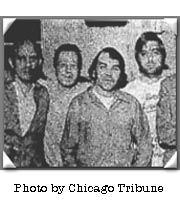
The four (left) were convicted of kidnapping, raping and killing William Velten. They could have been executed if not for an investigation by the Detroit News, which interviewed a key eyewitness in the case who said she was coached to identify the four.  Seventeen months later, the men were freed when another man confessed to the murder.

Inspired by the 1969 movie, "Easy Rider", Ron Keine a college student in Detroit at the time, decided to tour the country on a motorcycle with his friends. They joined an infamous California motorcycle gang Keine described as "a drinking club with a motorcycle problem."

In 1974, Keine, Doc and three friends had borrowed a van for a trip home when they were stopped and harassed by police in Oklahoma. They were arrested and charged with armed robbery of a gas station, which had burned down two years prior. But before Keine and his friends were set free, they were told they had to be extradited to New Mexico and were being charged with the Albuquerque murder of college student William Velten.

Once in New Mexico, Keine's court-appointed public defender advised Keine and his cohorts to plead guilty so they would only get life in prison. Keine pleaded not guilty and was taken immediately from the arraignment to death row, where he sat for two months awaiting trial.

At the trial, the prosecutor presented the testimony of a motel maid who claimed to have seen the men carry out the murder. Police, however, had found no evidence in the van the men were riding in or on their pocket knives, according to Keine. Keine asked his public defender several times to object to the evidence, but to no avail. He was convicted and sent to death row.

Keine said at that moment his "whole value system slammed down on you. Everything you believed about the law, the honesty, the ethics of it, out the window."

Keine stayed on death row awaiting his execution for two years, until a former police officer, Kerry Lee, confessed the murder to the pastor of a church. Keine was notified of his retrial nine days before his scheduled execution and was freed in 1976, according to the Death Penalty Information Center.


Read more...

Sunday, September 16, 2012

Man Sentenced to Death For Killing Two Men Who Raped Him As a Child.

Pennsylvania is preparing to execute Terrance Williams for killing two men who used their positions as a church leader and booster to get access to young boys, and who brutally raped Williams as a child. 

According to witnesses, Terrance Williams was allegedly sexually abused for years by these men as well as other older individuals throughout his life. His mother had abused him frequently and his father was absent from the home. His first experience with sexual assault was when he was just six years old, and the abuse continued steadily for the next 12 years of his life.

According to The Nation, "It was not until this past winter that another witness would come forward, a former pastor named Charles Pointdexter, who knew Norwood for thirty years. He admitted having known that he had sexually abused teen boys.

“Amos seemed to have lots of close relationships with young men…” he stated in an affidavit signed February 9, 2012, saying that he began to suspect that they were “inappropriate” in nature. A few years before Amos’s death, one of the parishioners, the mother of a 15-year-old boy, told him that he had “touched her son’s genitals” during a car ride and that “Amos had inappropriately touched a number of boys at the church.” Pointdexter kept the knowledge to himself.

Because Williams was embarrassed and ashamed by the abuse, he says he did not present his experiences as evidence for trial. His lawyer also failed to conduct a thorough investigation of Williams’ motivations for killing the men, and ignored obvious signs of sexual abuse.

Many notable people have come forward to state that they would like his sentence to be reduced to life without parole. Among those objecting to his sentencing include the wife of one victim, five jurors from the trial, judges, child advocates, former prosecutors, faith leaders, mental health professionals, and law professors.

Jurors from the trial now say they would not have voted for execution had they known about his experiences with sexual abuse as a child.

A widow of one victim said that she has forgiven Williams and does not want any more deaths to come of the incident. She expressed hope that Governor Tom Corbett, the Board of Pardons, and District Attorney Williams will reduce his sentence to life without parole.

Courts have agreed that Williams’ lawyer failed to give him a fair trial, but they also have stated that evidence of sexual abuse would not have made a difference in the sentencing.

Jurors, however, have signed sworn affidavits saying they would not have voted for death if they had known about his past.

Several jurors have also said that they voted for him to be executed because they believed that, if they had not, Williams would be eligible for release on parole.

However, a life sentence in Pennsylvania means the convicted will never be eligible for parole. Pennsylvania is the only state in the U.S. that does not require judges to explain to the jury that a life sentence means there is no possibility of parole.

No explanation of life sentencing was given at Williams’ trial.

Terry Williams’ death warrant for October 3 was signed by Gov. Corbett last week. Corbett is a Catholic Republican.

Read more...

Thursday, September 22, 2011

RIP Troy Davis

Update: Troy Davis proclaimed his innocence and asked mercy for those about to kill him.

11:25 AJC reporter Rhonda Cook and other media witnesses report that Davis addressed the MacPhail family directly from the gurney and again proclaimed his innocence, asked mercy for those about to kill him and asked his friends and supporters to continue working to get to the truth of officer MacPhail's death.
Reading the headline Ga. Executes Davis; Supporters Claim Injusticehit me like a ton of bricks, even though I was convinced there was no stopping the killing machine this time. I'm against the death penalty, 100%, despite guilt or innocence, but the thought that this man suffered all that he suffered as an innocent man is beyond comprehension in a society that we've been led to believe is civilized. It's clearly not.

Troy Davis first showed up on my radar in 2008. Former FBI director and former Chief Judge William S. Sessions wrote an article about why Troy Davis should receive a new hearing. The fact that this pro-death penatly, seasoned law enforcement officer took the time to do this, in my humble opinion, spoke volumes.
Mr. Davis has been on death row in Georgia for more than 17 years for the murder of a police officer, and related violent crimes. I was the director of the FBI under Presidents Reagan, Bush, and Clinton, and I believe that there is no more serious violent crime than the murder of an off-duty police officer who was putting his life on the line to protect innocent bystanders.

That being said, we must be convinced that the right person has been convicted. Serious questions have been raised about Mr. Davis’s guilt. The murder weapon was never found and other important physical evidence was missing. Key witnesses made inconsistent statements, and seven out of the nine non-police witnesses have now recanted or changed their original testimony, some stating that they had been pressured by the police to implicate Mr. Davis. One of the two witnesses who has not recanted his testimony has now been implicated as the real murderer by two witnesses at trial and four new witnesses. In addition, concerns have been raised about the conduct of the police and prosecutors.

It also appears that the quality of legal representation Mr. Davis received during trial was, by his own laywer's account, seriously deficient. Whle Mr. Davis's case proceeded through the courts, the budget of the Georgia Resource Center stated in an affidavit that, "We were simply trying to avert total disaster rather than provide any kind of active or effective representation."

The courts considering Mr. Davis's case properly administered procedural rules that prevent those courts from considering claims that were not raised at the right time or in the right manner. However, these rules can be too restrictive and can prevent the courts from dispensing justice. Presently, the rules can stop the courts from hearing claims of innocence, such as in Mr. Davis's case. They can prevent the courts from hearing these claims even if the reason they were not properly raised was because of an overburdened lawyer with insufficient resources, such as in Mr. Davis's case. As a result of these procedural obstacles, no court has examined the claims Mr. Davis's current legal team has raised.

I am a member of the Constitution Project’s bipartisan Death Penalty Committee, which includes supporters of the death penalty, like me, as well as opponents. We are united in our profound concern that in recent years, and around the country, procedural safeguards and other assurances of fundamental fairness in the administration of capital punishment have been revealed to be deeply flawed. Two of our consensus findings from our report on the death penalty apply directly to Mr. Davis’s case. First, we condemned the kinds of procedural barriers that prevented the courts from addressing the merits of Mr. Davis’s case and we recommended that they be eliminated. Second, we insisted that capital defendants have competent lawyers with adequate resources, which Mr. Davis’s own lawyer stated (through no fault of his own) was not provided in his case.

Former Chief Justice William Rehnquist once wrote that the judicial system, “like the human beings who administer it, is fallible.” I agree. Especially when it comes to a human life, the courts should always be able to examine claims of innocence.

On September 12, the Georgia Board of Pardons and Paroles denied Mr. Davis’ petition for clemency and scheduled his execution for September 23 at 7 p.m. Two hours before the execution was to take place, the U.S. Supreme Court granted a stay of execution until it could vote on whether to grant a writ of certiorari — that is, to decide to hear his case.

I hope the Court will grant certiorari to avoid a miscarriage of justice. At the very least, Mr. Davis’ substantive claims must be examined. The political process has failed Mr. Davis. Let us hope that the court of last resort rises to the challenge.

For every six people executed in Georgia since 1973, one has been exonerated. Misconduct by police and prosecutors played a major role in Georgia’s death row exoneration cases. And like most of those on death row today, many of Georgia’s wrongfully convicted could not afford a private attorney. Georgia does not guarantee counsel in the appeals process – even if the inmate has new evidence of innocence.


Where is the Justice for me?
A plea from Troy Davis

Where is the Justice for me? In 1989 I surrendered myself to the police for crimes I knew I was innocent of in an effort to seek justice through the court system in Savannah, Georgia USA. But like so many death penalty cases, that was not my fate and I have been denied justice. During my imprisonment I have lost more than my freedom, I lost my father and my family has suffered terribly, many times being treated as less than human and even as criminals. In the past I have had lawyers who refused my input, and would not represent me in the manner that I wanted to be represented. I have had witnesses against me threatened into making false statements to seal my death sentence and witnesses who wanted to tell the truth were vilified in court.

For the entire two years I was in jail awaiting trial I wore a handmade cross around my neck, it gave me peace and when a news reporter made a statement in the local news, “Cop-killer wears cross to court,” the cross was immediately taken as if I was unworthy to believe in God or him in me. The only time my family was allowed to enter the courtroom on my behalf was during the sentencing phase where my mother and sister had to beg for my life and the prosecutor simply said, “I was only fit for killing.” Where is the Justice for me, when the courts have refused to allow me relief when multiple witnesses have recanted their testimonies that they lied against me?

Because of the Anti-Terrorism Bill, the blatant racism and bias in the U.S. Court System, I remain on death row in spite of a compelling case of my innocence. Finally I have a private law firm trying to help save my life in the court system, but it is like no one wants to admit the system made another grave mistake. Am I to be made an example of to save face? Does anyone care about my family who has been victimized by this death sentence for over 16 years? Does anyone care that my family has the fate of knowing the time and manner by which I may be killed by the state of Georgia?

I truly understand a life has been lost and I have prayed for that family just as I pray for mine, but I am Innocent and all I ask for is a True Day in a Just Court. If I am so guilty why do the courts deny me that? The truth is that they have no real case; the truth is I am Innocent.

Where is the Justice for me?

By Troy A. Davis

Read more...

Monday, July 04, 2011

4th of July and Hypocrisy Reigns Supreme.

In January of this year, Hospira, the pharmaceutical company that produces sodium thiopental - the anesthetic most states use as the first drug in a three drug cocktail to execute prisoners in the US - ceased production over concerns about its use in executions. Since that time states have been scrambling to get their hands on their next fix on a replacement. After importing sodium thiopental from non-FDA approved sources, the state of Georgia acquired a replacement from Lundbeck, the Nembutol’s Danish manufacturer, who has repeatedly sent letters requesting that it not be used in executions. The manufacturer  “explicitly warned” that “this drug is not safe for use in judicial lethal injections.”

After Georgia's supply of sodium thiopental was seized by the DEA and after acquiring this controversial new sedative,  Roy Willard Blankenship thrashed, and jerked his way to death after its administration.  Mr. Blaankenship was not the first death-row inmate who suffered from a botched lethal injection  involving pentobarbital this year. Eddie Duval Powell also suffered from the administration of this deadly drug.
A death-row prisoner who was executed using a new lethal injection drug 'suffered greatly' during the process, a leading U.S. anaesthesiologist has testified.

Roy Willard Blankenship, who was executed on June 23 using pentobarbital - also known as nembutal - was said to be conscious for approximately the first three minutes of the execution and 'suffered greatly'.

Dr David Waisel, an Associate Professor of Anaesthesia at Harvard Medical School, also said in the sworn affidavit that 'his eyes were open throughout', according to witness accounts.

He said: 'I can say with certainty that Mr Blankenship was inadequately anaesthetised and was conscious for approximately the first three minutes of the execution.

So, 35-years after the US Supreme Court reinstated capital punishment, the US still remains among the top global executioners. 139 nations abolished the death penalty, but China, Iran, Saudi Arabia, the United States and Yemen continue to execute people, in direct contradiction to international human rights law. Like the other four countries listed, the death penalty in the United States is/was frequently imposed after unfair trials, where the defendant is almost always poor, uneducated, very often black, and totally vulnerable to a process that lacks fairness and integrity.

 138 innocent people have been sent to death row, and who knows how many victims were sent to their death, guilt-free.  The claim that the US is a progressive force for human rights is complete hypocrisy.

Read more...

Thursday, April 28, 2011

What is it About Florida and Texas?

Let's face it, even by contemporary US standards, both Florida and Texas have a ruthless and callous record on human rights issues. To start with, both states lead the nation, in numbers of people on death row; in numbers of people executed, and in numbers of innocent people, wrongly convicted. Add to that list: abuse of power by TSA agents, and Taser happy police.

Could it be the influence of the Bush Brothers? After all, the Bush family is notoriously known for its historic abuse of power. However, Texas and Florida were not exactly panaceas for humanitarians before the Bush brothers assumed leadership.

Anyway, once again, the state of Florida provides a shining example for all. Meg McClain spoke out about TSA abuse and "random" selection and the almighty TSA agents from Hell called in twelve police officers, and seven TSA agents; handcuffed her to a chair; gave her a 30-minute lecture on terrorism, and ripped up her plane ticket! Then, this poor girl, who couldn't even put on her shoes, was escorted out of the airport by 19 thugs security officials.


Harmless 18-year old man Tased for jogging naked. 

Read more...

Friday, November 19, 2010

Fed Up! Fight to Save America From Texas.

More specifically, Rick Perry, a man who clearly stands for injustice, as he not only proudly took the "Texecutioner" title away from George Bush, with 225 executions under his belt; in addition,  did everything he could to cover up evidence that would clear an innocent man, and save him from state sanctioned execution. Yet, this man, on top of winning a third term, fully expects to lead GOP governors group.

“Texans elect folks like me. The kind of guy who goes jogging in the morning, packing a Ruger .380 with laser sights and loaded with hollow-point bullets and shoots a coyote that is threatening his daughter’s dog.”
And the sad part is he's right, they do. He is now entering his tenth year as governor. He will soon be the longest-serving chief executive in Texas history.

I didn't think Texas could get any dumber, but apparently, dumbing down Texas was/is Rick Perry's strategy for staying in office forever. What else could explain his reelection for a third term, with a state budget deficit of $25 billion? Not to mention the highest uninsured rate in the nation with plans to increase that rate as lawmakers in Texas plan to use the  $25 billion shortfall in the state budget over the next two years to impose sweeping cuts to social services, including a massive cut to public schools and universities.  Yes, to make Texans even dumber!

Rich Perry and conservative Texan lawmakers want to ditch Medicaid due to its expansion under The Affordable Care Act, which will expand the program rapidly by subsidizing insurance for all Americans up to 133 percent of the poverty line. Yes, to make Texans even less insured!

Why is Texas bad for America?
“You prioritize what is important to the people in the state and then you reduce spending without raising taxes.” - Rick Perry
As Robert Perkinson, author of Texas Tough, said "Texas is America's new bellweather state...ground zero of the prison boom." The state's ideology has become the template for today's America, and its priorities, America's priorities.
In a sign of how far the far right has regained its confidence since its thrashing in 2008, in April, TX State board of education voted to radically overhaul their social studies curriculum that influences textbook purchases nationwide. Out went Thomas Jefferson, whose deism questioned the piety of the founders; in came Jefferson Davis who fought for state's rights. Less noticed was the elimination of justice from the list of virtues Texas school children have to master, as well as the phrase, responsibility for the common good. Launching the latest salvo in the nation's ceaseless culture war, but also brought the curriculum in line with the state's unequal social order. With its laissez faire corporate climate and anemic social services Texas simultaneously leads the nation in carbon emissions and children without health insurance.


Texas is wide open for business as the governor's economic development office proclaims but it's always had an uneasy relationship with lady justice. This is clearest of all in its criminal justice system which historically has always privileged ferocity over fairness...revenge over rehabilitation. -- Robert Perkinson
We, the People need to wake up to the thugs that have infiltrated our state and federal government. We need to stop voting them into office. However, there is no excuse for the Texans who voted Rick Perry into office for a third term...they are no better than he is. Having said that, I realize there are many good and decent Texans who should not be lumped in with the Texans so eager to follow psychopathic leaders.

Read more...
Iraq Deaths Estimator
Petitions by Change.org|Start a Petition »

  © Blogger templates The Professional Template by Ourblogtemplates.com 2008

Back to TOP