


What Should Be the Servant has Become the Master.
It's no secret that the ruling class does not want an alert and informed citizenry that can read budgets and ask critical questions. In fact, millions, if not billions of dollars are spent to keep the masses completely in the dark regarding our monetary system. Why? Those who "get it" are far more likely to fight for control.
In an overly acquisitive society such as ours, where the drive to amass obscene amounts of wealth trumps any and all regard for human life, it's time to reform our monetary system. Hence, the reason why it's so important to develop an understanding of what money really is. That is, if we, the masses, wish to not only take back our nation, but, moreover, to maintain our humanity.
Here's the thing, there is so much disinformation circulating, it's not easy to discern the truth. Nevertheless, this is some of what I've learned so far.
Economics is not a science, yet economists - in an effort to make economics, more scientific, I guess - removed "normative values" from its study. What are "normative values"? In one word, morality. Well, removing standards of ethics, honesty and morality from its study might be okay if economics followed the scientific method, and wasn't so intertwined with our survival, but it doesn't, and it is.
Unfortunately, too many economists ignore the historical origins of money, as most are trained to support the status quo...something that is clearly not working. As Alexander del Mar once said, "As a rule, economists do not take the time to study the history of money. It's much easier to imagine it and deduce the principles of this imaginary knowledge."
So, what is money?
John Locke and Ben Franklin defined money as a pledge for wealth instead of wealth itself. However, it is Aristotle's definition: "money exists not by nature, but by law," that made "money" by it's very nature, a fiat of the law. Now, despite the ranting and raving of the many against our fiat money system, fiat money, in and of itself, is not the problem; rather, it's fractional reserve banking...the private creation of "money" that is the problem here. Why? In a nutshell, it benefits only those who control its usurious issue. If the money power is privately controlled, it benefits the few...if publicly controlled, it benefits the many.
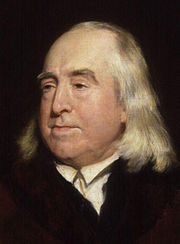
It was Jeremy Bentham, best known for his advocacy of utilitarianism, and his influence upon modern welfare economics, who we can thank for redefining usury. In a series of letters written to Adam Smith, he tried to convince Smith to give up his support for interest rate limits. Originally, the concept of usury was much more comprehensive than the mere charge of interest. According to Stephen Zarlenga, usury was the "antisocial misuse of the money mechanism for private gain". Our entire monetary system is a usurious kleptocracy.
Part of the "monetary" agenda consists of substituting the idea of credit for the concept of money, so that we, the people will come to think of money and credit as interchangeable, when that not true at all. Credit is only a promise to pay in the future; whereas money pays at the time of exchange. Not to mention, credit evaporates in a crisis; money does not.
What about Ron Paul and his mission to return to the gold standard?
Essentially, he is mis-defining money as a thing...in other words, as wealth. This will not give our society the ability to advance properly, because there will never be enough gold to keep pace with population and commerce growth. As history has shown, banks will cheat and issue private bank paper that only pretends to be convertable to gold. One can only imagine the problems that would cause in a crisis.
So back to Aristotle's defintion. The only problem with is that his definition is all too brief. Alexander del Mar later expanded on Aristotle with the following defintion of money:
"What is commonly understood as money has always consisted tangibly of the number of pieces of some material marked by public authority named and understood by the laws and customs that its palpable characteristic: mark of authority; essential characteristic: possession of value defined by law, and it's function: the legal power to pay debts and taxes and the mechanical power to fascilitate the exchange of other objects possessing value." -- Alexander DelmarIn other words, setting aside whatever is used to signify it - paper, metal, feathers, etc. - "money is an abstract social power embodied in law, as an unconditional means of payment." *
Which brings us to Stephen Zarlenga's three elements (The American Monetary and Financial Securities Act) that he maintains must be included in order to create a monetary system that works for the benefit of all:
- Put the Federal Reserve system into the US treasury so it is within our sytem of checks and balances.
- Get rid of the fractional reserve Stop the banks from creating our money supply...any of it. If they create even 10%, they're smart enough to get all of it. Billions are being stolen under cover of law, for not only doing nothing, but for damaging and destroying society.
- Government prints and spends new money into circulation to pay for infrastructure repair, either printed on paper or inserted on an account The key is that it's not debt; it's money. Moreover, human infrastructure must be included: health care and education, as you cannot build the hardware without healthy, intelligent people. .
* Stephen Zarlenga, author of the ‘National Emergency Employment Defense Act of 2010’ (renamed The American Monetary and Financial Securities Act by Rep Dennis Kucinich, which gets rid of a private credit system, and puts into place, a government money system), founder and director of the American Monetary Institute, and author of The Lost Science of Money Read more...


