UK or US: Who is More Civilized?
The following info-graph/poll can be found at the Justice Gap, a magazine about law and justice. And the difference between the two
See which side of the pond of justice you stand.



The following info-graph/poll can be found at the Justice Gap, a magazine about law and justice. And the difference between the two
See which side of the pond of justice you stand.
 |
| Crosley Green |
"People are alarmed to find out that courts have no problem at all saying you filed one day late… we're gonna use that as a basis to keep you in prison for the rest of your life not withstanding the fact that you can prove a clear miscarriage of justice," -- Seth Miller, runs the Innocence Project of Florida.
 | |
| Crosley Green, top row center, target with a bull's eye...the black spot you focus on. |
“That's a target with a bull's-eye for Crosley Green. ...His picture is smaller and darker than the other pictures," Harrison said of the photo lineup. "Anybody involved in police investigation and prosecution knows this. ...the position that your eyes are normally drawn to are right in the middle."And why was Kim Hallock eliminated as a suspect when it's normal procedure to investigate the last people to see victim alive...everyone closest to the scene? No one knows.
"It's a black spot," Green said of the photo. "That's what you focus on, that black spot." [...]
“When I went to homicide school ... they told us that this spot is the most likely that someone will pick a picture from," Mark Rixey said of the photo lineup.
"And where exactly is Crosley Green in that--"
"That's Crosley Green right in that spot," Green said, pointing to the second of three images in the top row.
"Anything that strikes you about this lineup?" Moriarty asked Christopher White.
"You can't see the guy in the top middle very well at all," he replied. "Crosley Green's photo is the darkest."
"If you don't specifically know who you're looking for, then that's the spot you will pick nine times out of 10," said Rixey.
“That's homicide 101, anybody who is present at the scene of a shooting ... gets their hands tested for gunshot residue," Rixey explained. "That should have been the very first thing that was done. ...That was never done."Moreover, the Brevard County State's Attorney's Office had a history of pressuring, coercing witnesses into lying. In the 1980s, Brevard County put away three men whose convictions have since been overturned.
“They coerced witnesses ... to lie and it's really as though you see -- a deliberate pattern of the state creating evidence to achieve a result that they wanted to achieve and that's what they got," said Jeane Thomas.In 2009, Green received a reduced sentence (life in prison) due to an error in sentencing. In total, Crosley Green has spent almost 26 years incarcerated for a crime he did not commit. Three witnesses recanted their testimony.
“Every witness recanted their story," Moura explained. "And every one of them had reason to be afraid of the police. ...They were squeezed. ...And they were squeezed hard."As it stands now, undeterred by exculpatory evidence withheld by the prosecution, the recantations of four of the prosecution's star witnesses, not to mention, more inconsistencies than a government's official story, the Florida Attorney General's Office is fighting to uphold Crosley Green's conviction. It says Green failed to meet a filing deadline for his appeal.
On Thursday, Mississippi is scheduled to execute the first woman, Michelle Byrom, 57, in the state since 1944, even though her son, Edward Byrom Jr., repeatedly confessed to the killing that she is slated to die for — evidence the jury did not hear because her defense attorneys--their first capital murder trial-- never admitted the confession letters into evidence. Ms. Byrom was a lifelong victim of abuse, both as a child and in the marriage that ended in her husband’s death. Not to mention, at the time of her husband's death, Ms. Byrom was in the hospital for double pneumonia while on mind-altering drugs.
“As I sat on my bed, tears of rage flowing, remembering my childhood my anger kept building and building, and I went to my car, got the 9mm, and walked to his room, peeked in, and he was asleep. I walked about 2 steps in the door, and screamed, and shut my eyes, when I heard him move, I started firing.” -- Edward Byrom JrDespite corroborating evidence supporting the son's confessions such as the gunpowder found on his hands, Byrom Jr. pinned the murder plot on his mother after prosecutors convinced him to take a plea deal in exchange for a reduced sentence.
“When they got me here, I gave them a bullshit story after another, trying to save my own ass, but when David Smith started questioning me, and told me what happened, I was so scared, confused, and high, I just started spitting the first thought out, which turned into this big conspiracy thing, for money, which was all BS, that's why I had so many different stories,"--Edward Byrom Jr.So authorities allege that Byrom Jr., his mother and his friend, Joey Gillis, colluded to kill Byrom Sr, in order for Michelle Byrom to collect on her husband’s life insurance policy. However, both Byrom Jr. and friend, Joey Gillis--accused of pulling the trigger despite the gun powder residue on Byrom Jr.'s hand-- walk free today.
“I have attempted to conjure up in my imagination a more egregious case of ineffective assistance of counsel during the sentencing phase of a capital case. I cannot."--Judge Jess DickinsonRead more...
In the documentary below, former Conservative MP, Michael Portillo pushes his body to the brink of death in an investigation into the science of execution. At the very beginning he states, "If the state's going to kill people, you want to do it as humanely as possible, I think most people agree on that." I'm not so sure. From my very limited perspective, I think the man who invented the lethal injection protocol, Dr. Jay Chapman's response, "My basic attitude is so they suffer a little pain, who cares?" might just be the attitude shared by most.
Of course, as I've stated repeatedly, I do not believe in the death penalty under any circumstances, but if the state insists upon executing people, the least they could do is spare the doomed individual as much pain as possible. As I have also stated many times before, I think the lethal injection protocol is, as they say in the film "torture disguised as a medical procedure." And that's whether they carry it with two or three drugs. I mean, just imagine not getting enough of the drug that is supposed to cause unconsciousness, before getting the paralyzing drug (most likely used for aesthetic reasons) that renders you unable to signal your distress, followed by a heart-stopping drug, which "feels like a fire traveling through the vein to the heart.” The chance of this occurring is extremely high because it is administered by ill-trained staff. After all, doctors and nurses are supposedly bound by the "Hippocratic Oath" or take a pledge to do no harm.
It's not just a lack of expertise that contribute to the controversy over lethal injection; it's the second drug in the cocktail: pancuronium bromide, the paralyzing agent Carol Weihrer, who has testified in 15 court cases against lethal injection, knows all too well the pain this drug can cause. During a routine eye operation, in which she was given anesthesia and then pancuronium bromide, the anesthesia failed to work, leaving her fully aware of the excruciating pain as the pancuronium bromide coursed through her veins, but unable to tell anyone or move. She said if felt like "ignited jet fuel going through your body feeling like you're absolutely on fire." Carol believes that most executed inmates go through the same experience as she did. She states that the anesthetic used in the lethal injection protocol is "short-acting, five minute version" and that that lethal injection "takes between 10-12 minutes on a good day." In other words, the inmate is put out for a couple of minutes, and then conscious, thus feels the pancuronium bromide painfully charge through their veins without being able to alert anyone and dies from suffocation before their heart is stopped.
One example:
 |
| Angel Diaz |
Update:: Dennis McGuire surpassed the projected five minutes--experiencing the "agony and terror of air hunger as he struggles to breathe for five minutes after [executioners] intravenously inject him with the execution drugs"--before he loses consciousness and expires--his lawyers said it would take to die, It took 15 minutes for him to die, as he "gasped, snorted and snored during a prolonged execution" from "air hunger" on January 16, 2014, when the state used the controversial, never-before-tried lethal injection after supplies of the state's previous drug dried up.
“The 53-year-old's attorneys had argued against using intravenous doses of the sedative Midazolam and the painkiller Hydromorphone, claiming the combination would cause 'air hunger' - where someone experiences immense terror and agony as they strain for breath during the execution."[...]
“He was then still for five minutes before emitting a loud snort as if snoring and continued to make this noise for several minutes. His stomach rose and fell several times as he repeatedly opened and shut his mouth, making what the Columbus Dispatch described as 'deep, rattling sounds.'Why can we put a dog/cat to death in less than 10 seconds but can't seem to do it when it involves putting a human-being to death. The answer is we can but the sequence of the "lethal cocktail" that enters the body is designed to provide the condemned with a feeling of terror, otherwise why not just inject a general anesthetic followed by whatever it is that stops the heart immediately?
His family sobbed as they watched him slowly die. At one point, his daughter exclaimed 'Oh my God' as she observed her father's final moments.
A coughing sound was Dennis McGuire's last apparent movement, at 10:43 a.m. He was pronounced dead 10 minutes later. McGuire as first injected with the drugs at 10:29 a.m."
“Ohio and other death penalty states have been struggling to keep executions going because supplies of pentobarbital traditionally used in a three-drug mix have all passed their sell-by dates thanks to its Danish manufacturer prohibiting its sale to US prison services. The European Union has also threatened to restrict sales of Propofol, a leading anaesthetic used in hospitals, were US death chambers to use it instead."I feel my whole body burning.
 |
| Out of Reach 2012 |

“Its most important role has been to serve as what’s known as a potter’s field, a common gravesite for the city’s unknown dead. Some 900,000 New Yorkers (or adopted New Yorkers) are buried here; hauntingly, the majority are interred by prisoners from Riker’s Island who earn 50 cents an hour digging gravesites and stacking simple wooden boxes in groups of 150 adults and 1,000 infants. These inmates—most of them very young, serving out short sentences—are responsible for building the only memorials on Hart Island: Handmade crosses made of twigs and small offerings of fruit and candy left behind when a grave is finished."Moreover, 41 states have debtors' prisons. Even though the U.S. officially made debtors' prisons illegal in the 1830s, you can still be jailed for showing "contempt of court" during a creditor lawsuit. In Ohio they're throwing people into jail for as little as $300! That's right, in Huron County, "more than one in every five of all bookings...involved a failure to pay fines."
A mother loses her job, a father is kept from working by an injury, a family is forced from their home by fire or natural disaster. Healthcare costs soar, public transportation is underfunded, affordable housing is almost impossible to find. These are the reasons why families now make up 40 percent of the homeless population, and why one out of every four homeless people is a child.Read more...
In response to this crisis, the Interfaith Hospitality Network brings the faith community together to help families regain their housing, their independence, and their dignity. IHN is a partnership of congregations within a community helping families who are facing homelessness. It offers an opportunity for volunteers of all faiths to reduce homelessness and transform lives.
Interfaith Hospitality Networks are currently operating in 41 states and the District of Columbia, in large cities, suburbs, and rural counties. They mobilize community resources: houses of worship for lodging, congregations for volunteers, social service agencies for assessment and referrals, and existing facilities for day programs. This strategy enables networks to help homeless families achieve lasting independence at a third of the cost of traditional shelters.


“The prosecution, Mr. Valeska specifically, looked me in the eye and said, quote, 'there ain't no such thing as an F.B.I. report.' Well, there probably wasn't a report, but there were 256 pages of information collected by Decatur police officers that were sent to the F.B.I.," -- Judge ThompsonAccording to Judge Thompson, Assistant Attorney General Don Valeska later came to him confessing there was withheld information. "Mr. Valeska came forward with the information after the conviction," said Judge Thompson. “Clearly, the only remedy was to grant him a new trial and I did," he said. "It frustrated and angered me that he would be willing to lie to the court," he continued.


“I feel like my prayers have been answered...It's been 24 years of this ordeal for my family and my friends, and now with it coming to an end, it's like a dream come true." -- Nathson Fields(M. Walberg, “23 years after judicial misconduct, ex-gang leader freed," Chicago Tribune, April 9, 2009). (R. Hussain, Man formerly on death row acquitted in retrial,” Chicago Sun-Times, April 8, 2009). See also People v. Hawkins, et al., 181 Ill.2d 41 (January 29, 1998) (upholding a circuit court's reversal of Fields' and Hawkins' convictions).


“In an interview yesterday in his mother's house, where he has lived since he was released in February on bail, Johnson said that "anger destroys," but still he is bitter about the legal system that twice convicted him, once to death, and once to life in prison. He accused prosecutors of manipulating both the jury and the testimony because they cared only about getting a conviction, not about the truth.
"It was a legal lynching," he said. The prosecution, he said, "fabricated and conspired" with Meyers. Both juries were all white; the murder victim was white, too, and Johnson, who is black, said the racial fears of the jurors were played on by the prosecution.
"I totally believed in the system of justice," he said. "My faith in the system is gone."


Update:
 Ernest (Shujaa) Graham . Shujaa Graham was born in Lake Providence, LA, where he grew up on a plantation. His family worked as share-croppers, in the segregated South of the 1950s. As a teenager, Shujaa lived through the Watts riot and experienced the police occupation of his community. In and out of trouble, he spent much of his adolescent life in juvenile institutions, until at age 18, he was sent to Soledad Prison. In 1961, he moved to join his family who had moved to South Central Los Angeles, to try to build a more stable life.
In prison, Shujaa, mentored by the leadership of the Black Prison movement, he taught himself to read and write, and studied history and world affairs, becoming a leader of the growing movement within the California prison system, as the Black Panther Party expanded in the community.
In 1973, Shujaa was framed in the murder of a prison guard at the Deul Vocational Institute, Stockton, California. As a recognized leader within and without the prison, the community became involved in his defense, and supported him through four trials. Shujaa and his co-defendant, Eugene Allen, were sent to San Quentin's death row in 1976, after a second trial in San Francisco.
Shujaa spent three years on death row, but he and Eugene Allen continued to fight for their innocence. A third trial ended in a hung jury, and after a fourth trial, they were found innocent in 1979, after discovering that the District Attorney excluded all African American jurors, the California Supreme Court finally overturned the death conviction. As Shujaa often says, he won his freedom and affirmed his innocence in spite of the system. He was released and exonerated in March, 1981, and continued to organize in the Bay area, building community support for the prison movement, as well as protest in the neighborhoods against police brutality.
In the following years, Shujaa moved away from the Bay area. Shujaa learned landscaping, and created his own business. He and his wife raised three children, and became part of a progressive community in Maryland.
In 1999, Shujaa was invited to speak about his experiences on Death Row at fund raiser for the Alabama Death Penalty project, sponsored by the New York Legal Aid Foundation. This was a new beginning, and provided Shujaa the opportunity to begin to tell his story, his experiences and grow through work with other death penalty opponents.
------------------------------------------------------------------------------------------

“Morris’s case was marked by the controversial use of testimony from a felon granted leniency for his testimony, and the prosecution’s failure to divulge this special relationship to the defense during the trial. The star witness later confessed that he had fabricated the entire case against Morris in return for favorable treatment in at least two criminal cases he was involved in.
The chief prosecutor in the case, Arthur Jean, Jr., is today a Los Angeles County Superior Court Judge. In a deposition about the case, Judge Jean said, “I wish I wasn’t on record having participated in giving him [Morris] something less than a perfect trial, but I am. It’s an embarrassing situation that I didn’t do well at the trial, and I didn’t handle things well. And misjudgments occurred, and I made them. And it’s tough to look people in the eye and ‘fess up with them sometimes.”
.... As a prosecutor, Mr. Jean had told the jury in Morris’s case that “there is no evidence, not a shred, and you would know if it existed, if Mr. West [the witness] got any benefit from the handling of his criminal case.” Records show that Mr. West in fact received a reduced sentence on a felony auto theft charge in return for his testimony against Mr. Morris, as well as termination of his prison sentence for parole violation. Mr. Jean’s handling of the Morris case drew the wrath of the California Supreme Court when it considered Morris’s automatic capital appeal and vacated his death sentence in 1988. Mr. Morris spent another 11 years in jail, until Mr. West recanted his testimony and Mr. Morris was released. (LA Daily Journal, Oct. 29, 2002)"-------------------------------------------------------------------------------------------------
 Patrick Croy In 1978, Patrick "Hooty" Croy was working as a logger in Yreka. A weekend of partying led to an ill-fated shoot out between police and a group including Croy. By the end, Officer Hittson was dead. Croy was convicted of attempted robbery and Officer Hittson's murder. The jury did not convict Croy of intentionally killing the offer, but, rather, convicted him based on the theory of felony murder -- that is, that he intentionally committed a robbery that resulted in the officer's death. Croy was sentenced to death.
“I am Norma Jean's brother Patrick "Hooty" Croy. I was convicted at the same time as my sister. I was sent to death row where I spent many years awaiting execution. In my retrial it was proven that I shot Officer Bo Hittson in self-defense. This acquittal has clearly exonerated my sister. The prison parole board refuses to recognize any evidence surrounding the acquittal. Norma Jean is the only one still doing time.------------------------------------------------------------------------------------------
July 16, 1978: It was high summer in Yreka, California and the town was celebrating the weekend with a street fair and dance. Norma Jean Croy was 24. Along with some friends and relatives, this Native Shasta woman was also enjoying the weekend. Visiting from home to home, laughing, watching movies, relaxing on
the hot summer night. They decided it would be good to go get pufitch night at her Grandma's place out in the country. First off, they needed some food and cigarettes at a local all-night store. It was near midnight.
The clerk at the convenience store was working the night shift, hoping his application at the police department would be approved soon. It was hot that night, maybe too hot. When Norma Jean, her brother Patrick Hooty Croy and three of their relatives (ages 17- 26) stopped at the store the clerk became verbally abusive, mistakenly accusing Hooty of short-changing him. Norma and 18-year-old Carol Thom defended Hooty against the verbal onslaught. Hooty did not want any trouble, he left the store. The clerk became physically and verbally abusive with Norma Jean and Carol. A scuffle broke out.
A squad car rolled into the parking lot. One of those coincidences. The clerk yelled "Get them", and then came the chase. "There's a carload of Indians," the police radio barked across Siskiyou County. One cousin, Darrell, just waking up in the back seat had the bright idea that he'd shoot out the headlights of the pursuing squad car. He picked up the .22 rifle as Hooty drove the old Pontiac. By the time they reached Grandma's, Darrell had managed to fire one bullet. He hadn't even hit the squad car, much less his target.
When the got to Grandma's, Norma Jean, Hooty and Darrell fled into the hills. The other two, Carol and 17-year-old Jasper (who had been asleep until arrival at Grandma's) attempted to turn themselves in to the police. The police responded by beating Jasper and handcuffing him and Carol in the line of fire.
Fifteen squad cars and 27 officers came to the scene. The police had military style semi-automatic weapons: M-16's, AR-15's, "riot shotguns", and .357 magnum pistols, shooting at "ANYTHING that moved". The Indians had one .22 caliber rifle and a handful of bullets. Memories of Captain Jack and the Modoc nation standoff against the US Cavalry whispered in the air.
Norma Jean, Hooty and Darrell continued to try and find cover in the sagebrush. Norma Jean got hit first, shot in the back. An officer was hit in the hand.
Trying to surrender, Darrell was shot in the groin. During a de facto cease-fire, Hooty approached the cabin to check on his Grandmother and Aunt.
There was a death. Yreka police officer Bo Hittson, who had been drinking prior to arriving on the scene saw Hooty attempting to get into the window of the cabin. One bullet hit Hooty in the lower butt and traveled down his leg, where it remains to this day. The other bullet entered through the back of his upper arm, bursting out the front. Hooty turned and shot-- one bullet from the .22 which hit the officer in the heart. The officer died instantly.
Hooty crawled to some storage shacks by the cabin, seeking shelter. Several police officers opened fire with semi-automatic weapons. Twice they spewed the bullets into the area where Hooty lay bleeding. By some miracle, Hooty survived. By dawn the dust cleared. The police had fired an excess of 200 rounds into the area. Only 6 .22 shots had been fired by the Indians.
Hospitals...Jail time...Trials. Penitentiaries. Jasper (a juvenile who ended up in adult court), got six years. Carol Thom was turned over to the California Youth Authority and separated from her baby daughter for 3 years. Darrell got 6 years. Norma Jean got life. Hooty got the death penalty. That was a long time ago. Today, all the Indians except for Norma Jean are out of prison. Hooty, in 1985, was granted a new trial by the California Supreme Court, and was found NOT GUILTY by reason of self-defense in May of 1990. With no release date, Norma Jean has been in prison for 12 years. [pg: at the time this was written. It's 17 years now.] A victim of gross miscarriage of justice, Norma Jean, unarmed in the racially-charged encounter, is still behind bars.
Here's what Hooty's (second) trial judge said:
"I think that when Norma Jean comes up for a parole hearing again, that the board should take into consideration the fact that this court, at least, believes Normal Jean Croy would have been found Not Guilty....I want the record to be clear that this is my judgement, my opinion, having heard the evidence in this case." -- Judge Edward Stern, Hooty's trial judge, San Francisco, May, 1990But when Norma Jean went before her parole board, they refused to consider the evidence which had come out at the new trial, or the trial judge's opinion.
She was given no release date then, told to return in several years for another hearing. She was denied release date in 1992, 1993, 1994. Should have another hearing in 1995, but her attorney believes prison crowding will delay it till Spring, 1996. Also believes no release will be set then.
Norma Jean and Hooty were both convicted in Placer County by an all-white jury of first degree murder, conspiracy to commit murder, attempted murder, assault on officers, and robbery in August of 1979. Norma Jean was sentenced to life, on some of the charges, long terms on others. Hooty received the death penalty. Their appeals went to different courts with different results. Hooty was granted a new trial at the end of 1985, Norma Jean's convictions were affirmed by a lower appeals court. Hooty's change of venue was considered a landmark case; Norma Jean's venue change was denied.
At Hooty's second trial, in San Francisco, evidence was presented which the 1979 jury had not heard on a dual system of justice for Indians, a background of racism in the community where the incidents occurred, misconduct by law enforcement officers, and most importantly, that Hooty had shot officer Hittson in self- defense. Hooty was found not guilty of all charges, murder, attempted murder and robbery.
International Indigenous People's 1993 Resolution Supporting Norma Jean Croy
WHEREAS Norma Jean Croy, 39, now serving a life sentence for a murder conviction in 1978, has been imprisoned as a political prisoner since she was 24, longer than any other Indian man or woman associated with the struggle for Native rights and sovereignty;
WHEREAS the facts of Norma Jean's case clearly indicate she was shot in the back by police officers who surrounded a relative's house and began shooting at
Norma Jean, her brother, Patrick "Hooty" Croy and old people in the house, the said police officers attacking these people in force after a minor verbal altercation with a store clerk mainly as part of the government assault on the American Indian Movment that followed the FBI incident at Oglala;
WHEREAS over 200 shots were fired in the assault, one office was killed by Patrick, and Patrick was shot twice from, and Patrick was convicted of murder,but won a new trial in 1985 after many years of support efforts, at which he was acquitted, and the jurors and trial judge said that Norma Jean would have been acquitted by them too, if she had been on trial;
NOW THEREFORE BE IT RESOLVED that Norma Jean Croy should receive an Executive pardon, since it has never even been alleged that she had anything to do with the officer's death other than being there and being shot in the back.
AND BE IT FURTHER RESOLVED that members of this conference and the groups they represent will make serious efforts to publicize and build support for Norma Jean against this long-standing injustice,which has been virtually ignored by everyone except a few women for more than 15 years. Resolution was passed by unanimous acclamation,Sept 2, 1993


“I have at least a philosophical objection to begging these people for my life, and I am not going to do it. I'm not going to do it. I'm not going to do it." - Dennis Lawley, a paranoid schizophrenic defending himself after which he was sentenced to death.The most comprehensive review of death penalty cases ever undertaken, led by Columbia Law School Professor James Liebman, found that California's trial courts produced an extremely high level of error in capital verdict cases. 87% of capital verdicts in California were tainted with an error serious enough to prejudice the outcome.
 |
| Ron Keine, Assistant Director for Witness to Innocence |
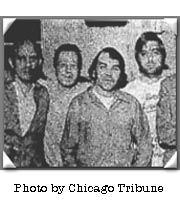 The four (left) were convicted of kidnapping, raping and killing William Velten. They could have been executed if not for an investigation by the Detroit News, which interviewed a key eyewitness in the case who said she was coached to identify the four. Seventeen months later, the men were freed when another man confessed to the murder.
“In 1974, Keine, Doc and three friends had borrowed a van for a trip home when they were stopped and harassed by police in Oklahoma. They were arrested and charged with armed robbery of a gas station, which had burned down two years prior. But before Keine and his friends were set free, they were told they had to be extradited to New Mexico and were being charged with the Albuquerque murder of college student William Velten.
Once in New Mexico, Keine's court-appointed public defender advised Keine and his cohorts to plead guilty so they would only get life in prison. Keine pleaded not guilty and was taken immediately from the arraignment to death row, where he sat for two months awaiting trial.
At the trial, the prosecutor presented the testimony of a motel maid who claimed to have seen the men carry out the murder. Police, however, had found no evidence in the van the men were riding in or on their pocket knives, according to Keine. Keine asked his public defender several times to object to the evidence, but to no avail. He was convicted and sent to death row.
Keine said at that moment his "whole value system slammed down on you. Everything you believed about the law, the honesty, the ethics of it, out the window."
Keine stayed on death row awaiting his execution for two years, until a former police officer, Kerry Lee, confessed the murder to the pastor of a church. Keine was notified of his retrial nine days before his scheduled execution and was freed in 1976, according to the Death Penalty Information Center.
First, let me state that I am 100% against the death penalty for any reason, however, this is the first time--as far as I know-- that banksters will be punished for participating in the destabilization of the global economy. An Iranian court dished out four death sentences in the country's biggest bank-fraud scandal to date: the embezzlement of $2.6 billion.
Constitution of the Islamic republic Article 49
"The government has the responsibility of confiscating all wealth accumulated through usury, usurpation, bribery, embezzlement, theft, gambling, misuse of endowments, misuse of government contracts and transactions, the sale of uncultivated lands and other resources subject to public ownership, the operation of centers of corruption, and other illicit means and sources, and restoring it to its legitimate owner; and if no such owner can be identified, it must be entrusted to the public treasury. This rule must be executed by the government with due care, after investigation and furnishing necessary evidence in accordance with the law of Islam.
Pennsylvania is preparing to execute Terrance Williams for killing two men who used their positions as a church leader and booster to get access to young boys, and who brutally raped Williams as a child.
According to witnesses, Terrance Williams was allegedly sexually abused for years by these men as well as other older individuals throughout his life. His mother had abused him frequently and his father was absent from the home. His first experience with sexual assault was when he was just six years old, and the abuse continued steadily for the next 12 years of his life.
According to The Nation, "It was not until this past winter that another witness would come forward, a former pastor named Charles Pointdexter, who knew Norwood for thirty years. He admitted having known that he had sexually abused teen boys.
“Amos seemed to have lots of close relationships with young men…” he stated in an affidavit signed February 9, 2012, saying that he began to suspect that they were “inappropriate” in nature. A few years before Amos’s death, one of the parishioners, the mother of a 15-year-old boy, told him that he had “touched her son’s genitals” during a car ride and that “Amos had inappropriately touched a number of boys at the church.” Pointdexter kept the knowledge to himself.
Because Williams was embarrassed and ashamed by the abuse, he says he did not present his experiences as evidence for trial. His lawyer also failed to conduct a thorough investigation of Williams’ motivations for killing the men, and ignored obvious signs of sexual abuse.
Many notable people have come forward to state that they would like his sentence to be reduced to life without parole. Among those objecting to his sentencing include the wife of one victim, five jurors from the trial, judges, child advocates, former prosecutors, faith leaders, mental health professionals, and law professors.
Jurors from the trial now say they would not have voted for execution had they known about his experiences with sexual abuse as a child.
A widow of one victim said that she has forgiven Williams and does not want any more deaths to come of the incident. She expressed hope that Governor Tom Corbett, the Board of Pardons, and District Attorney Williams will reduce his sentence to life without parole.
Courts have agreed that Williams’ lawyer failed to give him a fair trial, but they also have stated that evidence of sexual abuse would not have made a difference in the sentencing.
Jurors, however, have signed sworn affidavits saying they would not have voted for death if they had known about his past.
Several jurors have also said that they voted for him to be executed because they believed that, if they had not, Williams would be eligible for release on parole.
However, a life sentence in Pennsylvania means the convicted will never be eligible for parole. Pennsylvania is the only state in the U.S. that does not require judges to explain to the jury that a life sentence means there is no possibility of parole.
No explanation of life sentencing was given at Williams’ trial.
Terry Williams’ death warrant for October 3 was signed by Gov. Corbett last week. Corbett is a Catholic Republican.
Update: Troy Davis proclaimed his innocence and asked mercy for those about to kill him.
11:25 AJC reporter Rhonda Cook and other media witnesses report that Davis addressed the MacPhail family directly from the gurney and again proclaimed his innocence, asked mercy for those about to kill him and asked his friends and supporters to continue working to get to the truth of officer MacPhail's death.Reading the headline Ga. Executes Davis; Supporters Claim Injusticehit me like a ton of bricks, even though I was convinced there was no stopping the killing machine this time. I'm against the death penalty, 100%, despite guilt or innocence, but the thought that this man suffered all that he suffered as an innocent man is beyond comprehension in a society that we've been led to believe is civilized. It's clearly not.
Mr. Davis has been on death row in Georgia for more than 17 years for the murder of a police officer, and related violent crimes. I was the director of the FBI under Presidents Reagan, Bush, and Clinton, and I believe that there is no more serious violent crime than the murder of an off-duty police officer who was putting his life on the line to protect innocent bystanders.
That being said, we must be convinced that the right person has been convicted. Serious questions have been raised about Mr. Davis’s guilt. The murder weapon was never found and other important physical evidence was missing. Key witnesses made inconsistent statements, and seven out of the nine non-police witnesses have now recanted or changed their original testimony, some stating that they had been pressured by the police to implicate Mr. Davis. One of the two witnesses who has not recanted his testimony has now been implicated as the real murderer by two witnesses at trial and four new witnesses. In addition, concerns have been raised about the conduct of the police and prosecutors.
It also appears that the quality of legal representation Mr. Davis received during trial was, by his own laywer's account, seriously deficient. Whle Mr. Davis's case proceeded through the courts, the budget of the Georgia Resource Center stated in an affidavit that, "We were simply trying to avert total disaster rather than provide any kind of active or effective representation."
The courts considering Mr. Davis's case properly administered procedural rules that prevent those courts from considering claims that were not raised at the right time or in the right manner. However, these rules can be too restrictive and can prevent the courts from dispensing justice. Presently, the rules can stop the courts from hearing claims of innocence, such as in Mr. Davis's case. They can prevent the courts from hearing these claims even if the reason they were not properly raised was because of an overburdened lawyer with insufficient resources, such as in Mr. Davis's case. As a result of these procedural obstacles, no court has examined the claims Mr. Davis's current legal team has raised.
I am a member of the Constitution Project’s bipartisan Death Penalty Committee, which includes supporters of the death penalty, like me, as well as opponents. We are united in our profound concern that in recent years, and around the country, procedural safeguards and other assurances of fundamental fairness in the administration of capital punishment have been revealed to be deeply flawed. Two of our consensus findings from our report on the death penalty apply directly to Mr. Davis’s case. First, we condemned the kinds of procedural barriers that prevented the courts from addressing the merits of Mr. Davis’s case and we recommended that they be eliminated. Second, we insisted that capital defendants have competent lawyers with adequate resources, which Mr. Davis’s own lawyer stated (through no fault of his own) was not provided in his case.
Former Chief Justice William Rehnquist once wrote that the judicial system, “like the human beings who administer it, is fallible.” I agree. Especially when it comes to a human life, the courts should always be able to examine claims of innocence.
On September 12, the Georgia Board of Pardons and Paroles denied Mr. Davis’ petition for clemency and scheduled his execution for September 23 at 7 p.m. Two hours before the execution was to take place, the U.S. Supreme Court granted a stay of execution until it could vote on whether to grant a writ of certiorari — that is, to decide to hear his case.
I hope the Court will grant certiorari to avoid a miscarriage of justice. At the very least, Mr. Davis’ substantive claims must be examined. The political process has failed Mr. Davis. Let us hope that the court of last resort rises to the challenge.
Where is the Justice for me?Read more...
A plea from Troy Davis
Where is the Justice for me? In 1989 I surrendered myself to the police for crimes I knew I was innocent of in an effort to seek justice through the court system in Savannah, Georgia USA. But like so many death penalty cases, that was not my fate and I have been denied justice. During my imprisonment I have lost more than my freedom, I lost my father and my family has suffered terribly, many times being treated as less than human and even as criminals. In the past I have had lawyers who refused my input, and would not represent me in the manner that I wanted to be represented. I have had witnesses against me threatened into making false statements to seal my death sentence and witnesses who wanted to tell the truth were vilified in court.
For the entire two years I was in jail awaiting trial I wore a handmade cross around my neck, it gave me peace and when a news reporter made a statement in the local news, “Cop-killer wears cross to court,” the cross was immediately taken as if I was unworthy to believe in God or him in me. The only time my family was allowed to enter the courtroom on my behalf was during the sentencing phase where my mother and sister had to beg for my life and the prosecutor simply said, “I was only fit for killing.” Where is the Justice for me, when the courts have refused to allow me relief when multiple witnesses have recanted their testimonies that they lied against me?
Because of the Anti-Terrorism Bill, the blatant racism and bias in the U.S. Court System, I remain on death row in spite of a compelling case of my innocence. Finally I have a private law firm trying to help save my life in the court system, but it is like no one wants to admit the system made another grave mistake. Am I to be made an example of to save face? Does anyone care about my family who has been victimized by this death sentence for over 16 years? Does anyone care that my family has the fate of knowing the time and manner by which I may be killed by the state of Georgia?
I truly understand a life has been lost and I have prayed for that family just as I pray for mine, but I am Innocent and all I ask for is a True Day in a Just Court. If I am so guilty why do the courts deny me that? The truth is that they have no real case; the truth is I am Innocent.
Where is the Justice for me?
By Troy A. Davis

© Blogger templates The Professional Template by Ourblogtemplates.com 2008
Back to TOP

