Showing posts with label BP Oil. Show all posts

Wednesday, May 29, 2013

Giant and Unprecedented Sinkholes?

The Louisiana Assumption Parish Bayou Corne sinkhole is truly unprecedented globally, according to geologists. It is a living breathing thing that broke the record for breaching and compromising a salt dome to the largest extent know in history, and the 3400 foot deep cavern that caused it is still collapsing. Moreover, this now 15 acre sinkhole is leaking methane gases and crude as it continues to bubble in the bayou. 350 individuals were/are under a mandatory evacuation order, as this monster sinkhole shows no signs of receding. These effected residents began receiving weekly checks in the amount of $875, and now Texas Brine is supposedly preparing to offer settlements to the evacuated residents.,

So, how does an historical event like this escape national media coverage? Better yet, why does the national media ignore this event? Could it be that Texas Brine, an Oil Field Service Company, which provides a broad range of service including Waste Water(Brine) disposal to all major drillers including Halliburton who serves BP, and who once mined this salt cavern, and owns the salt dome, does not want the publicity? Because this was no natural disaster; it was the consequence of mining activities conducted by Texas Brine. It's a well known fact that the media and the authorities have been bought out by the corporations. Take the BP Oil Spill. Facts are still hidden including the oil that has been "cleaned" with lethal Corexit, not to mention, the people suffering from its effects, some, or even many of whom have not survived.

Bubbles were spotted in Bayou Corne and Grand Bayou in June 2012. Two months later, the ground opened up and left a nine-acre sinkhole. Residents were evacuated and have been for the past seven months. Most affected residents began receiving weekly checks from Texas-Brine in the amount of $875 per week.“
$2 million sinkhole in Washington DC:

Sinkhole in downtown Washington D.C. that continues to block traffic since May 22, 2013

Another view of $2 million sinkhole in Washington D.C.

Sinkhole in NJ warehouse swallows man and forklift:

A forklift operator and his forklift were swallowed by an 8-foot-deep sinkhole (left) 40 feet by 40 feet wide when the floor of the New Jersey warehouse (May 23, 2013) where he was working gave way underneath him. He was rescued and taken to a hospital with back injuries after the fall into the hole in East Rutherford.  The warehouse, which stores nonperishable food, was evacuated after the floor collapsed.

More sinkholes:

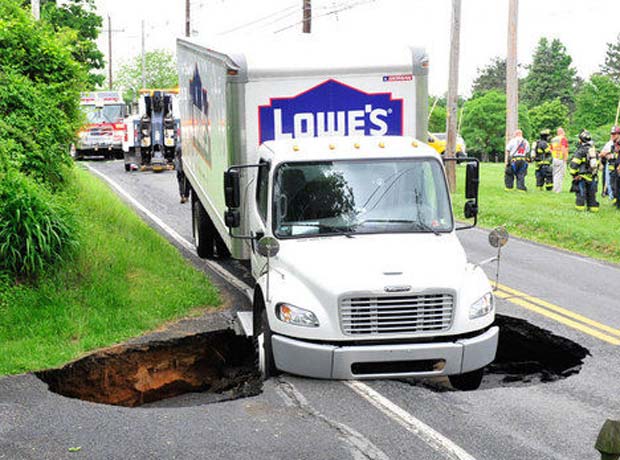
May 23, 2013: Sinkhole in Palmer Township, PA , swallows the front of a Lowe's delivery truck.

May 21, 2013 Massive sinkhole kills five in south China town of Shenzhen

May 12, 2013 Giant sinkhole near San Francisco swallows homes as families evacuate

May 2, 2013 Road Collapses in Greene County, Mississippi
April 20, 2013 Roadway Sinkhole Swallows 2 Cars in Vermont

April 18, 2013 A sinkhole swallowed three cars Southeast side of Chicago
Dozens of the sinkholes have appeared at random in recent weeks in Russia:.

April 10, 2013 Giant Sinkhole Swallows Homes in Russia

The city of Samara in Russia appears to be sinking into the earth, as massive sinkholes open up swallowing cars and wreaking havoc
April 2013


The sinkholes, some large enough to swallow an entire truck, are believed to have opened up as the Russian winter subsides
April 2013
There has reportedly been at least one fatality as a result of the sinkholes in the city, Russia's sixth largest
April 2013


There has reportedly been at least one fatality as a result of the sinkholes in the city, Russia's sixth largest
April 2013
There has reportedly been at least one fatality as a result of the sinkholes in the city, Russia's sixth largest
April 2013

The massive craters seem to have appeared at random in recent weeks
April 2013

These pictures are all believed to have been taken in recent weeks. Some reports have suggested the holes have been caused by ground water or soil decay
April 2013


Sinkholes are common hazards in mining regions, plaguing areas where miners have burrowed into layers of soluble minerals and accidental floods have followed
April 2013


The problem is thought to be causing carnage across the city. Now residents have organised a petition to urge authorities to find a solution
April 2013

A deep round sinkhole opened up under woman's bed in the middle
of the night in Guatemala City (Johan Ordonez/AFP/Getty Images)
A car juts out of a sinkhole caused by a broken
water main on Dec. 3, 2010 in Chevy Chase, Maryland. (Logan Mock-Bunting/Getty Images)
Car sits in giant sinkhole in Duluth, Minn. Wednesday, June 20, 2011.

Links:

Teenager jumps into a puddle for a $1 bet... and ends up completely submerged in huge water-filled hole (but at least he got a dollar!)

iWitness Pollution Map


Read more...

Wednesday, May 22, 2013

What About the $20 Trillion-EU-McGraw-Hill-Oil-Price-Fixing Scandal?

The mainstream media doesn't waste a minute confusing "informing" the masses about the Beng­hazi scandal. The DOJ/AP Reporters scandal. And let's not forget Jodi Arias trial. Fortunately for them, horrific natural and/or man-made disasters seem to occur almost weekly as well, distracting the public from what may be the most important scandal of all.

However, the masses have heard next to nothing, if anything at all, about the $20 trillion -McGraw-Hill-Oil-Price-Fixing scandal: the European Union's investigation/raid of the London bureau of pricing agency Platts and the offices of Statoil, Royal Dutch Shell and BP.  Like the Libor scandal, this is also about the price-setting mechanism.

Publishing giant McGraw-Hill is more like an octopus whose tentacles reach far and wide, or maybe a hydra because the company responded to demands by investors to break itself up by dividing itself into two businesses: McGraw-Hill Markets, which includes the S and P rating and index businesses and McGraw-Hill Education, composed of the publishing and education businesses owned by McGraw-Hill.

“That means the real power to con­trol the world lies with four com­pa­nies: McGraw-Hill, which owns Stan­dard & Poor’s, North­west­ern Mutual, which owns Rus­sell Invest­ments, the index arm of which runs the bench­mark Rus­sell 1,000 and Rus­sell 3,000, CME Group which owns 90% of Dow Jones Indexes, and Barclay’s, which took over Lehman Broth­ers and its Lehman Aggre­gate Bond Index, the dom­i­nant world bond fund index. Together, these four firms dom­i­nate the world of index­ing. And in turn, that means they hold real sway over the world’s money.”
So,  what does this have to do with the petroleum price fixing scandal?  Well, oil-pricing agency Platts, under EU investigation, is a unit of McGraw Hill Financial Inc, and is the most influential of the "independent price-reporting agencies." Platts makes assessments that are used to close deals for physical oil and oil derivatives that are worth billions in an overall $2.5 trillion market.

This complicated issue started when Hungary’s Pannonia Ethanol became one of the first companies to complain about access to the Platts market-on-close (MOC) system. The EU Commission has concerns that the companies may have colluded in reporting distorted prices to a price reporting agency to manipulate the published prices for a number of oil and biofuel products.”MOC trading is a series of bids, offers and trades that goes on during the last half hour of the trading day. Platts determines oil prices after that period. Furthermore, the Justice Department was asked to get involved in the EU investigation.

This price-fixing scandal dates back to 2002, right after 9/11, not to mention, Enron, and could have had a "huge impact" on the price of petrol at the pumps "potentially harming final consumers". However, this is not so much about petroleum, as it's about the commodities trading of the criminal, corrupt global financial sector.


Links:

The Rise of Financial Terrorism Part I

The Rise Of Financial Terrorism, Part II

The Four Companies That Control the 147 Companies That Own Everything

McGraw-Hill’s S&P Imperils $4.6 Billion Gain: Corporate Finance


Read more...

Tuesday, May 10, 2011

BP Genocide?

Gulf of Mexico dead zone
The impact of the BP Oil spill, made much worse by the toxic dispersal agent Corexit 9500 -  originally developed by Exxon and now manufactured by the Nalco Holding Company, which is 11 times more toxic than oil - is continuing to destroy lives, at a greater rate than before, yet, we hear almost nothing about it from the mainstream media.

According to four university studies, 79% of the oil is still there; however, as much of a problem as that poses, it's the toxic chemical dispersant  that is destroying the physical health of countless Gulf residents, not to mention, non Gulf residents.

People are sick...very, very sick.  Some have even died.  Eyewitness and personal accounts of scabs, lesions, skin rashes, and internal bleeding from every orifice including coughing up blood, nose bleeds, and rectal bleeding are reported all throughout the Gulf region. Because Corexit literally destroys red blood cells. The surfactants, which are the primary ingredient in Corexit destroy cell membranes.

"Oil rain"

Evaporation proceeds more quickly at higher temperatures. So, unlike the frigid water temperatures that the Exxon Valdez tanker dumped 11 million gallons of crude, the much warmer Gulf of Mexico waters will allow the “phase transition” of liquid to a gaseous state where it is then absorbed into clouds, and then released as “toxic rain”, potentially upon all of Eastern North America.

NASA conducted studies of the atmosphere and found a millimeter of oil over the Gulf, something they had never seen before. Robert Naman, president of Act Laboratory Inc in Mobile, AL, is one of the many people testing swimming pools and finding Corexit 957. Swimmers are developing rashes, vomiting, diarrea, low-grade fevers, and other flu-like symptoms as Corexit goes right through skin.

Barbara Schebler of Homosassa, Florida, just one hour north of Tampa, received word that test results on the water from her family’s swimming pool showed 50.3 ppm of 2-butoxyethanol, a marker for the dispersant Corexit 9527A used to break up and sink BP’s oil in the Gulf of Mexico.

From a scientist at the center of the spill:
The dispersant works as follows: The oil mixes with the dispersant and forms into tiny microdroplets of oil. These microdroplets have the same specific gravity as the water, so they just kind of hang suspended in the water. On the surface, this helps to break up the oil.

But in the deep sea, this prevents the oil from rising to the surface as quickly. The oil just hangs suspended in the depths, and is moved by the deep-sea currents.

In the history of oil spills before this one, dispersants had only been used on the surface. So this is the first time ever that dispersants have been used subsurface.
You also have to consider that in the deep sea there are hundreds of pounds of pressure per square inch; and it’s very cold, maybe one or two degrees Celsius; and there’s no sunlight to break down the dispersants—there is no sunlight below about 1,000 meters. All of those factors mean even more that the oil down there, when mixed with dispersant, will not rise to the surface for a long time.

Unfortunately we can’t measure the true impact of the spill if most of the oil is below the surface.

Are you saying that if the dispersants had not been applied at the well-head, then most or all of the oil would rise to the surface and these underwater plumes would basically not exist?

For the most part, yes. Or at least, the underwater plumes would be far shorter-lived since they would be rising to the surface.

If we had avoided the deep sea use of dispersants, and had simply let all of the oil rise to the surface or just below the surface, the situation would be much less catastrophic: We know how to deal with oil at the surface. We have precedent for that: We can skim it, we can burn it.

On the other hand, we cannot treat oil in the depths of the sea. There is no precedent. We don’t know how to do it. And as of now there is no plan to even try.

The trade-off was made between two fragile habitats: the marsh/freshwater habitat, and the deep-sea habitat of the Gulf of Mexico.

The marsh/freshwater habitat on the coast is very visible to the public, and of course a disaster there is also a PR disaster for the company that caused it.

The deep-sea habitat is largely unknown and certainly unseen. So in a sense, it is out of sight, out of mind. BP attempted to save the marsh/freshwater habitat at the expense of the deep-sea habitat.

But even with use of dispersants at the well-head, still a lot of oil is rising to the surface and is now making its way into the marsh/freshwater habitat—hence all the oil-covered fish, birds, and other creatures that are making the news.

So, instead of one habitat being saved at the expense of the other, effectively both habitats have been ruined.


Links:

Changing the end game

Gulf Chemist: BP Contractors Are Now Applying Toxic Dispersant - at Night and In an Uncontrolled Manner - Which BP Says It No Longer Uses

Statement from Gulf Oil Disaster Recovery Attorney Stuart Smith


Gulf oil spill harming children's health

Gulf Coast Barefoot Doctors

Read more...

Thursday, March 31, 2011

Fukushima: What's Really Going On?

If you listen to the mainstream media, regarding anything, really, you will probably hear what you want to hear: everything will be fine as long as you listen to us, but, everything will not be fine, especially if you listen to them. If you don't think so,  research the 9/11 workers who are sick, dying or dead.  Research the  Gulf Coast residents and workers, that nearly a year after the oil disaster began,are sick, and dying from BP’s toxic chemicals.  Where was/is the mainstream media?

Take "safe levels of radiation", or event better, at levels far below the levels that would pose a risk to humans” that self-interested parties like to claim, exist, without putting it into context.

"We all get between 1 to 10 millisieverts a year - an average 2 to 3 millisieverts - from background radiation," says Burns.

Air travel and CT scans are other common sources.

Official limits for radiation in food and water are set in the context of such exposures.

For example, the limit for nuclear workers is much higher than for the general public.

Ruff says it's important to remember radiation limits like this are not levels below which there is no effect.

"They're just a practical compromise between what's achievable and what's deemed an acceptable risk," he says.

Ruff says it's also important to remember the impact of radiation is greater on the unborn, infants and children, especially girls, compared to adults.
Now, Physicians for Social Responsibility say there are no safe thresholds for radiation.  However, once again, that means little without putting it into some sort of context.  Nevertheless, you can be sure of one thing.  Governments lie cover up. They always have and they always will...especially when profit is at stake. Moreover, every single government that has ever had a radiation problem covered up the extent of the danger.
There are no warning signs anywhere along the coast. People walk on this shoreline with their dogs and children. The dogs take the contaminated mud back home on their hair. The children carry it on their shoes. It then dries and can be breathed in. The deeper you dig down into the mud, the more poisonous the levels become because of the accumulation of waste over the years.
Fortunately, for us, we have the Internet, and the technology available to check them out. Unfortunately, the news is not good.

More signs of serious radiation contamination in and near the Fukushima Daiichi nuclear power plant were detected Thursday, with the latest data finding groundwater containing radioactive iodine 10,000 times the legal threshold and the concentration of radioactive iodine-131 in nearby seawater rising to the highest level yet.

It appears that the core of No. 2 reactor - the one that Dr. Chris Busby said has a 5% of creating a nuclear explosion - "has melted through the bottom of the pressure vessel and at least some of it is down on the concrete floor beneath".

One nuclear expert warned that it might be another 100 years before melting fuel rods can be safely removed.

Anaheim California registered highest radiation in US

Drifting radiation:


The following video took place in Stockholm, April 22, 2009. The recently resigned Scientific Secretary of the ICRP, Dr Jack Valentin (icrp.org), concedes to Pr. Chris Busby, ECRR (euradcom.org) , that the ICRP model cannot be used to predict the health effects of exposures and that for certain internal exposures it is insecure by up to two orders of magnitude. He also said that as he was no longer employed by ICRP he could agree that the ICRP and the United Nations committee on radiation protection (UNSCEAR) had been wrong in not examining the evidence from the Chernobyl accident, and other evidence outlined below, which shows large errors in the ICRP risk model.


Pr. Chris Busby, ECRR, versus Dr. Jack Valentin , ICRP, 1(2) from Radio Active on Vimeo.

Links:

The Low Level Radiation Campaign

European on Radiation Risk


Fallujah study finds epidemiological consequences worse than Hiroshima

Read more...

Sunday, June 27, 2010

What About the Super Sized 1000-year Methane Old Bubble?

Apparently "the most vigorous methane eruption in modern human history," is something to be concerned about...very concerned,  because methane, in addition to its explosive properties, on a 20-year time scale - as a greenhouse gas - is 56 times more potent, metric ton for metric ton, than carbon dioxide.
Methane or CH4 gas is being released in vast quantities in the Gulf waters. Seismic data shows huge pools of methane gas at the location immediately below and around the damaged "Macondo" oil well. Methane is a colourless, odourless and highly flammable substance which forms a major component in natural gas. This is the same gas that blew the top off Deepwater Horizon and killed 11 people. The "flow team" of the US Geological Survey estimates that 2,900 cubic feet of natural gas, which primarily contains methane, is being released into the Gulf waters with every barrel of oil.

12 scientists from the Texas A&M University, who have been running tests in the area within a 5 mile radius of the drill site, have found levels of methane in the ocean that are through the roof. In some pockets of the ocean the concentrations of methane gas levels are up to 100,000 times the norm and even more incredibly up to 1 million times higher.
The oil emanating from the seafloor contains about 40 percent methane, compared with about 5 percent found in typical oil deposits, said John Kessler, a Texas A&M University oceanographer who is studying the impact of methane from the spill.

BP and Transocean were warned, a little over a year ago, that putting their exploratory rig directly over the area of seabed containing this massive super-sized bubble of methane  might be unstable and inherently dangerous. 


Read more...

Friday, June 25, 2010

Drill Baby Drill! Echoes Despite A Profoundly Ravaged Ecosystem

Thirty-seven of the 64 judges - in Gulf Coast districts, where the bulk of Gulf oil spill-related lawsuits are pending - have financial connections to big oil.  This, of course, complicates matters immensely, because federal judicial rules require judges to disqualify themselves from hearing cases involving a company in which they have a direct financial interest., which brings us to Federal Judge Martin Feldman, appointed by President Ronald Reagan in 1983.

On Tuesday, Judge Feldman blocked the temporary moratorium on new offshore exploration and deepwater drilling that the Obama administration imposed last month.  However, this judge, according to the most recent financial disclosure form, had holdings of up to $15,000 in Transocean in 2008 and recently owned stock in Halliburton, Prospect Energy, Hercules Offshore, Parker Drilling Co., and ATP Oil Gas. A financial conflict of interest? Possibly. As of today, most of his recent financial disclosures are not yet available.

Regardless, rather than express humility in the face of forces not fully understood, in the midst of the biggest environmental disaster in US history, this judge, the corporate elite and government officials have chosen to proceed with the same hubris and arrogance that left the earth with a gaping, gushing hole that no one knows how to repair and countless individuals with nowhere to turn.

Read more...

Tuesday, June 15, 2010

What does BP stand for?

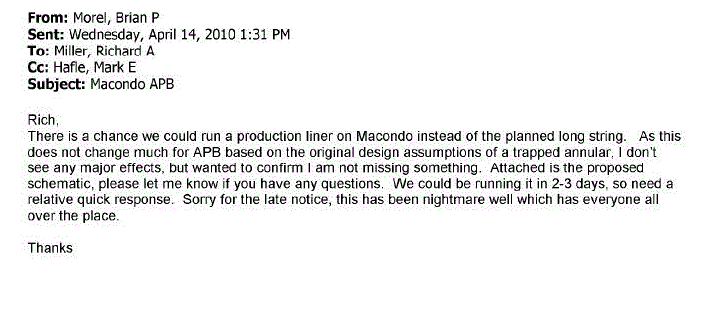
The House Energy and Commerce Committee has published documents relating to its hearings into the Deepwater Horizon accident and subsequent oil leak, and what should come as a surprise to no one,  BP made a series of money-saving shortcuts and blunders that dramatically increased the danger of a destructive oil spill in a well that an engineer ominously described as a "nightmare" just six days before the blowout.

Congress wrote a letter to Tony Hayward outlining its concerns that BP took shortcuts and undertook risky practices, in an attempt to keep costs down. This letter was written in preparation for Hayward's testimony on Thursday of this week.

Worse yet, oil and gas industry insider, Matt Simmons has been warning that the scale of the spill is much bigger and that there's a larger leak several miles away.  He also thinks that sealing the gush of oil might very well entail  "what the Soviet Union did decades ago -- setting off a bomb deep underground so that the fiery blast will melt the surrounding rock and shut off the spill."

Despite BP's egregious history and continuance of corporate criminality -  in addition to its behavior before and after the the Deepwater Horizon oil spill - BP, which stands for Beyond Prosecution
"...the Justice Department (DOJ) abruptly shut down West's investigation into BP in August 2007 and gave the company a "slap on the wrist" for what he says were serious environmental crimes that should have sent some BP executives to jail."
and will no doubt avoid the harsh consequences it deserves, as BP stands for  Bankruptcy Protection.
They have about a month before they declare Chapter 11. They're going to run out of cash from lawsuits, cleanup and other expenses. One really smart thing that Obama did was about three weeks ago he forced BP CEO Tony Hayward to put in writing that BP would pay for every dollar of the cleanup. But there isn't enough money in the world to clean up the Gulf of Mexico. Once BP realizes the extent of this my guess is that they'll panic and go into Chapter 11. -- Matt Simmons
Meanwhile, T. Boone Pickens, Rand Paul, and  Mike Bloomberg think we're being too hard on BP.

On his weekly radio show, the mayor of New York said, "The guy who runs BP didn't exactly go down there and blow up the well."

No, he didn't "go down there"...he didn't have to "go down there." Remote control is just as effective.

In other news, over the weekend, oil spilled once more.  21,000 gallons from a Chevron pipeline leaked into the Red Butte River which runs through the center of Salt Lake City.
Chevron is expected to unveil a cleanup plan this morning, after a day in which the company focused on containing an oil leak that fouled Red Butte Creek and Liberty Park pond, in hopes of keeping the toxic spill from reaching the Great Salt Lake.

Read more...

Sunday, June 13, 2010

Oil Disaster: If It Were My Home

See all 8 photos: Caught in Oil

A bird (left) is mired in oil on the beach at East Grand Terre Island along the Louisiana coast on Thursday, June 3, 2010. (AP Photo/Charlie Riedel)

As the BP Oil gush makes its way to land, the effects are becoming much more evident. It's bad enough when innocent birds and animals are injured due to either accidental events or acts of nature, however, it's beyond heartbreaking to watch as the Gulf's seabirds and creatures suffer due to an event brought on by human greed, negligence, and if you ask me, downright evil.

At the website Ifitwasmyhome you can visualize the BP oil spill disaster and move it anywhere you want in the world and then move it back again.

Read more...

Tuesday, June 08, 2010

Remember Who Authored this Tragic Script..

As NPR's  Chris Satullo   so eloquently authored and voices in A driller's lament, President Obama is not the "author of this tragedy".

Most of us can agree, I'd imagine, that the Obama administration has made a political hash out of the Gulf oil spill.

The president hasn't nailed either half of the required theatrics: the righteous rage toward BP and the rest, of the Clintonesque quivering lip that shows he feels the Gulf Coast's pain.

But we do understand a few things, don't we? The latest Gallup Poll suggests that many of us do. Such as:

The inability to stem the leak is a technical issue, not one of political will. It is a failure of engineering know-how, not leadership.

It's not that people aren't trying to stop the oil from gushing. They've tried everything they could think of, and nothing worked.

And that's the scary thing.

Which drives you back to deeper points. What in the world were we doing letting corporations drill this deep if we couldn't curb the damage should something go wrong? And why let corporations follow their own judgment when it comes to keeping things from going terribly wrong?

Those mistakes date back to long before the current president.

Some people now deem it very bad form to point out that any current calamity is very significantly the fault of George W. Bush. Of course, many of the people who say that have spent the last 40 years blaming everything that goes wrong in America on a couple of Supreme Court decisions and a few hairy protesters back in the 60s.

Fact is, we do have political parties in this country, and they are different.

Only one party has made a national project out of limiting rules on business and defanging the agencies that enforce those rules. Only one party chants Drill, Baby, Drill!

As you may have heard, the agency that was supposed to help prevent calamities like the spill is a mess, a watchdog put to sleep by bribes as cheap as tickets to a football game.

Ask yourself: Which president was himself a driller, who made it his agenda to to put industry executives in charge of the agencies that regulate industry?

Hint, it wasn't Barack Obama. It was that guy before him.

Just thought I'd mention that before we all swallow hole the emerging media theme that the spill is Obama's Katrina.

Read more...

Thursday, June 03, 2010

A Drop in the Bucket Could've Prevented Oil Spill?

The BP oil well "accident" that has evolved into one of the largest oil spills ever in US water continues to spew crude into the Gulf of Mexico. 11 lives have already been lost, and countless other lives, shattered. 

Here's the thing. This "accident" could've been avoided if BP Oil  had shelled out $500,000 (pocket change)  for a remote-control shut-off valve, called an acoustic switch - an underwater valve that shuts down the well even if the oil rig itself is damaged or evacuated - that is normally used as a last-resort protection against underwater spills.  However, unlike most of the  oil producing countries of the world,  "U.S. regulators don't mandate use of the remote-control device on offshore rigs, and the Deepwater Horizon, hired by oil giant BP PLC, didn't have one."

Several years ago, the U.S. considered requiring a remote-controlled shut-off mechanism, but drilling companies questioned its cost and effectiveness, and the Minerals Management Service (MMS), part of the Interior Department responsible for regulating both offshore wind development and oil and gas drilling, decided the remote device wasn't needed because rigs had other back-up plans to cut off a well.

Really?

Well, I guess, amidst “a culture of substance abuse and promiscuity” MMS officials had better things to do than regulate oil drilling. After all, when you're "responsible" for collecting approximately $10 billion in royalties annually and you're one of the government’s largest sources of  income, it's easy to understand how hubris and greed could've created the "free-for-all" atmosphere that developed and prevailed for much of the Bush administration’s watch and how that might obscure one's thinking. Thus,  making it probable that the first priority became maintaining that coke-sniffing, porn surfing, golf playing, orgasmic kind of climate. And how do you ensure its continuance? Profit, profit, and more profit.

Now, after this horrific event, BP says it is spending $6 million a day to battle the oil spill. Clearly, the sense of power and greed that inspired these officials to shun the vagaries of self-control and instead fully embrace monumental hedonistic debauchery, complete with the senseless and random act of taking "tickets to a Toby Keith concert", did, in fact, render these "officials" dumb as...well, dumb as a BP oil executive.

Granted, much is still unknown about what caused the problems in Deepwater Horizon's well, however, because of the greedy oil executives and the immoral, compliant, greedy MMS officials, who seem to predominate today, in this culture of deregulation that was so heavily advocated for during the Bush Administration - or really, since the inception of Reaganomics - we'll never know if the decision to make the infinitesimally small purchase, relatively speaking, of a football-sized acoustic remote-control may have been able to stop the oil well disaster.

Read more...

Monday, May 31, 2010

Ain't it Obvious? We Can't Trust BP to Do the Job.

BP's only interest is the bottom line. From no plans in case of a disaster, to its audacious short-cuts throughout the entire process, judge shopping, and the outright lies BP has told since the beginning, this company is useless and good for nothing, except maybe for its lobbying talents. 

Greed is the essential component in the formula for disaster. Why? Because ultimately, greed leads to negligence, incompetence and most of all bold faced lies, which, thanks to Rachel Maddow, is eloquently demonstrated in a segment of "The Rachel Maddow Show"(video below).

So, it follows that when the only incentive given to each player is individual profit,  (huge windfall profits) the incentives of the company will never align with the needs of public safety...or the public good.

It's very clear. Mad dashes for profit and perverse incentive structures = disaster.

BP is one of the biggest spenders on lobbying in the oil and gas industry to represent its interests in Washington.

During the first quarter of 2010, it spent $3.5 million on lobbying, second only to ConocoPhillips, according to figures compiled by the nonpartisan Center for Responsive Politics.

Yet despite the far from resolved Gulf Oil disaster and as plenty of evidence suggests, BP's responsibility, they want to avoid curbs on new drilling, according to  its lobbyists.

BP officials, who put profits above all else, including safety, wanted to proceed quickly as possible in order to save money on the current well's cost, and  so they could begin on another well, which was behind schedule.

Lies and more lies.


BP, Government Risk Larger Spill to Stem Leak

BP CEO disputes claims of underwater oil plumes.


BP Lowballing Oil Flow

BP is vastly understating the amount of oil flowing into the Gulf in order to decrease fines, which are based on the number of barrels leaked per day. Host Scott Simon talks with Markey about his criticism of the oil company and its efforts to contain the oil spreading in the Gulf of Mexico.


Read more...

Sunday, May 30, 2010

Ensuring Change Takes Place This Time Around.


31-years ago, on June 13, 1979, while the Trans-Alaskan oil pipeline (right) -  technically 800 miles of pipleline with a diameter of 48 inches that crosses three mountain ranges and over 800 rivers and streams, that connects oil fields in northern Alaska to a sea port where the oil can be shipped to the lower 48 states for refining - was in a state of "repair" (continuous)  from the previous oil leak(s) that allowed 1500 barrels of crude oil to escape, the Gulf of Mexico was trying to handle a much larger oil spil(June 3, 1979) that dumped 30,000 barrels of crude per day into the Gulf.

Sound familiar?  Well, that's not all. The techniques used to contain the 1979 spill are all too familiar to us today, and on August 7, 1979, reports of oil containment workers were still dominating the news. Then, on n August 8, 1979, reports of that all too familiar loop current, that we hear so much about today. On September 25, 1979, it was reported that "Operation Sombrero" that tried to put a 300 ton steel cone over the mouth of the runaway well, that once in place will collect over 90% of the crude oil, gushing from the well for over 3.5 months. BP's "Top Hat", anyone?  Yes, they even tried their own brand of "Top Kill", and pretty much every other technique we see trying and... failing today.

And the best part? All of these failed techniques used over thirty years ago, failed in 200 feet of water! What in the hell has possessed the minds of these over-the-top, highly paid, oil-drilling "experts" that makes them think these failed techniques will work at a depth of 5,000 feet?  Could it be "royalty breaks of $1 billion over five years" that is drying up the brains of these high-paid executives? Royalty Tweaks Target Deep Reserves?

Well, as we've seen in the banking industry, "royalty increases" greed can drain the capacity for all forms of high level cognitive activity in even the most brilliant of minds.  And therein lies the problem. It's all well and good to develop oil and gas resources, even when they are the most costly to develop and access, if they will more than likely pay off to line the pockets of those in charge.

Anyway, the 1979 "historical" oil spill continued for nine months, until relief wells were created to relieve pressure on the blown-out well, so that eventually it could be capped.


In the end, the only way to ensure change takes place is if we are willing to raise our standards of what we deem acceptable. If we contiue to allow personal gain to trump all else, things will never change...ever.

Thanks to Rachel Maddow's fabulous report on how much oil disasters and oil disaster response has not changed one iota in over 30 years.

Read more...
Iraq Deaths Estimator
Petitions by Change.org|Start a Petition »

  © Blogger templates The Professional Template by Ourblogtemplates.com 2008

Back to TOP