Showing posts with label credit card industry. Show all posts

Thursday, May 03, 2012

Laundering Money Through Credit Card Transactions & ABCs of Money Laundering

Chances are, whenever you hear the words 'money laundering' images of the movie, "The Godfather", comes to mind; however, according to a former senior business relationship manager - responsible for managing and monitoring business accounts, cash flow, borrowing habits, and the relationship between those business accounts in order to invest money, ensuring profitability - at HSBC Holdings, PLC, a global company located in 80-90 countries, known as the "king of trade", John Cruz, author of World Banking World Fraud: Using Your Identity,  it’s the powerful “too big to fail” banks who are set up to do this dirty deed.

Keep in mind, bank employees - from $9/hour bank tellers to bank managers to loan officers to dime-a-dozen, vice presidents -  are vulnerable to prosecution for the slightest misstep. For instance, years ago, during my bank teller training, I was told that tellers could be prosecuted for adding or subtracting one penny in order to come out even at the end of the day. Adding one penny to your drawer is grounds for prosecution!

Anyway, as an employee of HSBC, John Cruz, after reviewing corporate accounts, started seeing suspicious patterns of deposits and withdrawals, which led Cruz to believe credit card transactions were being used as a means to launder money.   How did he figure this out?  Well, hundreds of thousands of corporate accounts were only being used for wire transfers Paypal, American Express, etc., only,  in even denominations: $20,000... $50,000...$500,000. Cruz tried to visit these corporations.  There was  one problem: they didn't exist.  Oh, on paper, they sure did, but there were no physical entities.   I mean, come on, how many companies do business in even round numbers like that? It's so obvious that Paypal, and American Express - complicit, or not - were/are used as vehicles to launder money. Of course, Paypal and American Express, when contacted, never responded.

"I found many accounts where PayPal and American Express were used as conduits through which hundreds of thousands of dollars were deposited or withdrawn from HSBC customer accounts in a pattern of suspicious transactions that should have been reported to legal authorities under various banking statutes, including the Patriot Act," - John Cruz
Cruz collected thousands of pages of customer account records that he claims are evidence of an international money-laundering scheme involving hundreds of billions of dollars by the global banking giant, which reportedly is under investigation by a U.S. Senate committee.

One would think, how do large corporations get away with this when their "dirty deeds" are so obvious to so many?  Simple. It only takes a few crooked people, strategically placed to set up the system; after that, it's mostly electronic, and once again, all it takes is a few strategically placed employees to monitor and ensure the process runs smoothly.   The rest of the employees are so conditioned not to question authority that they turn a blind eye. When that exceptional someone tries to blow the whistle, he's dealt with, usually fired.  And, on the rare occasion when someone like Cruz, takes it to the next level, the bought and paid for mainstream media totally ignore it.  Not to mention, most people know, deep down,  how whistle-blowers are treated: terribly.

Is HSBC the only corporation involved in laundering money?  Hardly.  Money laundering is built into the system of every large bank. If, by chance these banks are "caught", they pay a trivial fine. No one goes to jail, no one pays the price.  However, god forbid you're a $9/hour teller who deposits one penny to come out even, the all-powerful bank can prosecute her to the fullest extent of the law.

Given the billions of dollars involved in the drug trade, not to mention, human trafficking, there is no way the drug producers could function without banks.
"Why is drug supply prosecuted so vigorously and demand so leniently? Who in the United States is receiving drugs from Colombia, laundering the money, marketing the drugs every day to 30 million U.S. citizens, bribing lawyers, the police, and politicians? There must be U.S. drug barons far more powerful than any Colombian trafficker. But the people who are dying are those fighting them in Colombia, not in the United States. 

 What is the basis of the anti-Mexican phobia…? During a recent visit to Los Angeles, I heard the same arguments over and over… [Mexicans] are…the reason for unemployment in California, and, last but not least, they introduce drugs.

Drugs do not enter the United States through Tijuana and San Diego tied up in migrant workers kerchiefs. They arrive in planes belonging to U.S. dealers whose names no one knows and who are never the objects of the sort of publicity and persecution given their Latin American counterparts.

The United States has washed its hands of its drug barons—-and laundered their money. All guilt is in the offer, none in the demand. It is easier—-and more Pharisaical—-to militarize Bolivia than to militarize the Bronx."

▬Carlos Fuentes, A New Time for Mexico, 1996
Links:

The ABCs of money laundering.

Special Report: Documents allege HSBC money-laundering lapses

UN crime chief: Was the bailout the largest drug money laundering operation in history?


The cycle of terror and intervention

This page is in Spanish. Here is translated excerpt:
"...other facts reveal that the United States intervenes in other ways in Mexico:
  • Some sources state that 13,000 guns are introduced every year to Mexico. [...]
  • The fact that major commanders of the Zetas, who, prior to desert the Mexican Army have been trained in counterinsurgency tactics at Fort Bragg, North Carolina, by the U.S. Army.
  • Continuous raids on Mexican territory, especially in Ciudad Juarez, [...]
  • The de facto operation of the Zetas as a kind of casual immigration police, "a migration of death" to contain and regulate the flow of migrants wickedly toward Central America. [...]
  • Cartel kingpins...are of American nationality. Furthermore, the presence and operating with impunity in hundreds of Mexican drug traffickers in the cities of that country. The rapid arrest of 600 of them after the assassination of U.S. agent Jaime Zapata in San Luis Potosi merely reveal that in America there is a broad-based operational drug is tolerated until they violate certain rules.
[...]

Bi-national war where one country makes the decisions and the other pays the price” is the way Quintana begins. He goes on to make the case that the United States incites crises in countries like Mexico so that it can intervene into the internal politics of the country. The reason the United States “perpetrates terror, provokes terror and reacts against terror” is in order to “maintain its very weakened hegemony in the region.”

“The cycle of intervention-terror-intervention is the only way to keep us following the doctrine of the decadent empire.,” Quintana continues. “Against this the Mexican government has responded as we suspected: slowly and fearfully.

Read more...

Tuesday, October 27, 2009

Are the Credit Card Companies Asking Us to Intervene?

Currently, the relationship between credit card companies and we, the consumers clearly puts the card companies in the car jacker's driver's seat. Despite the The Credit Card Accountability, Responsibility, and Disclosure (CARD) Act, due to go into effect, February 2010, the banksters are making sure that we, the people continue on, hostage to their demands.

That's right. As predicted, the banksters are rushing ahead of the new restrictions coming their way. They are changing the rules faster than Gov. Rick Perry can tie a lynch knot. Some banks plan to either charge annual fees for customers who pay off their credit cards every month, who, by the way, have excellent credit ratings, or charge customers who don’t use their cards enough, or charge customers for not using them at all (inactivity fees). Overdraft fees are another way that banks are looking to raise revenue.

Keep in mind, the Fed is giving the banks money at 0% interest.

Bank of America will start charging an annual fee from $39 - $99 to some of their best customers.

Citigroup will start charging a fee of an unspecified amount to customers who charge less than a certain amount every year. And the amount that's been batted around is about $2,400 a year. So if you spend less than $2,400 a year on your credit card, you might be hit with a fee, for not spending enough. Citigroup has also raised interest rates to 29.99% for many cardholders.

Clearly, the banksters are crying out for debtor's revolt an intervention. The poor things...they're addicted -- to greed. It's gotten to the point where they need our help. Just as a drug addict doesn't often directly ask for help, the banksters cannot articulate their request in words, but they don't need words as their actions speak louder than words ever could. They are begging us to save them from themselves. Tough love is our only option.

Links:

Dodd: Freeze Interest Rates Now. The House Financial Services Committee last week approved a bill that would move up provisions of the Credit Card Accountability Responsibility and Disclosure Act to Dec. 1 from Feb. 22. Rep. Barney Frank, D-Mass. and the committee chairman, has said an earlier date would prevent banks from "taking advantage of the delay" by raising rates, but the Senate is seen as unlikely to follow suit amid complaints from banks that they need more time to comply with the new rules.

Credit Card with a 79.9% interest rate - The offer is for a Premier card from First Premier Bank, which is based in South Dakota (no maximum or usury restriction in South Dakota and Delaware). The issuer "focuses on individuals who have less than perfect credit but are actually still creditworthy."

Act fast to cash in credit card rewards - If you have a Home Depot Rewards MasterCard--and have been counting on tapping that line of credit for a big job--you need to go shopping, and fast. Citi, which issues the card, has announced that cardholders can use them to make purchases only through Saturday, Oct. 31. And Rewards Points must be redeemed by Jan. 31, 2010, or they expire.

Understanding the Credit Card Accountability Responsibility and Disclosure Act

Read more...

Saturday, October 17, 2009

Purposely Reordering Customer Charges to Maximize Overdraft Fees


45% of the nation’s banks and credit unions collect more in overdraft services than they make in profits. This year alone, banks are expected to bring in $27 billion from overdraft fees alone. They allow customers to continually make purchases on their debit cards, once their checking account is overdrawn, which then automatically sets off a cascade of fees, at up to $39 a pop, sometimes for purchases less than $5, continuously. When the customer calls to complain that they've been charged over $300 in fees, they tell the customer that they are doing him or her a favor by not embarrassing them. That's what Wachovia told me when I went into the branch to complain.

Apparently, I'm not the only one.

When Peter Means returned to graduate school after a career as a civil servant, he turned to a debit card to help him spend his money more carefully.So he was stunned when his bank charged him seven $34 fees to cover seven purchases when there was not enough cash in his account, notifying him only afterward. He paid $4.14 for a coffee at Starbucks — and a $34 fee. He got the $6.50 student discount at the movie theater — but no discount on the $34 fee. He paid $6.76 at Lowe’s for screws — and yet another $34 fee. All told, he owed $238 in extra charges for just a day’s worth of activity.

Mr. Means, who is 59 and lives in Colorado, figured employees at his bank, Wells Fargo, would show some mercy since each purchase was less than $12. In addition, a deposit from a few days earlier would have covered everything had it not taken days to clear. But they would not budge.

Banks and credit unions have long pitched debit cards as a convenient and prudent way to buy. But a growing number are now allowing consumers to exceed their balances — for a price.

Banks market it as overdraft protection, and the fees it generates have become an important source of income for the banking industry at a time of big losses in other operations. This year alone, banks are expected to bring in $27 billion by covering overdrafts on checking accounts, typically on debit card purchases or checks that exceed a customer’s balance.

In fact, banks now make more covering overdrafts than they do on penalty fees from credit cards.

But because consumers use debit cards far more often than credit cards, a cascade of fees can be set off quickly, often for people who are least able to afford it. Some banks further increase their revenue by manipulating the order of a customer’s transactions in a way that causes more of them to incur overdraft fees.

Read more...

Wednesday, April 23, 2008

The Loan-Shark Industry


A few months ago, Rep. Carolyn B. Maloney introduced the Credit Cardholders' Bill of Rights Act of 2008 (H.R. 5244). The proposed legislation, co-sponsored by Rep. Barney Frank, D-Mass., chairman of the Financial Services Committee calls for badly needed comprehensive credit card reform.

The bill establishes the following rights for credit card holders:

  • Cardholders will not be subjected to arbitrary interest rate increases.
  • Cardholders who pay on time will not be penalized unfairly.
  • Cardholders will not be subjected to due date gimmicks.
  • Cardholders will be shielded from misleading terms.
  • Cardholders may set their own limits on their credit.
  • Card companies will credit and allocate payments fairly.
  • Card companies will not impose excessive fees on cardholders.
  • Card companies will not issue subprime credit cards to people who cannot afford them.
As it stands, credit-card companies are loan-shark companies, maybe even worse. Loan-sharks may break your legs if you don't pay up, however they make that clear from the beginning. Loan-shark companies, on the other hand, dress up the terms making it appear you are getting a great deal and then, sometimes even if you follow the terms, they break your legs anyway. As long as the "loan-shark" industry is allowed to operate free of regulation, "we the people" don't stand a chance.
“The playing field between card companies and cardholders has become very one-sided in recent years. Yet, more and more Americans are turning to their credit cards to help pay bills, buy groceries, and make ends meet in this troubled economy. Instead of looking the other way while Americans fall deeper into debt, Congress can and should take swift action to reform major credit card industry abuses and improve consumer protections for cardholders. The balanced reforms in this legislation will help do just that.” -- Rep. Carolyn B. Maloney

Read more...

Sunday, March 23, 2008

Banks are Robbing Us Blind

Bank fees, something we're all familiar with, generate lots of revenue for the banking industry, and as the fees multiply and become more expensive, it is also getting harder to get them reversed. I thought the banking industry was "robbing" us, but were doing so under the law. Not so, says the GAO.

Lack of a clear and conspicuous fee schedule violates the 1991 Truth in Savings Act and Federal Reserve Regulation DD. But while banking regulators cited firms for ignoring fee disclosure rules 1,674 times between 2002 and 2006, the GAO found that significant consequences for violations are rare. Only twice did regulators undertake formal enforcement actions.

Read more...

Thursday, February 21, 2008

Protect Yourself from Credit Protection Plans!

Credit card "credit protection plans" - an insurance plan that is supposed to cover your minimum payments should the customer lose his job, is admitted to the hospital, becomes disabled or dies - are the biggest rip-off going, yet they get very little bad press, more than likely, because of their "affiliation" with the big credit card companies. "Affiliation", more than likely, means the credit protection plan is just another division of your bankcard company, although they will do their very best to make you believe otherwise. After asking several times, in several different ways I finally found out my parent's credit card "credit protection plan" was with the same bank that issued their credit card, Bank of America.

Having worked for a bank card company at one time, I know a good percentage of customer inquiries are from customers who signed up for credit card protection plans who were not aware of being enrolled until they saw the charge on their statement. This has happened to me several times. I will have to call, cancel the service and have them credit the charge back to my account. I did not agree to enrollment because why would I want to add, what would be the equivalent of 10%, to my APR for absolutely no reason? No matter what the credit protection plan advertises, the eligibility requirements are so restrictive, the chances of the customer collecting are slim to none.

I also have personal experience with the so called "benefits" advertised by these plans...

After discovering a $69 charge on her credit card statement for a "credit protection plan", my mother knew nothing about, but had been paying on since 2003, we inquired to see if - since they could not reverse the charges - we could cash in on the benefits considering my mother (71-years old) had just been released from the hospital less than one month ago. We were told we had only 30 days from the time she was admitted to the hospital to request, collect the necessary proof, and then submit the forms. So, after paying a couple of thousand dollars, at least, my mother and father (77-years old) never collected a penny, even though they have been hospitalized repeatedly over the last five years.

One could definitely argue my parents should have paid closer attention to their credit card bill, but in their defense, with as much as they've gone through; it's amazing their bills were paid at all. I'm sure even if my mother knowingly enrolled in 2003, she was sold a bill of goods.

The sad truth is the credit card industry targets the elderly because they know they are the most vulnerable. Even if one takes the time to read the "mouse print", barely readable with 20/20 eyesight, there are so many loopholes that allow the bank to deny claims under credit protection policy, that there is no way to comprehend what would be covered. We need protection plans protecting us from "credit card protection plans"!

Credit insurance -- This "perk" preys on fear and is as necessary as a bee suit in Alaska. For an exorbitant premium, the insurer agrees to make minimum payments on your debt should you become unable to. You'll pay $13 a month to get a credit protection plan for a $2,000 balance. The laws of probability -- and the FTC -- are on your side anyway. And they're free.
Here are a few of examples of the millions of people scammed by credit protection.
Assad of Miami FL (02/12/08) says, "I have been paying for credit protection on this credit card in case of an emergency. Last year I lost my job in part because I was sick. I called and emailed washington mutual about my problem so said they would send me paperwork to activated the credit protection plan I have been paying every month. They never sent me anything and sent me to a collection company. This is after almost $50.00 they charged me every month for the credit protection..."
FIA card services added what they called a credit protection plan to my closed account that took a 3k bal to 7 k since 2002 with no purchases. This company is a scam! They do not even have a credit protection department, I have called over 20 times trying to get this problem solved....
I called FIA Card Services on 9/11/07 to transfer balances to their FIA Card Services Account/Sovereign Bank Card account. I got my first statement end December 07. In fact I have been out of home at the time I received the statement and I saw this statement first week January. I immediately called and made a phone payment. Approximately two weeks after I made the payment, I noticed an amount of $ 61.77 on the statement against credit protection Plan. Then, I called FIA Card Services who directed me to the Credit Protection Plan Customer Services Rep who informed me that I have committed myself for a Credit Protection plan and began explaining benefits of Credit Protection Plan (“If you die or lose your job you are being protected”) which words I am hearing for the first time. I requested him to kindly cancel the Plan which he did without any hesitation. When I asked to be reimbursed, I was told that this is not possible, because 30 days have lapsed since the enrollment in November 07....
I was charged for protection plan monthly that i did not authorized or trial on.
I am steaming mad about being lied to or treated unfairly...I received the bill I noticed that my min payment was for 168.00..and 44.00 was going to go to some program called 'credit protection plan'....I immediately questioned this, called the 800 number on my bill..it was really weird because there was no Bank of America greeting it was pretty generic and did not identify the company I had to call at least two times to verify I actually dialed the correct number....
When I signed up for my First Equity Credit Card I also signed up for their credit protection plan as well. It stated that by signing up for the plan it would cover my monthly bill for me in the case of disabilty from my job, that was one of about 10 different situations. Well I called the company to activate it and it was. 1 month later I recieved my bill with no credits paid towards it late fees and they still charge me for my credit protection coverage. I paid anywhere from $35 to $55 a month for this coverage and for it not work for me...
Please let everyone know...If someone calls during your dinner to sell you a Citibank Credit Protection Plan- JUST HANG UP! It is not the cardholders credit that they are protecting. It is another corporate ploy to exploit those who can least afford it...
After receiving my mastercard...statement (closing date 11/08/2001) I noticed a very high charge for credit card protection (insurance) for $100.99...
In addition, Federal law limits every credit card customer to a maximum of $50 liability for unauthorized use of his or her credit card. Every credit card bank must have procedures in place for disputing unauthorized charges.

Read more...

Friday, January 11, 2008

Eighth Grade Clarity Committees in Government and Corporate America

After reading Mike Huckabee's Tax Plan is Brilliant in Slate Magazine, I began to ask myself, how do I know if his plan is brilliant? How do I know if any plan is brilliant when I cannot tell you much about our current tax code, most of the contracts I've signed, anything about the irritating little fees on my cell phone, credit card, cable, electric, gas bills etc? Mike Huckabee's plan may sound good now because the article is written so that it is easily understood. However, once it is approved and implemented it will take ten Rhodes Scholars to interpret it.

Before we change anything, why can't "We the People" demand every American has a right to understand what's going on now whether it concerns taxes, law, paying our bills or contracts? Why is it legal that a PhD is required to understand our credit card agreement and sometimes that's not enough?

The answer is fairly obvious. By confusing and frustrating "We the People", government and corporations know that most of us will surrender because we don't have the time nor the patience to analyze that which is designed to be incomprehensible...who does? Why isn't there more outcry against this?

The objective is clearly to make most Americans feel powerless and stupid knowing the most Americans will not advertise that they don't completely understand most of what they pay for, vote for, and depend on a daily basis. No one likes to admit their failure to comprehend the tax code, real estate papers, statutes, executive orders, affidavits, jury instructions, insurance contracts, investment contracts, 16 page credit card agreements (printed on tissue paper in microscopic type, written on the "twenty-seventh" grade reading level) and all consumer-finance contracts and anything and everything written in legalese.

We all know a confused American is very profitable, easy to control and therefore, very desirable to the few at the top who pull the strings. What would happen if every piece of legislation, every contract, credit card agreement, and basically anything legally binding had to pass through the Eighth Grade Clarity Committee (EGCC), made up of a diverse group of eighth graders of average intelligence, as a final test of clarity. If all the eighth graders appointed understand, it passes...if not, must go back for a rewrite until the EGCC grasp whatever it is being tested with little effort.

People like myself will be most appreciative and I think we would see a happier, patient, and most importantly, an informed America evolve.

Read more...

Saturday, April 14, 2007

Plastic Economy

Plastic Economy site features tools, information, and resources to help individuals manage and reduce their credit card debt.

TrackCards allows you to track and manage credit card debt through a simple, easy to use interface. It's simple to get started: sign up, login, and enter in some basic information. That's it.

Debt Stats illustrates the average amount of household credit card debt and interest rates by state. This data is being retrieved from actual credit card owners using TrackCards.

Credit Counselors helps you find a credit and debt counseling company in the United States.

Glossary of Credit Card Terms provides definitions of common credit card terms -- without the legaleze.

Read more...

Wednesday, April 04, 2007

Legislation Should Protect People from Corporations


But instead our current laws are drafted by the corporations for the corporations...the people be damned.

Incomes aren't rising nearly as fast as housing, education, and healthcare. At the same time, two-thirds of all Americans cannot pay off their credit cards every month and the new bankruptcy laws pave the way for the predatory credit card companies to increase the rate of Americans not able to pay off their credit card balances. The credit card companies, oil companies, or in other words, corporate America are claiming record profits while "the people" are barely able to keep their heads above water.

The credit card debt of middle-class families rose more than 75 percent from 2001 until present. It is not uncommon for interest rates to exceed 30 percent and late fees alone cost Americans billions of dollars. People are becoming dependent on their credit cards for essentials such as the big-ticket items mentioned above which only means this pattern will continue to worsen until the middle-class is no more.

Read more...

Saturday, March 31, 2007

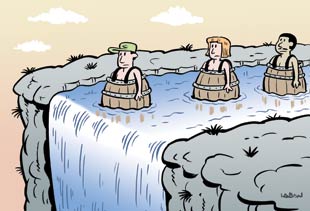
Living on the Edge of a Cliff.

Mostly ordinary middle-class American families are paying $90 billion dollars a year to the credit card industry.
Harvard Law Professor Elizabeth Warren is an expert on bankruptcy and is an outspoken critic of consumer lenders. She has appeared before the Senate Banking Committee to discuss the abusive lending practices by credit card companies and explains what many of us do not understand about the credit card industry.

Eight billion pre-approved credit card solicitations were sent out last year to American families advertising the lowest interest rate in big bold letters up front. Lurking in the finest print there is; the credit card company discloses that it reserves the right to change the interest rate in what could be written in Farsi as far as anyone understanding what they've written. But, it all comes down to this one statement:

“We reserve the right to change the terms of your credit card agreement at any time for any reason.”

The reasons for changing can literally be just because they feel like it, but here are some common reasons:

Customer is over the limit
Customer is one day late getting their payment in.
Took out another credit card
Dispute with another creditor
Demographics

The Universal Default Rate is one tactic credit card companies use to maximize their profit. The universal default rate means the credit card company checks your FICO score and if they find the customer does not meet every payment, every where, every time, the credit card company can raise that customer's interest rate to the default rate which can jump your APR as much as 30 percentage points in some cases.

3% cash back experiment:
Ms. Warren's class of 80 Harvard Law students ready to graduate were given the task of figuring out a 3% cash back offer one credit card company was offering in class She asked two questions:

What’s the effective interest rate on this card?

How do you get the money back?

It took Ms. Warren’s entire class of 80 ready-to-graduate Harvard law students the entire time the class ran (one hour) to decipher the 3% cash back offer.

Since the bankruptcy laws became tighter in 2005, the credit card companies, between 2005 and 2006, increased the number of mailings by 30%. They are looking harder for less than stellar customers and pushing them harder with tricks and traps pricing knowing they can hang on to them longer because they would less likely to declare bankruptcy

Credit card companies pushed for this law and literally drafted this law, their lobbyists wrote it and then paved its way through Washington and now they are reaping the benefits.

Read more...

Tuesday, January 23, 2007

50 Fun Facts About Credit Cards

Blueprint For Financial Prosperity found 50 very interesting facts about the credit card industry.

Read more...
Iraq Deaths Estimator
Petitions by Change.org|Start a Petition »

  © Blogger templates The Professional Template by Ourblogtemplates.com 2008

Back to TOP